Phonics and Spelling Rules in Order: A 130-Rule List
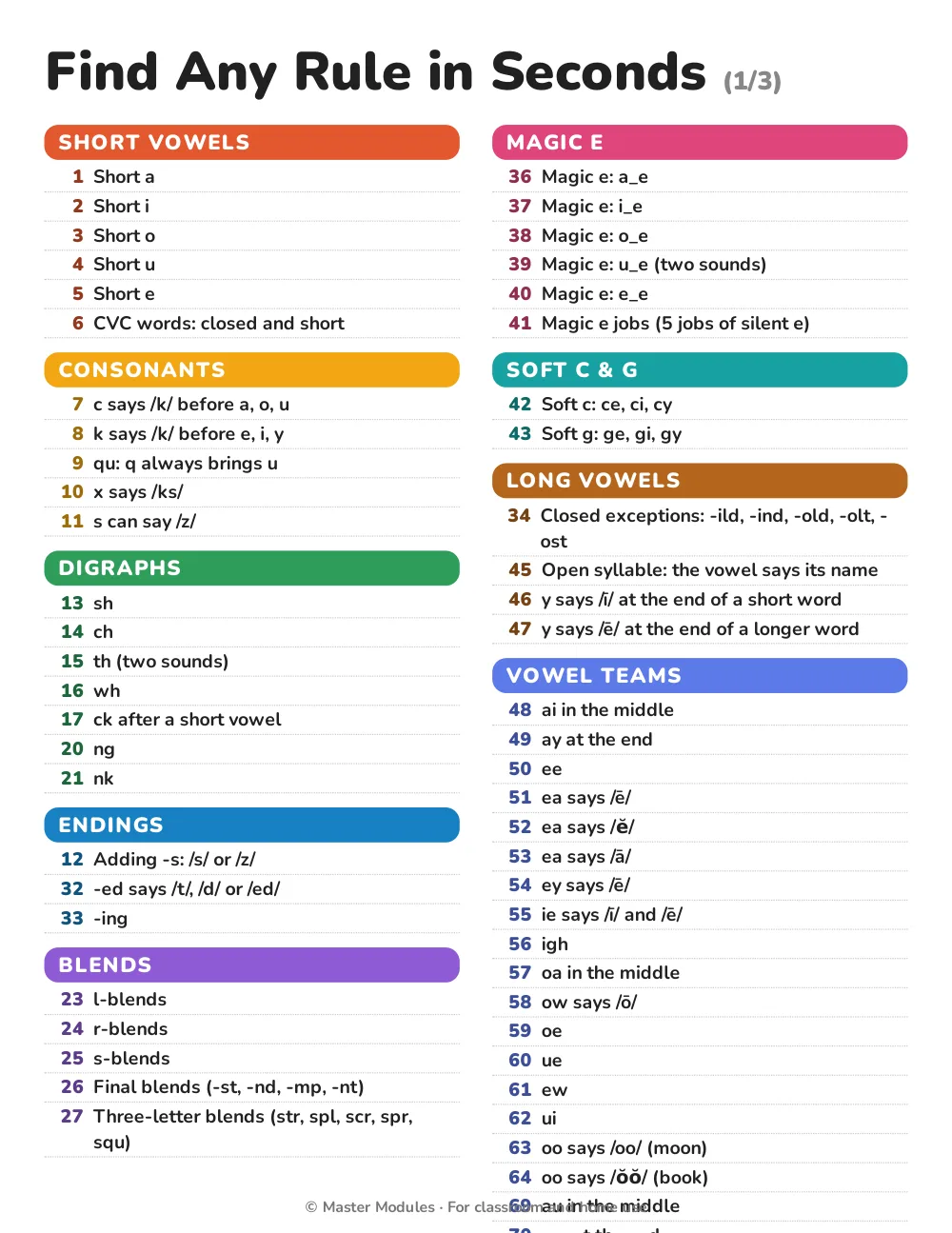
There is no single list of spelling rules, but there is a sensible order. This list groups 130 phonics and spelling rules into three stages: sounds and simple words (rules 1–44), long vowels, vowel teams and syllables (45–88), and word-building plus tricky spellings (89–130). Each entry has a one-line summary and example words. Use it as a checklist, a lesson order or a way to see what a child may be missing.
How to read this list
- Rules are numbered in a teaching order. Earlier rules support later ones.
- Each rule is small enough for one short lesson.
- Exceptions are named, not hidden.
- You do not have to teach all of it in one year. Start where your learners are.
Stage 1: Sounds and simple words (rules 1–44)
This stage covers short vowels, consonant spellings, digraphs, blends and the first spelling rules for word endings.
Short vowels and CVC words (1–6)
One vowel followed by a consonant says its short sound: cat, pin, hop, cup, bed. Closed-in vowels are short.
Consonant spellings (7–12)
- c before a, o, u says /k/ (cat, cot, cup); k before e, i, y (kit, key).
- qu: q is always followed by u (queen, quick).
- x says /ks/ (fox, box).
- s can say /z/ (is, his), and the plural -s says /s/ or /z/.
Digraphs (13–21)
Two letters, one sound: sh, ch, th, wh, ng, nk. And ck after a short vowel. See the ck guide.
Doubling and special endings (18–22)
The FLOSS rule (ff, ll, ss, zz) and -all, -oll, -ull. Add -es to words ending in s, x, z, ch or sh. Read about the FLOSS rule and its exceptions.
Blends (23–27)
L-blends, r-blends, s-blends, final blends (-st, -nd, -mp, -nt) and three-letter blends (str, spl, scr, spr, squ). You hear every sound in a blend.
Endings and /ch/ /j/ spellings (28–35)
- -tch after a short vowel (catch) and -ch after a consonant or long vowel (lunch).
- -dge after a short vowel (badge) and -ge after a consonant or long vowel (page).
- -ed says /t/, /d/ or /ed/. -ing says /ing/.
- Closed exceptions: child, find, gold, bolt, most.
- English words do not end in v: have, give, love.
Magic e, soft c and g, compounds (36–44)
The five magic e patterns, the five jobs of silent e, soft c (city), soft g (gem) and compound words (sunflower). The magic e guide walks through these.
Stage 2: Long vowels, vowel teams and syllables (rules 45–88)
Open syllables and y as a vowel (45–47)
An open vowel says its name (he, go). At the end of a short word y says /ī/ (my), and in a longer word /ē/ (happy).
Vowel teams (48–72)
Vowel teams are pairs of letters that make one vowel sound.
| Sound | Spellings |
|---|---|
| /ā/ | ai (rain), ay (day), ea (great), ei/eigh (eight) |
| /ē/ | ee (tree), ea (eat), ey (key), ie (field) |
| /ī/ | igh (high), ie (pie) |
| /ō/ | oa (boat), ow (snow), oe (toe) |
| /oo/ | ue (blue), ew (new), ui (fruit), oo (moon) |
| short oo | oo (book) |
| /ow/ | ou (cloud), ow (cow) |
| /oi/ | oi (coin), oy (boy) |
| /aw/ | au (haul), aw (saw), al (salt) |
Details are in the vowel teams guide.
R-controlled vowels (73–82)
ar, or, er/ir/ur, ore, air/are/ear, ear/eer, plus the w rules: wor says /er/ (work), war says /or/ (warm), wa says /ŏ/ (wash). And the unstressed -er, -or, -ar ending (water, doctor, sugar). See the bossy r guide.
Syllable types and division (83–93)
The six syllable types: closed, open, magic e, vowel team, r-controlled and consonant-le. Then the division patterns: VC/CV, V/CV, VC/V, and keeping blends and digraphs together. The schwa closes the stage. See the syllable types guide and how to divide syllables.
Stage 3: Word-building and tricky spellings (rules 89–130)
Suffix endings (94–97)
-tion (action), -sion (mansion, vision), -ture (picture), -cian/-cial/-tial (musician, special).
Adding endings (98–106)
- The 1-1-1 doubling rule and its two-syllable version.
- Drop the silent e (making).
- Change y to i (happier, tried) and keep y before -ing (trying).
- Plurals: -s/-es, y to ies, f/fe to ves, and irregular plurals. For doubling in detail, see the doubling rule guide.
Prefixes and suffixes (107–117)
Prefixes un-, re-, pre-, dis-, mis-. Suffixes -ful, -less, -ness, -ly, -er/-est, -able/-ible, -ous. The base word stays whole.
Silent letters and unusual spellings (118–123)
kn, gn, wr, mb, gh/ght, plus ph (phone) and ch saying /k/ or /sh/ (school, chef).
Spelling rules and tricky words (124–130)
i before e, except after c (see the full guide), -ey or -y at the end, ough (six sounds), contractions, possessives, homophones and the choice of -c, -k, -ck or -ke at the end of a word.
What to teach first
If you can only teach part of the list:
- Short vowels, digraphs and blends (stage 1) before anything else.
- The ck, FLOSS, -tch and -dge endings, because they come up in every piece of writing.
- Magic e and the vowel teams for the sounds children already say.
- The doubling and drop-the-e rules the first time a learner starts adding -ing and -ed.
How to use the list with a class
- As a pacing guide. Tick a rule when it has been taught and check again when it has been used in writing.
- As a diagnostic. When a child misspells a word, find the rule behind it. A child who writes hoping for hopping needs rules 98 and 100 side by side.
- As a parent handout. Give the rule, six words and one sentence for the current unit.
A planned year that spreads this list across 36 weeks is described in the phonics lesson plan guide.
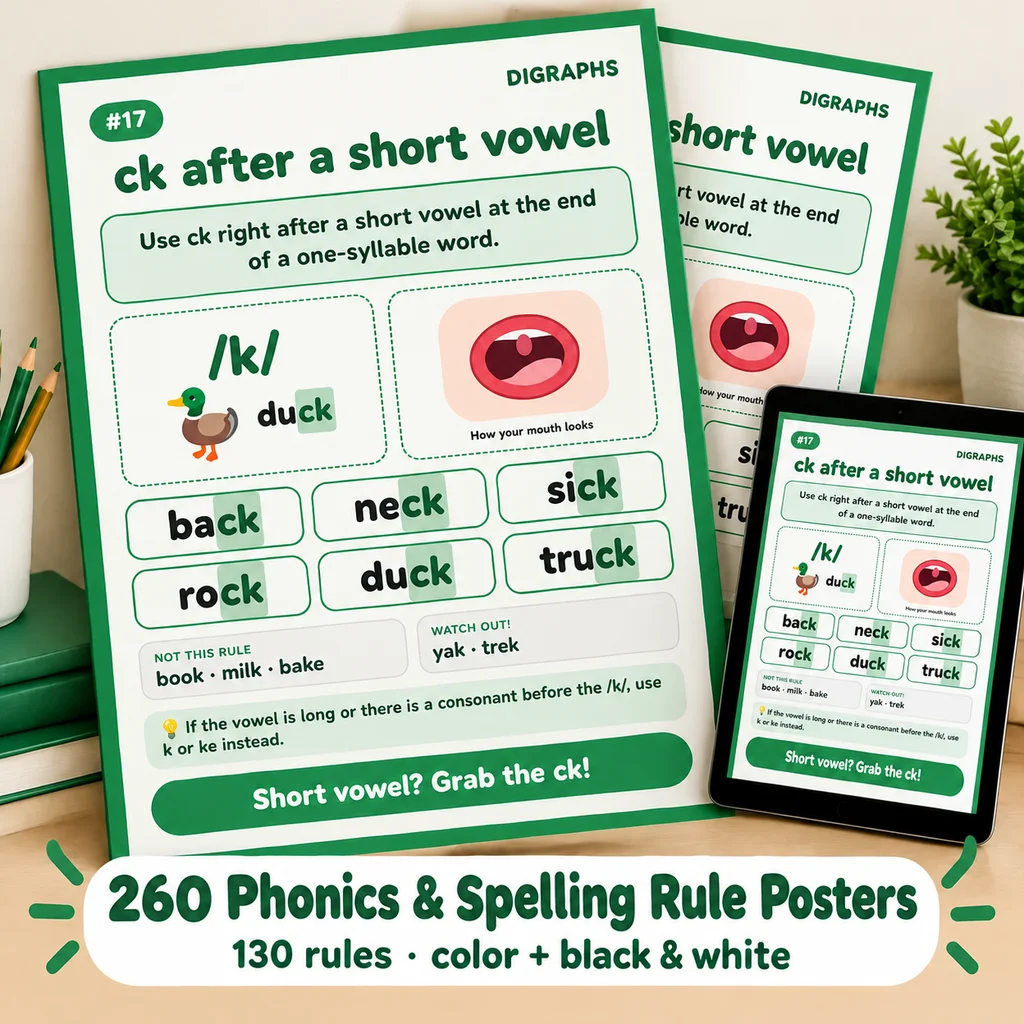
The same list as a set of posters
Phonics & Spelling Rules Posters is built from exactly this list: one poster for each of the 130 rules, with the rule in plain language, six example words, a contrast, the real exceptions and a decodable sentence. The set includes an Index of All 130 Rules in three parts, and each poster comes in color and black & white at full-page, half-page and mini sizes.