Decodable Readers: A Stage-by-Stage Tour of 9 Stages and 108 Stories
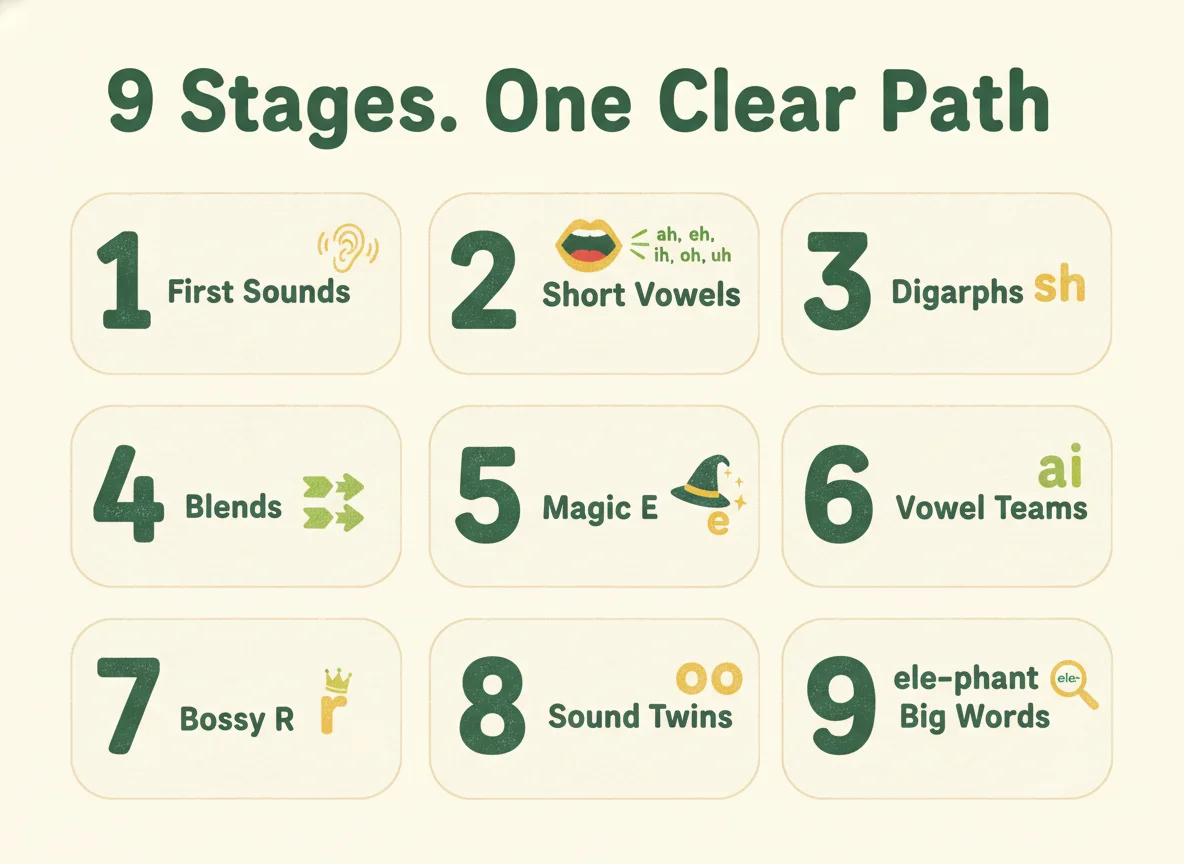
The Decodable Readers Library is a set of 108 printable decodable stories in 9 stages, with a placement test, a parent guide, 72 activity centers and a progress tracker. This guide walks through it stage by stage so you can see what each one teaches, what the stories look like and what you need to run it at home or in a small group.
The set at a glance
| Part | What you get |
|---|---|
| Stories | 9 stages, 12 stories each: 108 in total, six pages each |
| Lesson packets | A four-page packet for each story: warm-up, story, activities |
| Activity centers | 8 for each stage: 72 in total |
| Placement test | A 3-minute test with word lists for each stage |
| Parent Guide | What to say on every page, plus a page for each stage |
| Start Here | Your first five minutes |
| Progress Tracker | A page per stage, fluency log, sticker sheets and a wall chart |
| Certificates | One for each stage and a final one |
| Formats | Color and black and white PDFs on US Letter, and a members web app |
Every story is checked by a script against the letter patterns and tricky words taught up to its stage.
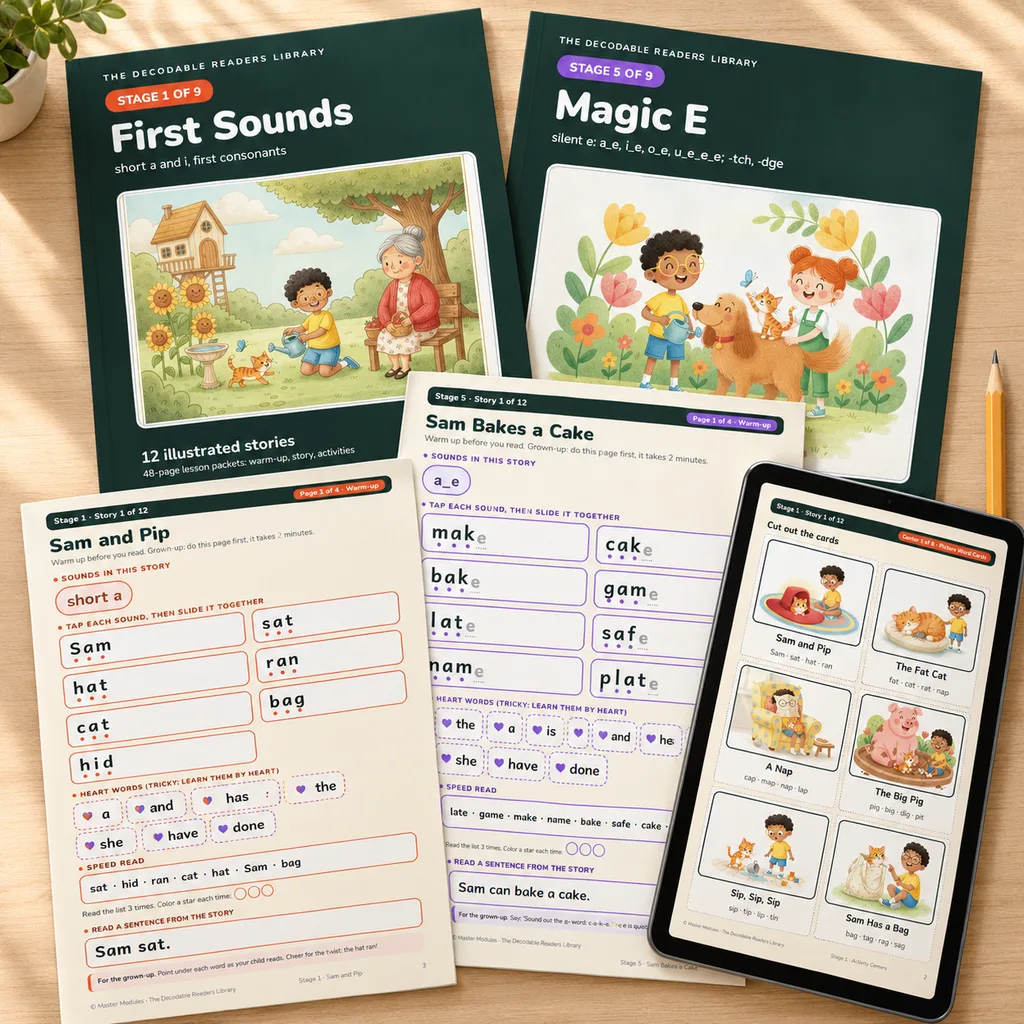
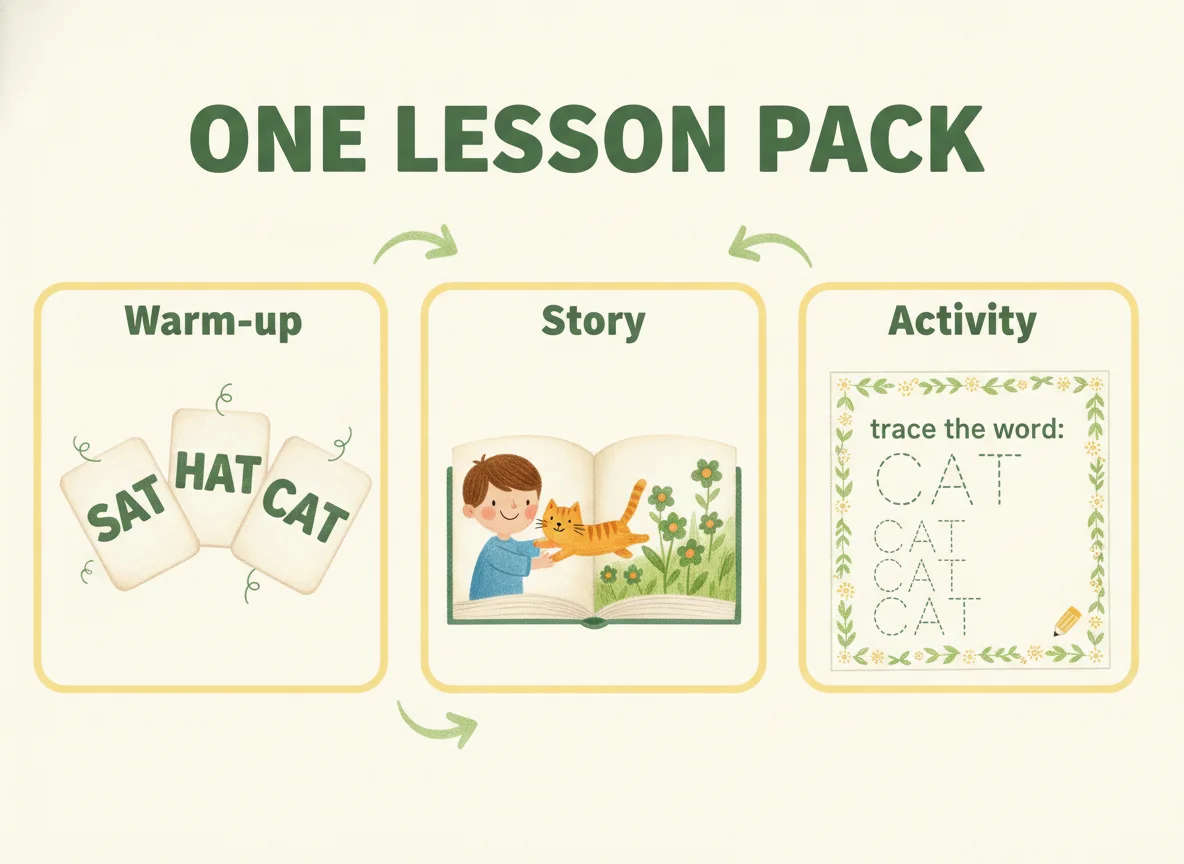
What a lesson packet holds
- Page 1, warm-up. The new sounds, tap-and-slide words, tricky words and a speed read.
- Pages 2 and 3, the story. Six pages of illustrated text.
- Page 4, activities. Three questions, a word hunt, a sentence to write and a space to draw, plus the rule behind the story.
The nine stages
| Stage | Name | Focus | Up to words per page |
|---|---|---|---|
| 1 | First Sounds | Short a and i, first consonants | 12 |
| 2 | All Short Vowels | Short o, u, e and the rest of the alphabet | 16 |
| 3 | Digraph Detectives | sh, ch, th, wh, ck, ng, nk, ff, ll, ss, zz | 20 |
| 4 | Blend Builders | Beginning and ending blends | 24 |
| 5 | Magic E | a_e, i_e, o_e, u_e, e_e, -tch, -dge | 28 |
| 6 | Long Vowel Teams | ai, ay, ee, ea, oa, ow, igh and y at the end | 32 |
| 7 | Bossy R | ar, or, ore, er, ir, ur | 36 |
| 8 | Sound Twins | oo, ou, ow, oi, oy, au, aw, ew, ue | 40 |
| 9 | Big Word Readers | Endings, compound words, -le, two-syllable words | 48 |
Stage 1: First Sounds
The stories use short a and short i with 15 consonants and a handful of tricky words (the, a, I, is, to, and, his, has). A sample story, Sam and Pip, runs: Sam sat. Pip sat. Sam has a hat. Pip hid in the hat. The hat ran! Other titles include The Big Pig, Sit, Pip! and The Big Dig.
Stage 2: All Short Vowels
Short o, u and e arrive, along with qu and the rest of the letters. Titles include Max the Dog, Mud Fun, Max Gets a Vet and The Fox in the Box. Fourteen tricky words are added, such as was, you and said.
Stage 3: Digraph Detectives
Letter teams that make one sound. Titles include Pip's Fish Wish, Lunch on the Bench, The Moth on the Math and Bugs in the Mugs.
Stage 4: Blend Builders
Sounds side by side. Titles include The Glum Plum Slug, The Clap Club, The Camp Lamp and Six Lunches.
Stage 5: Magic E
The silent e changes the vowel. Titles include Sam Bakes a Cake, Kit Rides a Bike, The Witch in the Patch and Sam the Fudge Judge. There is a closer look at this stage in silent e stories.
Stage 6: Long Vowel Teams
Vowel teams such as ai, ay, ee, ea, oa, ow and igh. Titles include The Sleepy Bee, A Goat on a Boat, Snow Pals and A Great Day at the Bay.
Stage 7: Bossy R
R-controlled vowels. Titles include The Star in the Jar, Max at the Barn, Gran's Pot of Corn and Dad's Tractor.
Stage 8: Sound Twins
Vowel pairs and diphthongs. Titles include Sam's Moon Spoon, The Mouse in the House, The Brown Cow in Town and Salt for Gran.
Stage 9: Big Word Readers
Endings, compound words and two-syllable words. Titles include Max Jumped In, The Backpack Picnic, The Tallest Sunflower and The Baking Mix-Up.
The recurring cast
Stories feature a small, recurring cast so children recognize characters from stage to stage: Sam, Pip the cat, Kit, Max the dog, Meg, Gran, Dad and Mom. Each has a fixed look, so the illustrations stay consistent. All characters and stories are original.
The 8 centers in every stage
Each stage has the same eight hands-on centers, which reuse the words from the stories: picture word cards, word building, clip cards, roll and read, tracing, sentence scramble, read and match and a reward chart. With 9 stages, that makes 72 centers.
Starting in the right place
The 3-Minute Placement Test has a list of ten words for each stage. Score each list, stop at the first one below 9 out of 10 and start there (or one stage lower for a score of 6 or fewer). A re-test every six to eight weeks keeps the level right.
Who it is for, and what it is not
It suits parents teaching at home, homeschool families and teachers working with a small group of beginning readers. It starts from the first letter sounds, so it also fits older beginners who need to build from the start.
It is practice for phonics and early reading, not a complete language arts course. It has no separate fluency passages, no grammar or handwriting program and no spelling lists.
Optional add-ons
Two add-ons are sold separately and are not part of the main library: a set of 650+ Blending and Segmenting Cards with a guide and practice sheets, and 60 Core Phonics Rule Posters tied to the nine stages.
How to get started
- Take the 3-minute placement test.
- Read the first pages of the Parent Guide.
- Print one stage's first week of stories.
- Spend ten minutes a day on one packet.
- Tick it off on the tracker.
For background on the idea, read what decodable books are. For the order of patterns, see the phonics scope and sequence. For printing tips, read printable decodable books, and for early readers, decodable books for kindergarten.