Phonics Lesson Plans for 36 Weeks: A Year-Long Pacing Guide
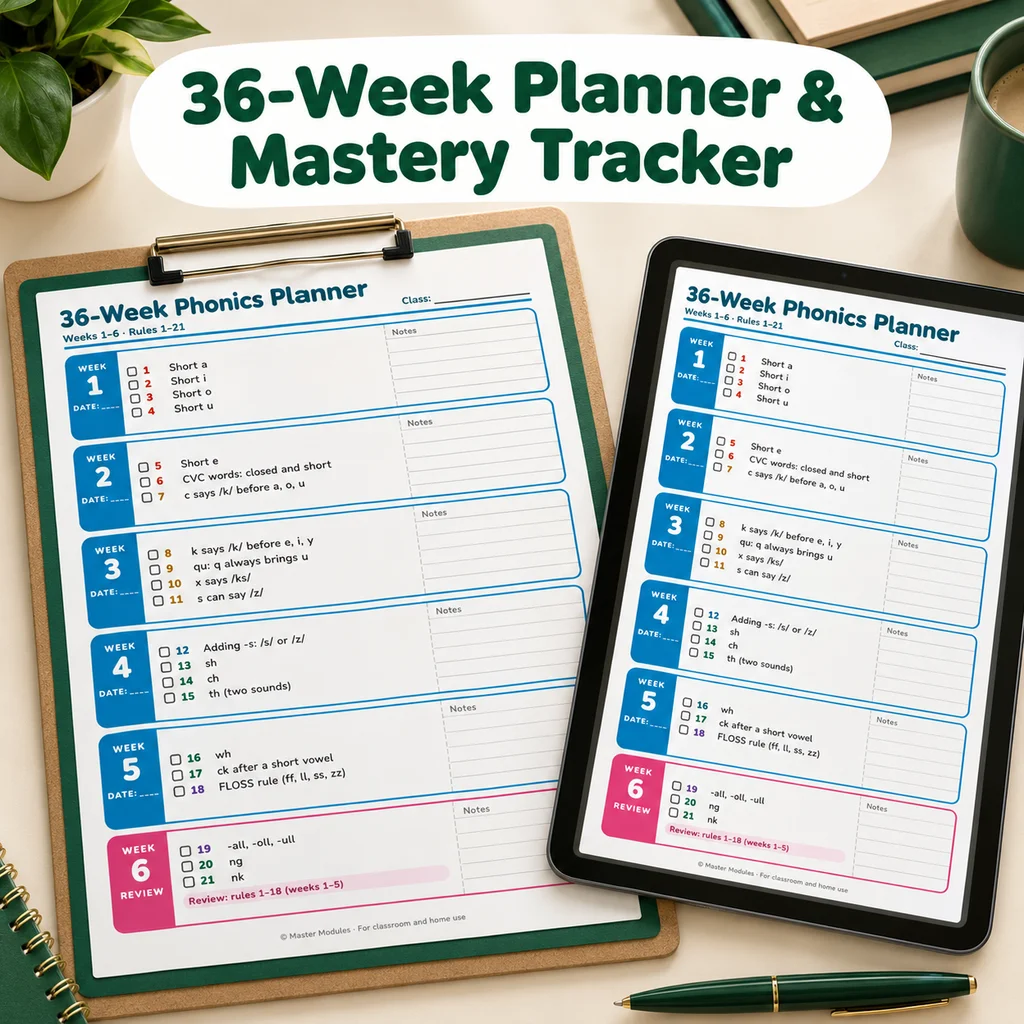
A year of phonics fits in 36 weeks if you plan three or four rules a week and leave every sixth week for review. With 130 spelling and phonics rules in a teaching order, that pace covers short vowels in the first weeks and finishes with silent letters, homophones and tricky spellings. This guide shows how to build the plan, what a daily five-minute routine looks like, how to track mastery and how to bring families in.
The math of a school year
Start with the numbers.
| Count | |
|---|---|
| Rules to teach | 130 |
| Weeks in the plan | 36 |
| Review weeks (every 6th) | 6, each with 3 new rules |
| Weeks of mostly new rules | 30 |
| New rules per week | 3 to 4 |
One rule per day for four days, with the fifth day for catching up, gives you room for a school week that is interrupted by a fire drill, an assembly or a field trip. The review weeks give a second pass at everything covered so far.
How a week is built
A typical week has three or four new rules, taught in the order of the scope and sequence.
| Day | What happens |
|---|---|
| Monday | Rule 1 of the week |
| Tuesday | Rule 2 |
| Wednesday | Rule 3 |
| Thursday | Rule 4, or a catch-up on the week |
| Friday | Catch-up, quiz or dictation |
If you only have three rules that week, use the extra day to revisit the one that was hardest.
Review weeks
Every sixth week (weeks 6, 12, 18, 24, 30 and 36) is a review week. A review week lists the rules from the five weeks before it, plus three new rules, so you are never reviewing without also moving forward.
Ways to run a review week:
- Rule sorts. Mix words from five rules and have students sort them by pattern.
- Dictation. Read ten words and two sentences from the last five weeks.
- Poster walk. Students tour the last five posters and say each rule aloud.
- Mini assessment. Check spelling and reading of words with the five patterns.
Following the sequence
The order of the rules matters more than the dates. The plan starts with short vowels and closed syllables, moves through consonant spellings, digraphs, blends and the endings that protect short vowels (ck, FLOSS, -tch, -dge), then magic e and soft c and g. It continues with long vowels, vowel teams and r-controlled vowels, then syllable types and division, and finally suffixes, endings, prefixes, plurals and silent letters. The full list is in the spelling rules in order.
If your class is behind, slide every week down by one. If your class is ahead, use the extra time to deepen practice, not to skip rules.
A five-minute daily routine
A small, steady routine works better than a long lesson that happens only when there is time.
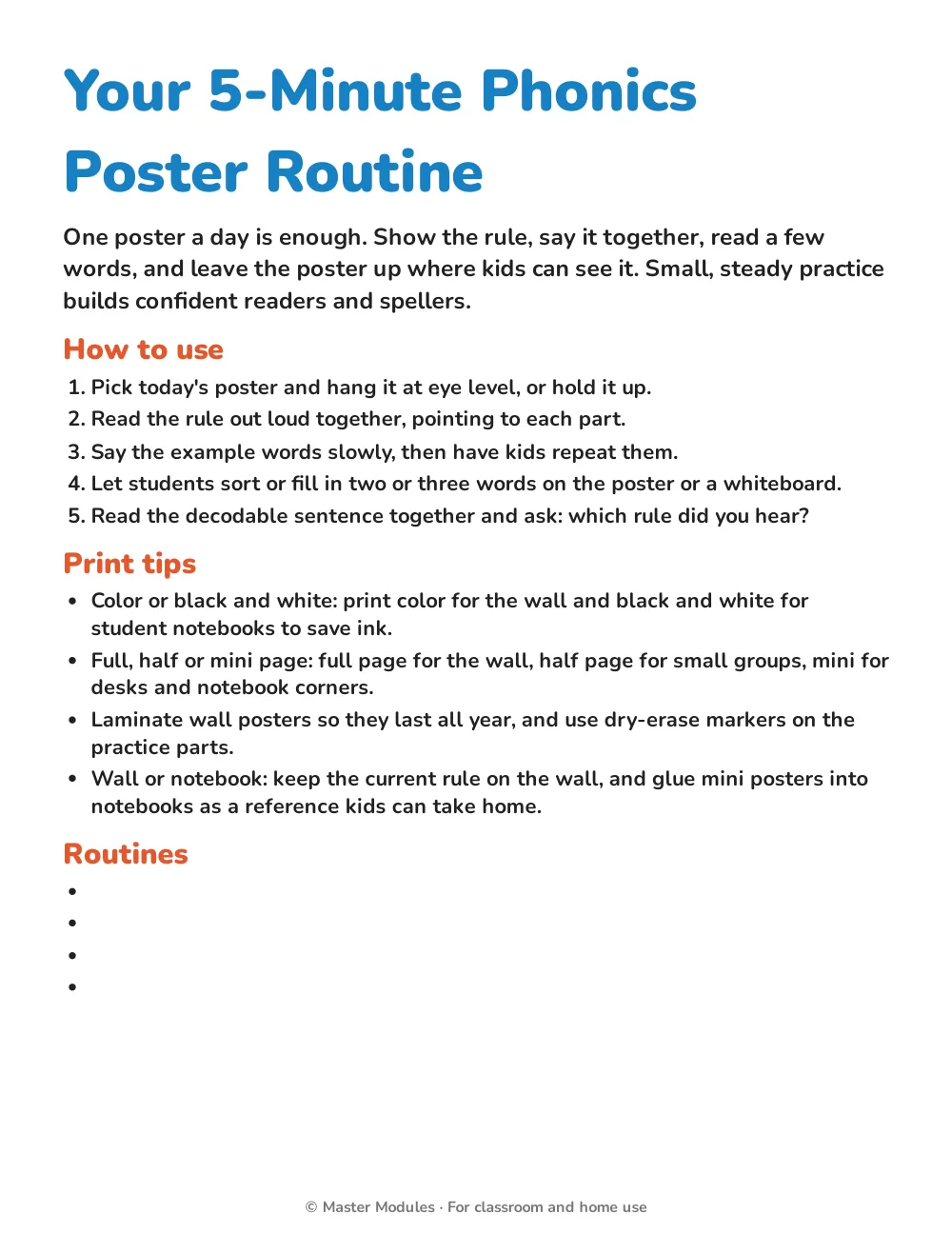
- Pick today's poster and hang it at eye level, or hold it up.
- Read the rule out loud together, pointing to each part.
- Say the example words slowly, then have kids repeat them.
- Sort or fill in two or three words on the poster or a whiteboard.
- Read the decodable sentence together and ask: which rule did you hear?
Some classrooms add variations: a Rule of the Day (find two example words in the room), a Sound Check (copy the mouth shape for a sound) or Sort It Out (call out words and have kids tap the column they belong in). A few minutes each day is enough. For ready-made sentences, see the decodable sentences guide.
Track mastery, not just coverage
Teaching a rule is not the same as children knowing it. A class tracker helps you see the difference.
- Write each student's name on a roster page.
- After a quiz, a sort or a few minutes of listening to a child read, mark one circle per child per rule.
- Use three levels: introduced, developing, mastered.
- Mastered means the child can read the words, spell them and explain the rule on their own.
Look down a column to see where one child needs help. Look across a row to see which rules need reteaching for the whole class.
Bring families in
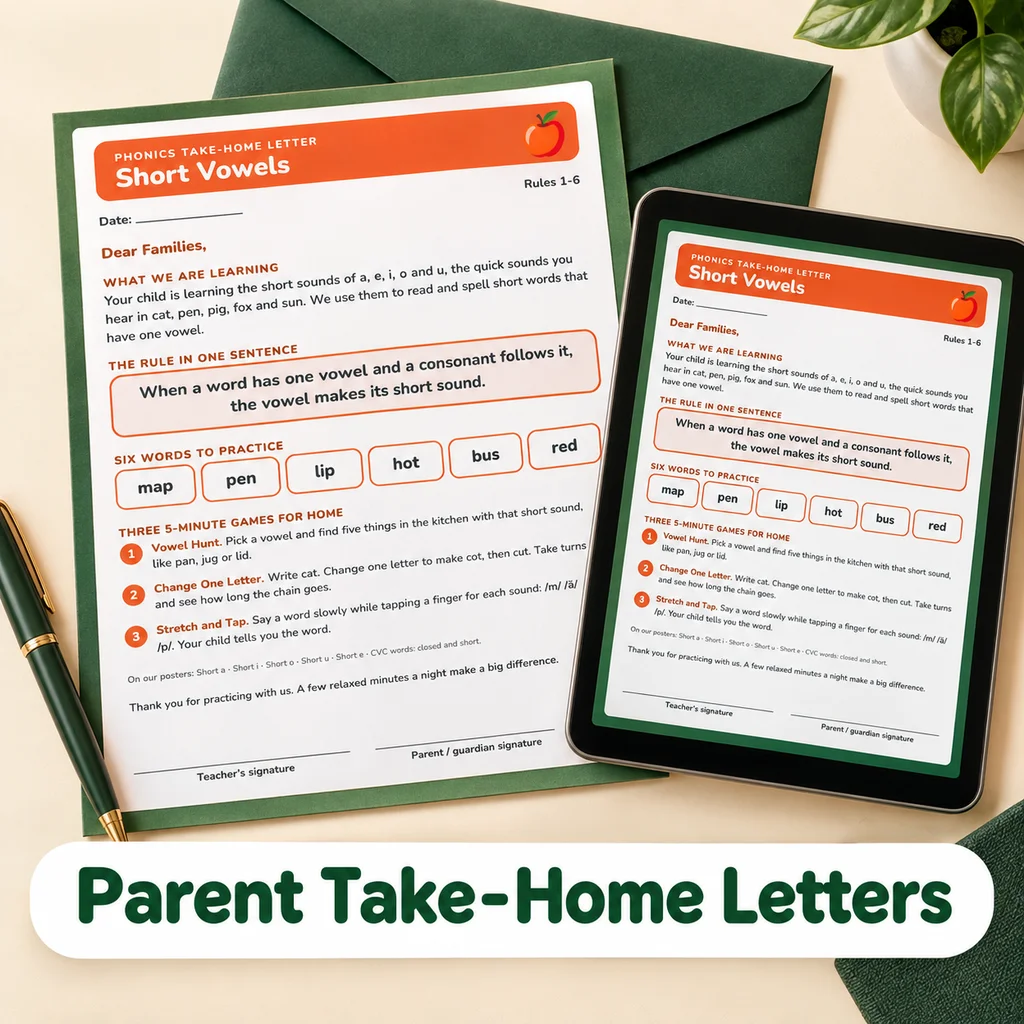
Children practice more when families know what is being taught. A short take-home letter at the start of each group of rules does three things: names the rule in plain words, gives six practice words and suggests two or three quick games, such as hunting for items with a short-vowel sound around the house or changing one letter at a time (cat, cot, cut). Families do not need flash cards or training. A few minutes at the table is enough.
Planning with posters
Rule posters give the plan something to see. Hang the current rule at eye level, keep recent rules nearby and move older ones into a binder. For how many to post and in what size, see how many phonics posters a classroom needs. For rule-by-rule detail on syllables, see the six syllable types.
Adjusting the plan
- Younger or slower groups. Teach three rules a week, take two weeks for each hard rule and stretch the plan across more than 36 weeks.
- Older students filling gaps. Use the tracker to find the rules that are not secure and skip the ones that are.
- Split classes or intervention groups. Run the plan per group. Each group keeps its own tracker.
- Interruptions. If a week is lost, slide down by one rather than cramming.
What the planner looks like
The Phonics & Spelling Rules Posters set includes a 36-Week Planner & Mastery Tracker built on exactly this structure: three or four rules a week in the order of the scope and sequence, review weeks at 6, 12, 18, 24, 30 and 36, a class roster page, a mastery grid and checklists. It comes with the 130 rule posters, a Quick-Start Teacher Guide that describes the five-minute routine, an Index of All 130 Rules and Parent Take-Home Letters for each group of rules.