Words Ending in CK: When to Use ck, k, c or ke
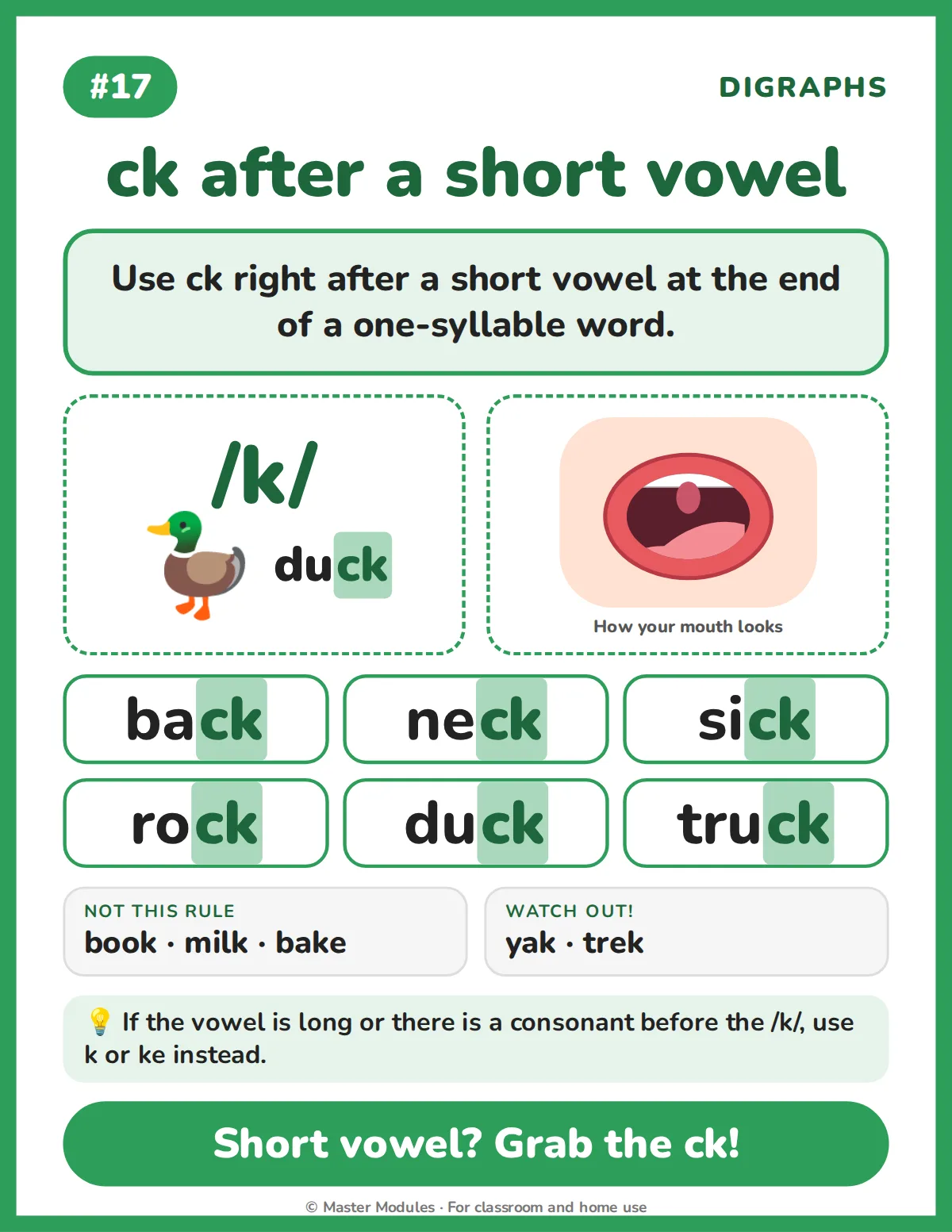
Use ck to spell the /k/ sound when it comes right after a short vowel at the end of a one-syllable word. That is why we write back, neck, sick, rock and duck. If the vowel is long or a consonant comes before the sound, a different spelling takes over: ke (bike), k (milk, book) or, in longer words, c (picnic). This guide gives the rule, a quick test you can run on any word, lists of examples and the exceptions that trip people up.
The rule in one sentence
Short vowel + /k/ at the end of a one-syllable word = ck.
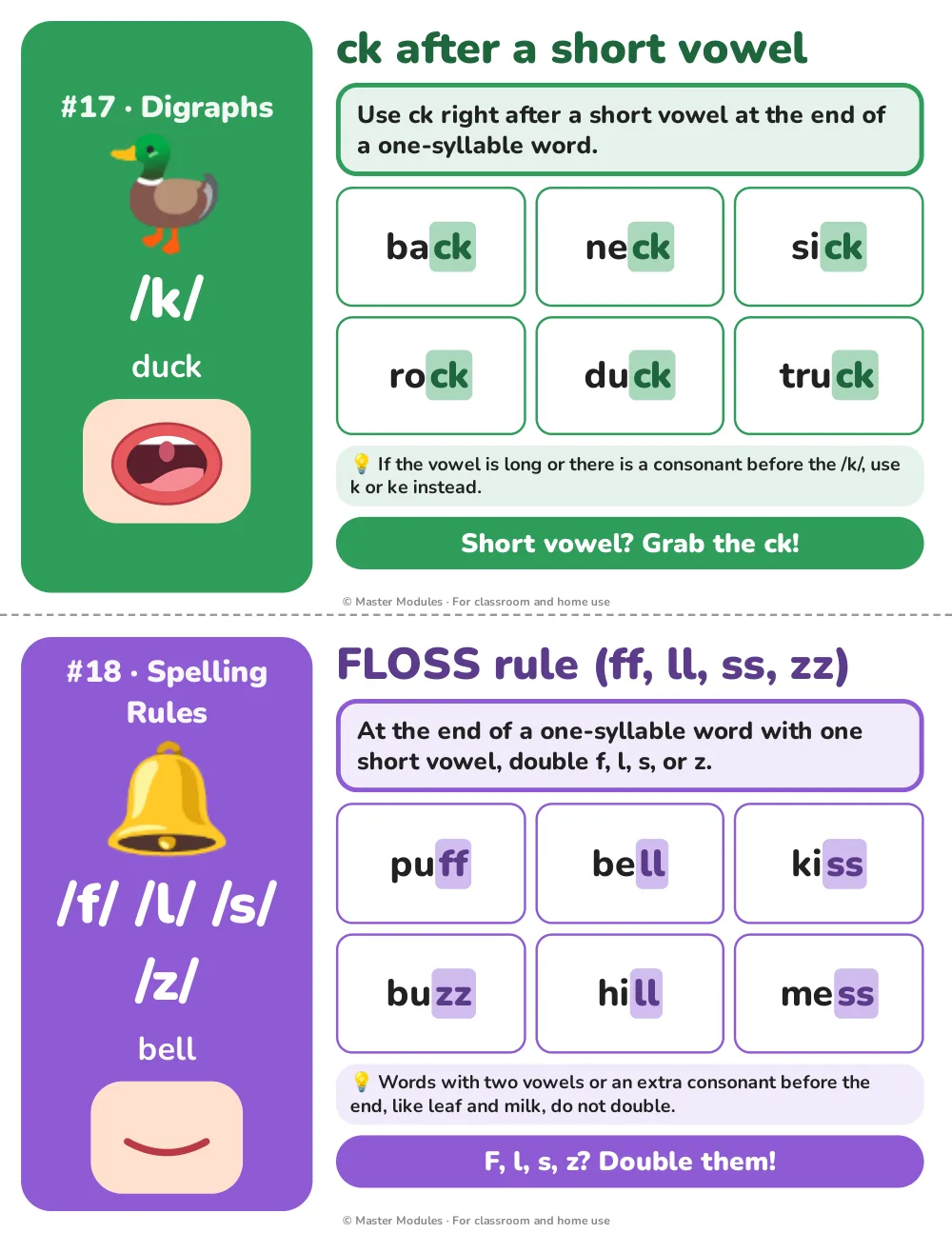
The reason is simple. English wants a short vowel to be "closed in" by a consonant sound. When the next sound is /k/, we mark it with two letters, ck, so the word looks and feels solid. The same idea explains why we write puff, bell and kiss with doubled letters (see the FLOSS rule).
| Pattern | Examples |
|---|---|
| short a + ck | back, pack, black, snack, track |
| short e + ck | neck, deck, check, speck |
| short i + ck | sick, kick, quick, thick, stick |
| short o + ck | rock, sock, clock, block, shock |
| short u + ck | duck, truck, luck, stuck, chick |
A three-question test for the /k/ sound
When you hear /k/ at the end of a word and need to pick a spelling, ask three questions in order.
- Is there one short vowel right before the /k/ sound, in a one-syllable word? Use ck. (duck, pick, sock)
- Is the vowel long, with a silent e at the end? Use ke. (bike, cake, smoke)
- Is there a consonant or a vowel team before the sound? Use k. (milk, desk, bank, book, week, beak)
If the word has more than one syllable and ends in an unaccented /ik/ sound, the spelling is usually a plain c: picnic, music, magic, public, panic.
Worked examples
- Duck. One syllable, short u, then /k/. Question 1 says ck.
- Bike. The i is long because of the silent e. Question 2 says ke.
- Milk. The l is a consonant sitting before /k/. Question 3 says k.
- Book. The oo is a vowel team. Question 3 says k.
- Picnic. Two syllables, ends in a weak syllable. Plain c.
Why k and not ck after a consonant?
The ck spelling exists to protect a short vowel. A consonant like l, n or s already does that job. In milk, the l and the k are doing the closing. In sink the n is. Adding a c would be spelling the same sound twice, so English leaves it out.
The same logic explains why words with a vowel team use plain k. In week the ee is a long vowel sound, and nothing needs "closing", so there is no ck.
Do not mix up /k/ at the start of a word
At the beginning of a word, two other rules decide the spelling:
- c before a, o, u: cat, cot, cup, corn.
- k before e, i, y: kit, key, kid.
Two letters, c and k, can each make /k/. Which one you use at the start depends on the next letter. Because c says /s/ before e, i or y (city, cent), a /k/ sound before those letters needs a k (kit, key).
Where ck shows up inside words
Although the rule is about the end of one-syllable words, you will also find ck in the middle of longer words when it comes right after a short stressed vowel: pocket, chicken, ticket, rocket, jacket, packet, sucker. The ck marks the short vowel before it. It never appears at the start of a word.
When you add endings, the ck stays: packed, kicking, ducks, sticky, tricky. You do not double a k or c after a ck, because the ck already did the closing job.
Exceptions you will meet
Honest rules come with exceptions. The ones to teach:
- Yak, trek. One syllable, short vowel, but they use k. They are rare words, and most children meet them late.
- Kayak. A longer word, with k at the end of the last syllable.
- Picnic, music, magic. Longer words ending in an unaccented /ik/ use c.
- Black, truck, stick. These still follow the rule. The consonant is before the vowel, not between the vowel and the /k/, so the ck stays.
If a child asks "why is it picnic and not picnick?", you now have a precise answer: the ck rule covers the end of a one-syllable word.
Four ways to teach it
1. Sort and say. Give your class a set of words ending in /k/ and two columns, "short vowel + ck" and "other". Read each word, tap the vowel and sort. Start with back, bike, book, duck, milk, rock, cake, desk.
2. Chain the word family. Write -ack, -eck, -ick, -ock, -uck on five cards. Build lists: back, pack, sack, black, track. Each family teaches the same pattern.
3. Fix the mistake. Present four misspellings (bak, dukc, biick, mik) and have kids rewrite them with the rule. Ask which of the three questions they used.
4. Dictation. Read one sentence aloud and let kids spell the ck words. A good sentence: "The duck sat on a rock by the dock." The spelling pattern is ck three times.
A one-minute mini lesson
- Say a word, such as sock, and stretch it: /s/ /o/ /k/.
- Tap the vowel. Ask: is it short? Yes.
- Write the word. Underline ck.
- Say the rule together: "Short vowel? Grab the ck!"
- Read three more words and let kids add one of their own.
Where this fits in the bigger picture
The ck rule is one of about 130 spelling and phonics patterns that tend to come up in grades K–3. It sits next to the FLOSS rule (ff, ll, ss, zz), the -tch and -dge rules that also protect short vowels, and the magic e rule that handles long vowels. The magic e guide shows the other half of the story: how the spelling changes when the vowel is long. For the whole list in a sensible order, see the spelling rules list.
A poster for each of these rules
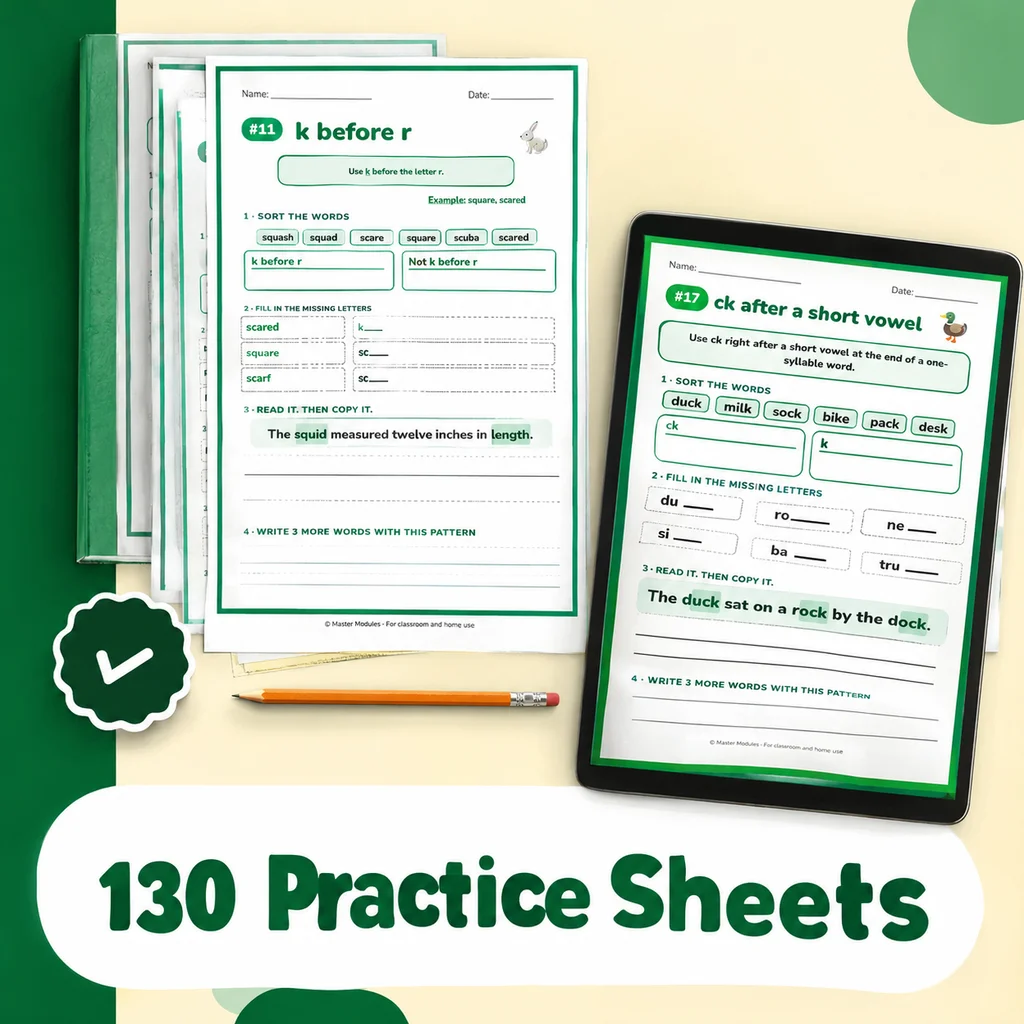
Phonics & Spelling Rules Posters has a poster for ck after a short vowel, and a separate poster for the /k/ choice at the end of a word: -c, -k, -ck and -ke. Both sit in the same 130-poster set as the FLOSS rule, -tch and -dge, and each poster has a rule in plain language, six example words, a contrast and a decodable sentence. You can hang the full-page version on the wall, hand out the half-page for small groups, or give each child the mini version for their notebook.