The 1-1-1 Doubling Rule: When to Double the Consonant
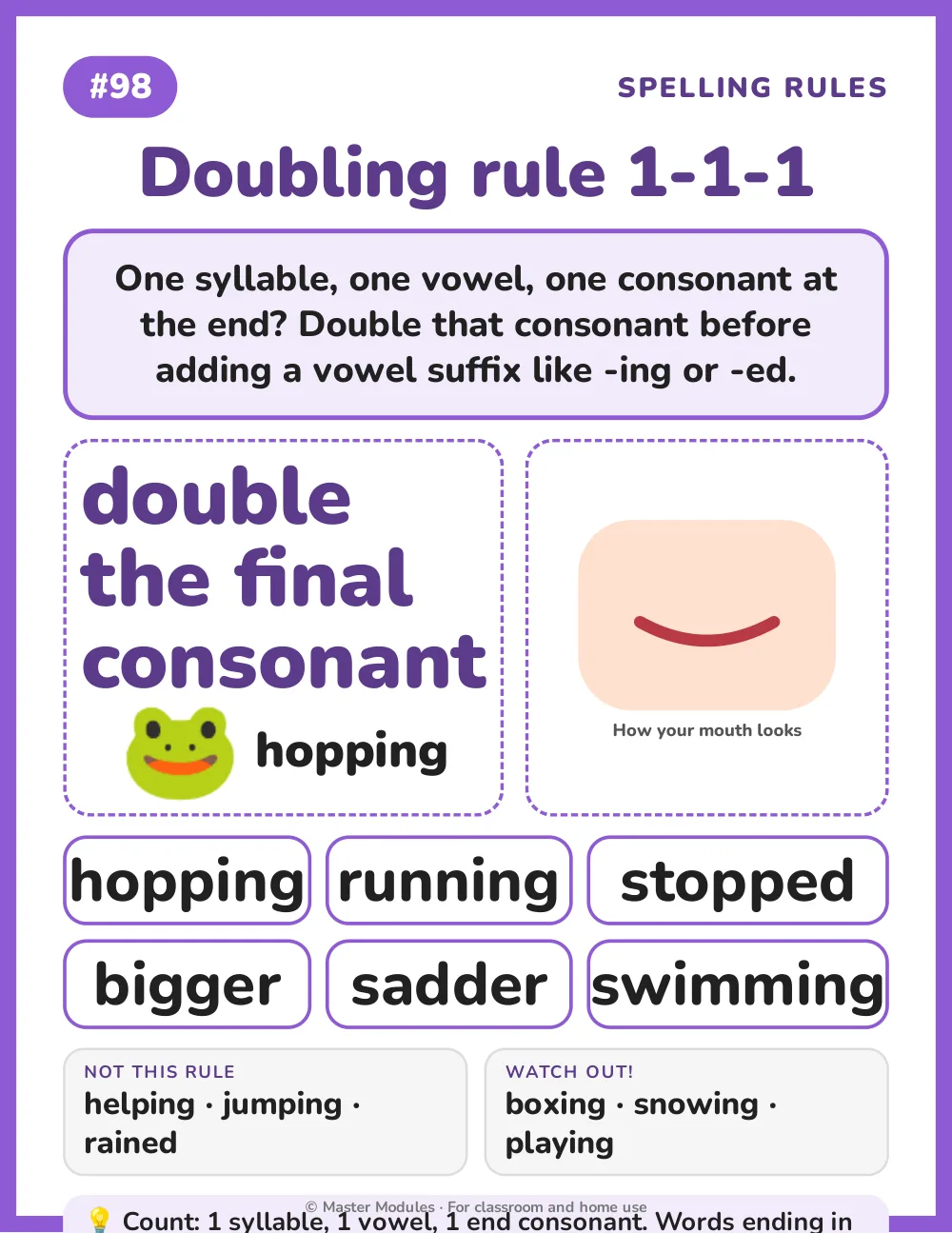
Double the last consonant when a one-syllable word has one vowel and ends in one consonant, and the suffix starts with a vowel. That is the 1-1-1 rule: one syllable, one vowel, one final consonant. It explains hop → hopping, run → running, big → bigger and stop → stopped. This how-to shows how to apply the rule in four checks, what changes for two-syllable words, and how it pairs with the drop-the-silent-e rule.
The four checks
Before adding -ing, -ed, -er or -est to a word, run these checks in order.
- Does the suffix start with a vowel? -ing, -ed, -er, -est and -y all do. If not (-ful, -ly, -ness), do not double.
- Does the base word have one syllable? (If not, see the two-syllable section below.)
- Does it have one vowel? Rain has two vowel letters, so it does not double.
- Does it end in exactly one consonant? Jump ends in two. Hop ends in one.
If all four checks pass, double the last letter.
| Word | Checks | Result |
|---|---|---|
| hop + ing | 1 syllable, 1 vowel, 1 final consonant | hopping |
| big + er | passes | bigger |
| swim + ing | passes | swimming |
| jump + ing | ends in two consonants | jumping |
| rain + ed | two vowels | rained |
| help + ing | ends in two consonants | helping |
Why doubling happens
The doubled consonant protects the short vowel. Hoping (long o) and hopping (short o) are different words, and the double p is what tells you which one you are reading. This is the same logic as the silent e: one signals a long vowel, the other protects a short one. See the magic e guide for the long-vowel side.
Letters that never double
Three letters do not double, even when the other checks pass:
- w: snow → snowing, show → showing.
- x: box → boxing, fix → fixing.
- y: play → playing, stay → stayed.
These are the honest exceptions, and they are easy to teach, because the letters are few.
Two-syllable words: look at the stress
The rule extends to longer words with one extra check: double the final consonant only if the stress is on the last syllable.
| Word | Stress | Result |
|---|---|---|
| begin | be-GIN (last syllable) | beginning |
| forget | for-GET (last syllable) | forgetting |
| admit | ad-MIT (last syllable) | admitted |
| prefer | pre-FER (last syllable) | preferred |
| visit | VIS-it (first syllable) | visiting |
| open | O-pen (first syllable) | opening |
| listen | LIS-ten (first syllable) | listening |
To find the stress, say the word aloud and notice which syllable is louder and longer. Clap it if you need to. Then apply the same four checks to the last syllable.
Some word forms are British or American variants (traveling versus travelling). Choose one and stay with it.
The drop-the-silent-e rule
The doubling rule has a partner. When a word ends in a silent e, drop the e before a suffix that starts with a vowel, and keep it before a suffix that starts with a consonant.
| Base | Suffix | Result | Why |
|---|---|---|---|
| make | -ing | making | drop e before a vowel suffix |
| hope | -ed | hoped | drop e |
| ride | -er | rider | drop e |
| hope | -ful | hopeful | keep e before a consonant suffix |
| safe | -ly | safely | keep e |
Exceptions include noticeable and courageous (the e stays to keep c and g soft) and dyeing (to keep it apart from dying).
Putting both rules together
When a child writes hoping or hopping, the spelling shows the vowel sound. Ask the child to say the word slowly and decide: long o or short o? Long o means a silent e was dropped (hoping). Short o means the consonant was doubled (hopping). That is one of the most useful checks in beginning spelling.
A quick routine
- Write a base word on the board (run).
- Ask: does the suffix start with a vowel? (-ing: yes.)
- Say the four checks out loud as a class.
- Add the suffix and read the new word.
- Write a sentence: "The dog was running in the sun."
Practice with a basket of ten base words and three suffixes. Kids who can explain why a word doubles or does not are using the rule, not just memorizing words. For a map of how this rule connects to others, see the list of spelling rules, and for how to split long words, see the syllable division guide.
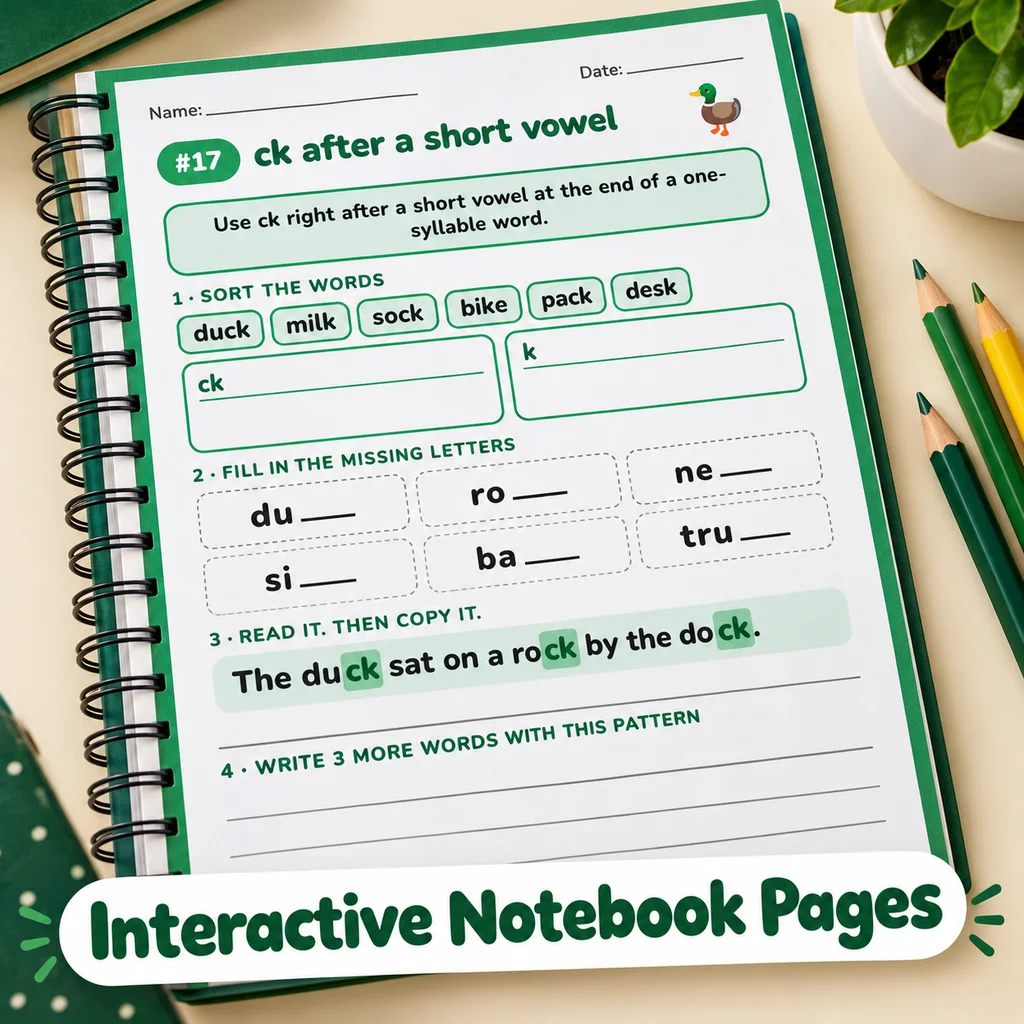
Posters for the doubling rules
Phonics & Spelling Rules Posters includes three posters for this topic: the 1-1-1 doubling rule, the doubling rule for two-syllable words, and the drop-the-silent-e rule. Each has a plain-language rule, six example words, a contrast and a decodable sentence. They belong to the full set of 130 posters, in color and black & white, in full-page, half-page and mini sizes.