The Silent E (Magic E) Rule and the 5 Jobs of Silent E
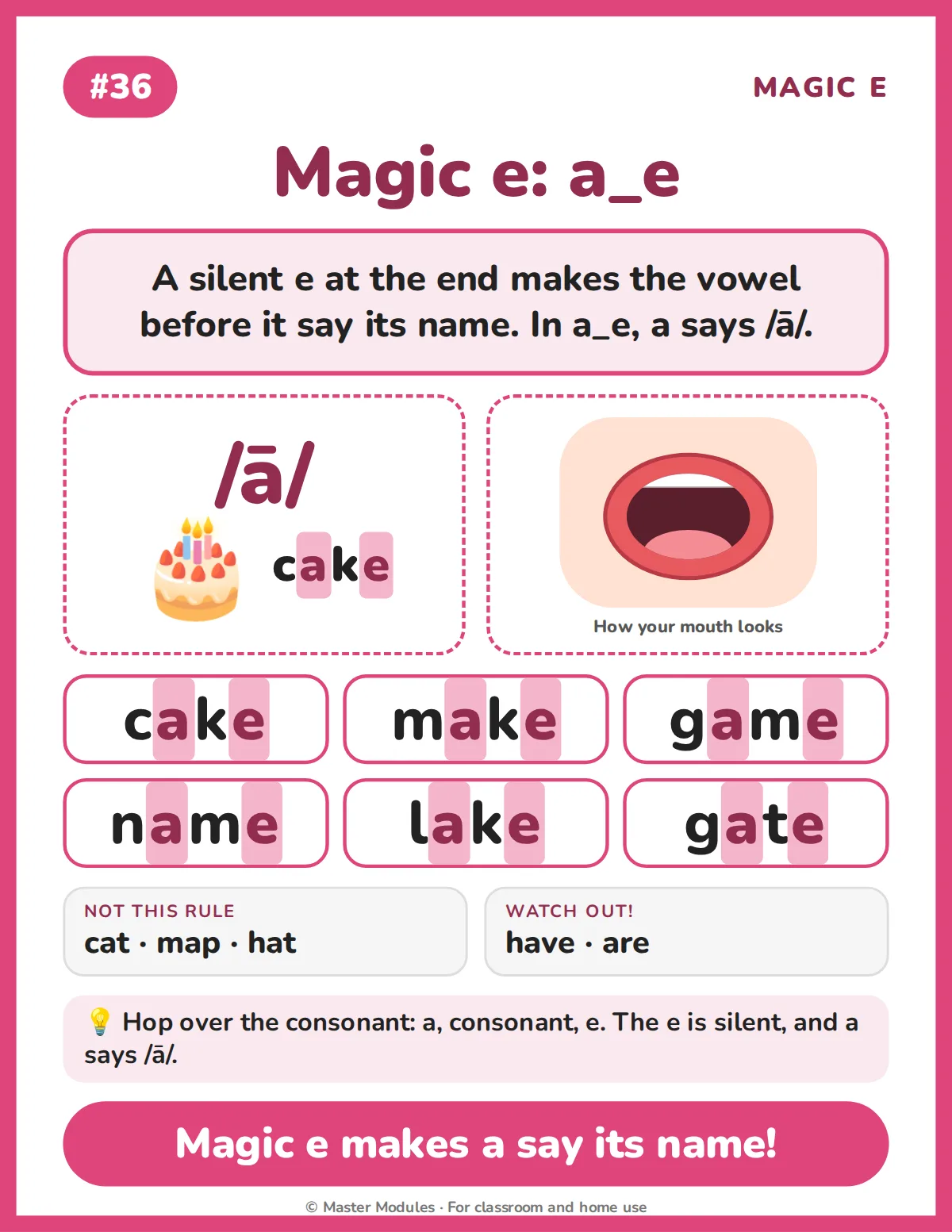
A silent e at the end of a word usually makes the vowel before it say its own name. That is why cap becomes cape, kit becomes kite, hop becomes hope and cub becomes cube. The e makes no sound. Teachers call it "magic e" because of the change it causes. But the silent e does more than one job, and a few common words ignore it. This guide covers the main rule for each vowel and then the five jobs of silent e that explain nearly every word that ends in an e you cannot hear.
The main rule: VCe
The pattern has three parts: a vowel, a consonant and a silent e at the end.
| Pattern | Without the e | With the e |
|---|---|---|
| a_e | cap, mad, plan | cape, made, plane |
| i_e | kit, pin, bit | kite, pine, bite |
| o_e | hop, not, rob | hope, note, robe |
| u_e | cub, tub, cut | cube, tube, cute |
| e_e | (rarely changes a word) | these, theme, eve |
Say the word with and without the e. The vowel sound flips from short to long. That contrast is the heart of the lesson.
a_e, i_e, o_e
For these three, the vowel says its letter name: /ā/ in cake, /ī/ in bike, /ō/ in home. Word lists are long and regular. Teach them first.
u_e: two sounds
The u_e pattern has two sounds. After most consonants it says /ū/ ("yoo"), as in cube, cute and mule. After r, l, j or ch it more often says /oo/, as in rule, flute, June and chute. Both are the long u, so the silent e is doing the same job either way.
e_e: the rare one
The e_e pattern (these, theme, eve, scene, extreme) is the rarest of the five. Don't spend a week on it. Tell children it exists, show five words and move on.
The five jobs of silent e
A silent e at the end of a word is not always about the vowel in front of it. These are the five jobs, in order of how often children meet them.
- Makes the vowel long. cake, bike, home, cube.
- Keeps c and g soft. The letter c says /s/ and g says /j/ before an e. So face has an e to keep the c soft, and page has an e to keep the g soft. Without the e, fac would be read with /k/.
- Stops a word ending in v. English words almost never end in the letter v, so a silent e follows it: have, give, live, love, five. Here the e does not make the vowel long. Have and give have a short vowel anyway.
- Keeps a singular word from looking like a plural. A word like house or please would look like a plural if it ended in a bare s. The e makes it clear this s is part of the word.
- Finishes a syllable. Every syllable needs a vowel. In table, little and apple, the last syllable has a consonant plus le, and the e is what completes it.
If a child asks "why does this word have a silent e?", they can check the list. Most words fall under at least one job.
Exceptions you will meet
Honest teaching includes the words that do not follow the pattern:
- Short vowel with silent e: have, give, live (as in "I live here"), love, come, some, done, gone, one.
- Different vowel sounds: are, were, there, where, sure.
- Foreign-origin words: police, machine, giraffe.
Many of these are very common words that children meet early. A short list of the highest-frequency exceptions taught separately works better than hoping children will figure them out alone.
Closed or magic? A decision tree for reading
When a child sees an unfamiliar word with a vowel, a consonant and an e, ask:
- Does the word end in VCe? Try the long vowel first.
- Does it sound like a real word? If not, try the short vowel.
- If neither works, consider it one of the exception words.
This "try long, then short" habit is more reliable than guessing a single answer, because it checks the result against a word the child already knows.
A five-day mini-unit
| Day | Focus | Activity |
|---|---|---|
| 1 | a_e | Build pairs: cap/cape, mad/made, tap/tape |
| 2 | i_e and o_e | Add the e to word cards; read both versions |
| 3 | u_e (two sounds) | Sort words into /ū/ and /oo/ |
| 4 | Job 2–5 | Find silent e words in a book; label the job |
| 5 | Exceptions | Play a "rule breaker" hunt |
Each day follows the same four steps: read the rule, say two example words, sort or build, then read a sentence together. Because the routine stays the same, kids can focus on the pattern.
Spelling with silent e and endings
When you add an ending that starts with a vowel, the silent e usually goes away: make → making, hope → hoping, ride → riding. When the ending starts with a consonant, the e stays: hope → hopeful, safe → safely. That is the "drop the silent e" rule, and it works hand in hand with the doubling rule for short vowels. Look at the 1-1-1 doubling guide for the other half of that story.
If a student mixes up hoping and hopping, that is the magic e and doubling rules colliding: hoping has a long o from the silent e, and hopping has a short o protected by double p.
Where this fits in the bigger picture
The silent e is one of the first "long vowel" patterns a child learns. It sits between the short vowel work in closed syllables and the later vowel team patterns. In syllable terms, VCe words are called magic e syllables, one of the six syllable types. The full list of spelling rules shows where silent e fits in the sequence.
A poster for each pattern
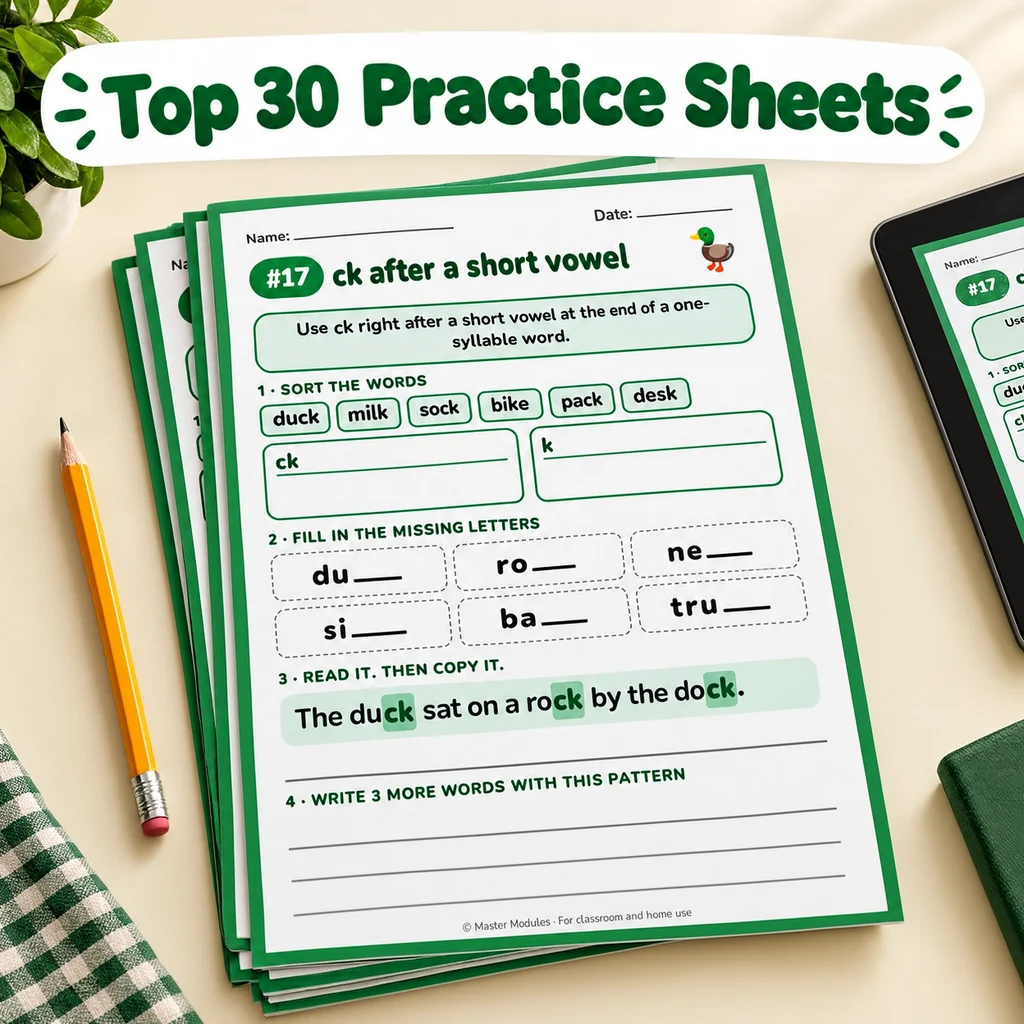
Phonics & Spelling Rules Posters has a poster for each of the five magic e patterns (a_e, i_e, o_e, u_e with its two sounds, and e_e), plus a poster for the five jobs of silent e. They are part of a set of 130 posters, each with the rule in plain language, six example words, a contrast and a decodable sentence, in color and black & white at full-page, half-page and mini sizes.