The FLOSS Spelling Rule and the Words That Break It
The FLOSS rule says: in a one-syllable word with one short vowel, double the final f, l, s or z. That is why we write puff, bell, kiss and buzz, not puf, bel, kis and buz. The name is a memory aid. The letters F, L, S and S (plus Z, which behaves the same way) are the ones that double. This guide shows what the rule covers, where it stops, and which common words refuse to follow it.
The rule in plain language
Look at three things at the end of a word:
- It has one syllable.
- It has one vowel, and the vowel is short.
- It ends with the sound /f/, /l/, /s/ or /z/.
If all three are true, double the final letter.
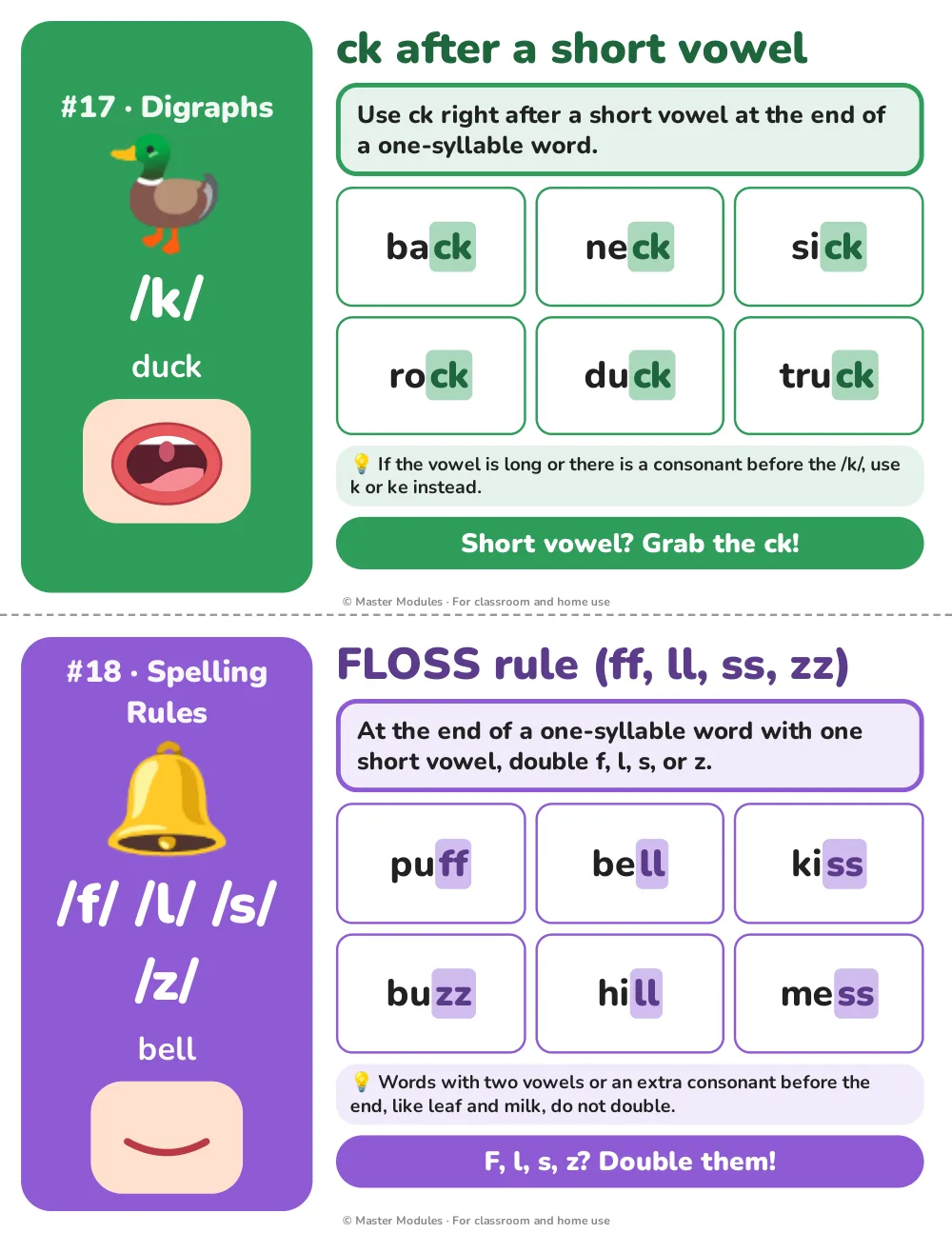
| Letter | Doubled | Examples |
|---|---|---|
| f | ff | puff, stuff, cliff, staff, sniff |
| l | ll | bell, hill, doll, spell, shell |
| s | ss | kiss, mess, miss, moss, class |
| z | zz | buzz, fizz, jazz, fuzz |
A teacher's shorthand: "short vowel, doubled friend."
Why English does this
Short vowels like to be "closed in" by consonant sounds. Doubling the last consonant gives a short, solid ending: hill and not hil. It also keeps English words from looking like they end in a bare short vowel. The same idea sits behind the ck rule for /k/. Together, ck, FLOSS, -tch and -dge cover many of the most common one-syllable word endings.
Where the rule stops
Long vowels. A long vowel gives you a single letter: size, not sizz; loaf, not loaff; rose, not ross. Compare buzz and puff, where the vowel is short.
Consonants before the ending. If a consonant sits before the final sound, the rule does not apply: self, milk, pulse, wolf. Words like golf and elf have a consonant (l) in front of the f, so a single f is right.
Longer words. The rule belongs to one-syllable words. In animal or carpenter the endings behave differently. When you add a suffix, a different doubling rule decides (see the 1-1-1 doubling guide).
The words that do not follow it
Teachers get this question all the time: "What about bus?" Most of the exceptions are very frequent little words, which is why children notice them early.
| Word | What happens |
|---|---|
| if, of | one f, even though the vowel is short |
| bus, gas, yes, us, plus | one s |
| is, his, as, has, was | the s says /z/ and stays single |
| this | one s |
| quiz, whiz | one z; the qu or wh has its own story |
| pal, gal | one l |
Notice that many of these are among the first words children read. A good way to teach them is to separate the rule words from the exception words:
- Rule words can be sounded out and spelled by pattern.
- Exception words go on a short list that gets reviewed a few times a week.
That approach is more honest than telling kids the rule "always works". A rule that has a short, clear list of exceptions is a rule worth teaching.
-all, -oll and -ull: the cousins
Doubled l has a few special partners:
- -all says /ol/, as in ball, tall, fall, wall, call, small. The a changes sound. Exceptions: shall.
- -oll appears in doll (and toll, roll with their own sounds).
- -ull appears in bull, full, pull.
Those rules deserve their own mini lesson, because the vowel sound differs from the plain short vowel. Teach them after the basic FLOSS rule is secure.
How to teach the FLOSS rule in 10 minutes
- Show two columns. Write puff, bell, kiss, buzz on the left and if, of, bus, gas on the right. Ask what is different.
- Check the three conditions. One syllable? One short vowel? Ends in f, l, s or z?
- Sort word cards. Mix rule words and exception words. Kids sort and say why.
- Spell by ear. Dictate stiff, shell, glass, fizz. Dictate bus and if and ask what to do.
- Read it in a sentence. "The bell and the buzz made the cat hiss." Circle the doubled letters.
Common errors and what they mean
- **Writing bel or kis.** The child has not noticed the rule yet. Have them check the three conditions.
- **Doubling after a long vowel (loaff).** The child is over-applying. Ask: "Is the vowel short?"
- **Doubling after a consonant (milll).** Ask whether another consonant is already closing the word.
- **Treating bus as a mistake.** Make a "rule breakers" list and let kids add to it.
Why exceptions are worth teaching openly
Children notice exceptions faster than adults expect. A child who has just learned that puff and bell double their last letter will spot if and bus within days and wonder if the rule is broken. Naming the exception list up front turns that doubt into a strength: the rule is real, it has a small boundary and the boundary is known. It also gives kids a model of how English works, where a pattern can cover hundreds of words and still leave a short list of oddballs that simply have to be remembered.
Mastery check
A child has the rule when they can do all three without help: spell ten FLOSS words by ear, say why bus is not spelled buss, and explain in one sentence why loaf does not have two f's. For more on the structure of the whole spelling system, see the full list of phonics and spelling rules.
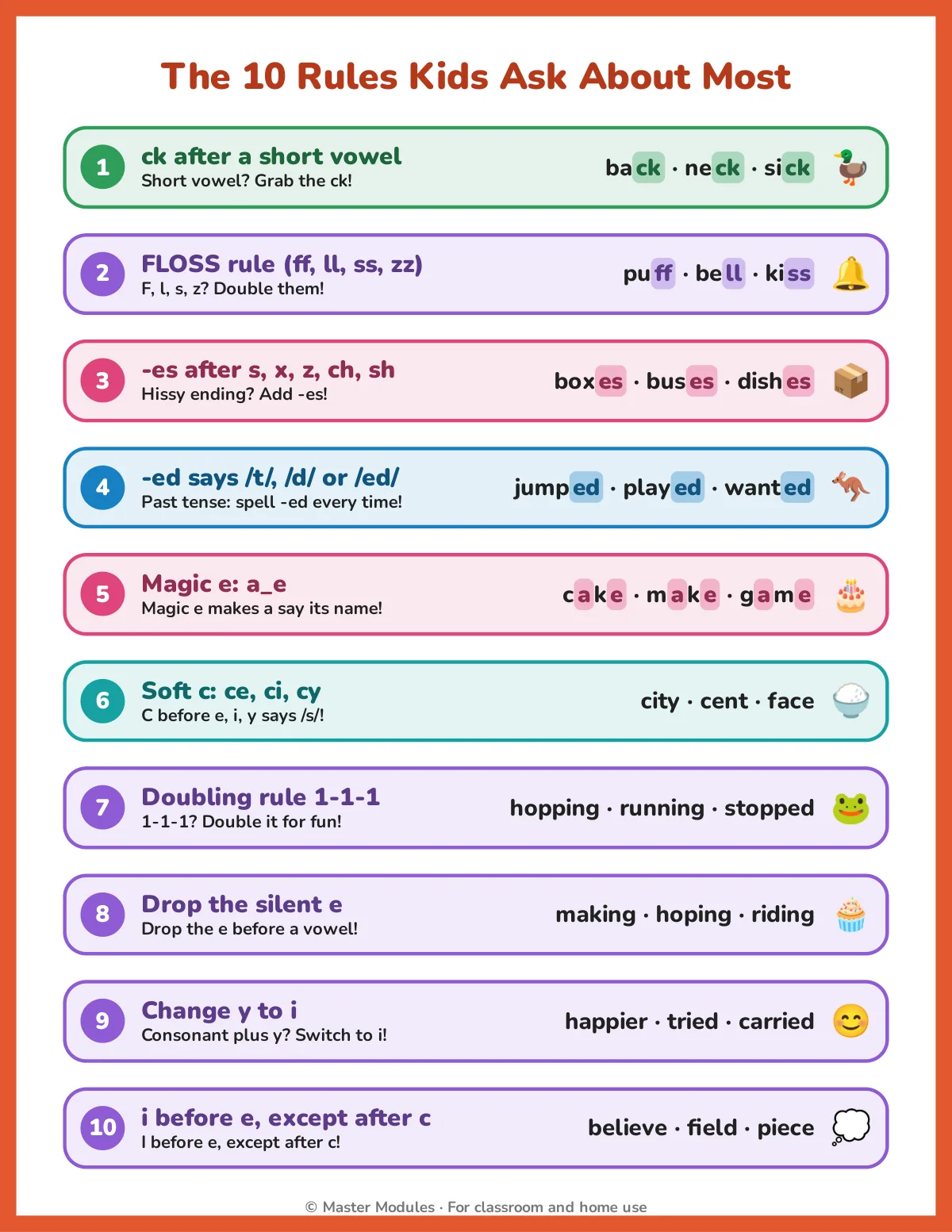
A poster for this rule and for -all, -oll, -ull
Phonics & Spelling Rules Posters has a FLOSS poster (ff, ll, ss, zz) and a separate poster for -all, -oll and -ull. Each has the rule in plain language, six example words, a short list of exceptions and a decodable sentence, in color and black & white, at full page, half page and mini size. The posters are part of a set of 130, so the same format carries over to the ck rule, the -tch rule and the rest.