How to Set Up a Sound Wall in Your Classroom
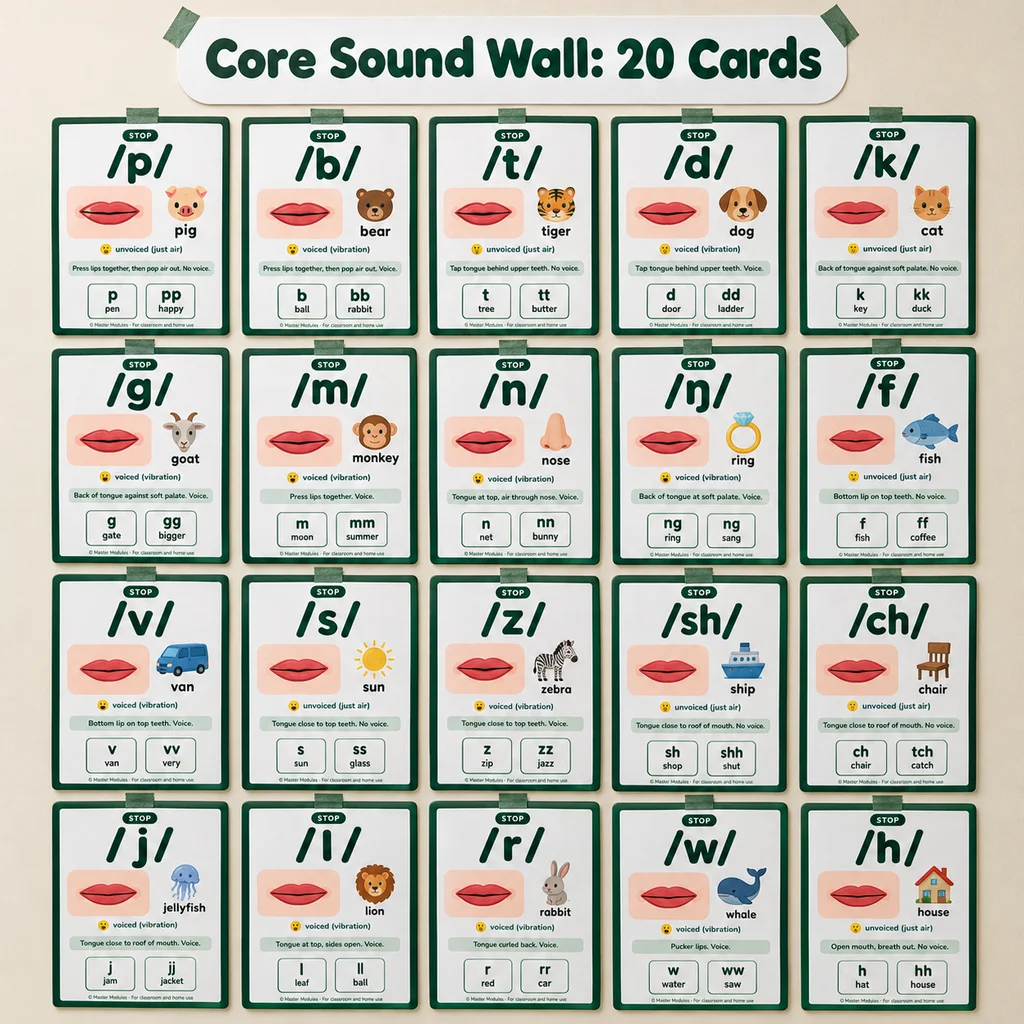
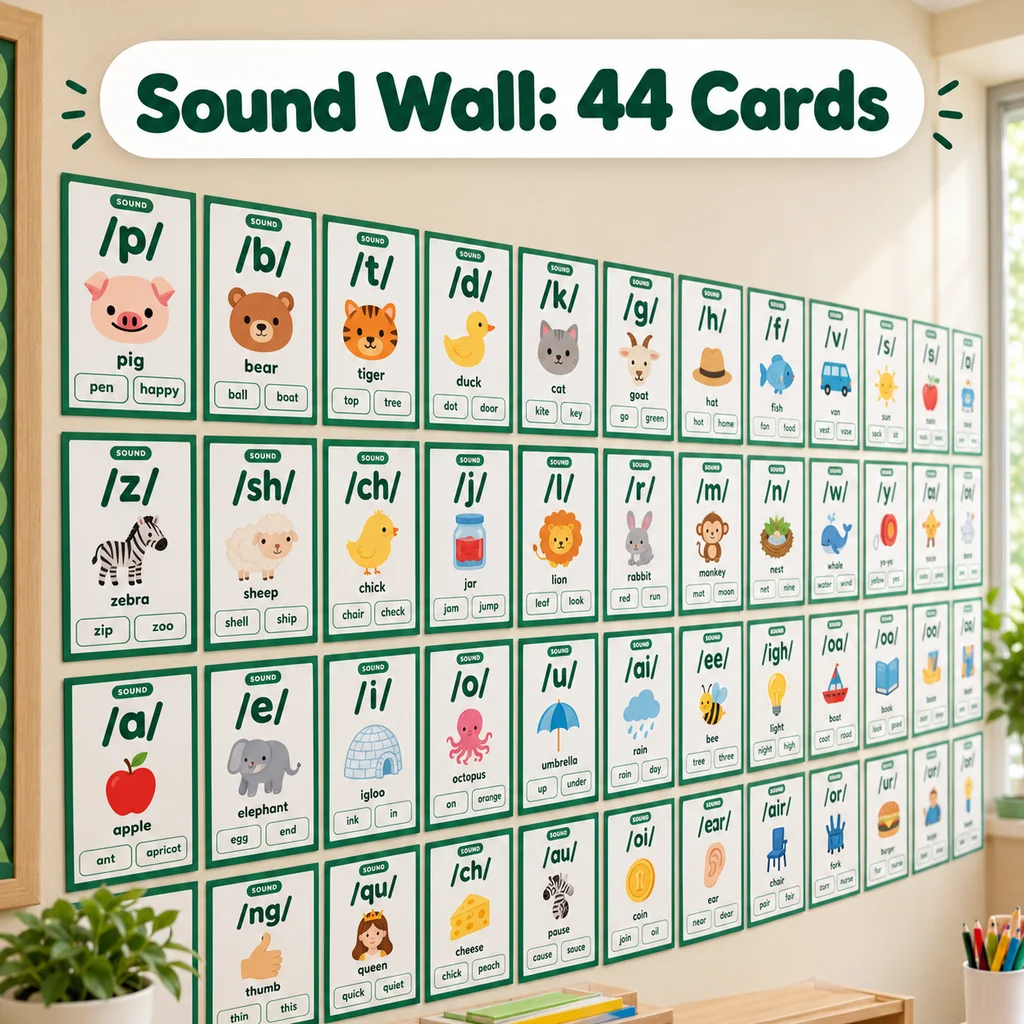
A sound wall is a classroom display organized by sounds, not letters. Each of the 44 sounds in English gets a card with a keyword, a picture, a note on how the mouth makes the sound and the spellings that can stand for it. Students use the wall to answer two questions: "What sound do I hear?" and "How can I write it?" This guide shows how to build one, where to put it and how to use it every day.
What goes on a sound wall
A complete sound wall has four parts.
- Sound cards. One for each sound: 24 consonant sounds and 20 vowel sounds.
- A keyword and picture. For example /p/ with pig, /b/ with bat, /sh/ with ship.
- A mouth cue. A drawing or photo and a short description. For /p/: "Press lips together, then pop air out. No voice."
- Spellings. The common ways to write the sound with an example word. The /k/ card, for example, lists c (cat), k (kit), ck (duck) and ch (school).
The point is that a sound can be written in more than one way. The wall shows the choices.
Sound wall versus word wall
| Word wall | Sound wall | |
|---|---|---|
| Organized by | first letter | speech sound |
| Starts from | the letter | what the child hears |
| Helps with | spelling known words | encoding and decoding new words |
| Shows | whole words | sounds, mouth positions and spellings |
Many classrooms keep both. The word wall holds high-frequency words; the sound wall teaches the system behind spelling.
How to organize the wall
Consonants by how they are made. Group them by where the mouth does the work: lips together (/p/, /b/, /m/), teeth on lip (/f/, /v/), tongue between teeth (the two /th/ sounds), tongue behind teeth (/t/, /d/, /s/, /z/, /n/, /l/), and back of the tongue (/k/, /g/, /ng/). Within a group, pair a voiced and unvoiced sound: /p/–/b/, /f/–/v/, /s/–/z/, /k/–/g/.
Vowels in a mouth-shaped arrangement. Many teachers place vowels from the widest open mouth to the smallest, so students can feel the jaw move. Short vowels come first, then long vowels, then the glides (/ow/, /oi/) and the r-controlled sounds (/ar/, /or/, /er/, /air/, /eer/).
Place it where kids can reach it. Put the wall at child eye level, near the reading area or the whiteboard. Cards should be big enough to read from a few feet away.
Set it up in five steps
- Pick a spot at eye level, wide enough for 44 cards in rows.
- Choose a sequence. Start with the sounds you are teaching, not the entire wall. Add cards as you go.
- Print and mount the cards. Laminate for durability.
- Add spellings gradually. Start with the main spelling, then add the others as students learn them.
- Model every day. Point to the wall during reading and writing lessons.
Start small if you teach kindergarten
You do not need all 44 sounds in September. A core set of about 20 common sounds (the early consonants /p/, /b/, /t/, /d/, /k/, /g/, /f/, /s/, /sh/, /ch/, /m/, /n/, /l/, /r/, /h/ and the five short vowels) covers the first weeks of decoding. Add the rest when the lessons reach them. The 44-sound set is the destination, not the starting point.
Daily routines that make the wall work
- Sound check (2 minutes). Point to a card, say the sound, and have kids copy your mouth.
- Mouth watch. Pairs say a sound while looking in a small mirror. Which part moves?
- Tap and spell. Say a word, tap out the sounds, and find each one on the wall.
- Which spelling? Show a sound with three spellings. Ask which one fits rain, day or eight.
- Fix-it. Show a misspelled word and use the wall to correct it.

Connecting the wall to spelling rules
A sound wall tells students which spellings are possible. A spelling rule tells them which one to choose. For example, the /k/ card shows c, k, ck and ch. The rule posters explain that ck comes after a short vowel (see the ck guide), c comes before a, o and u, and k before e, i and y. Using both together is stronger than either one alone. The 44-sound chart lists all the sounds and their spellings in one table.
How the Phonics & Spelling Rules Posters connect
The 130 Phonics & Spelling Rules Posters in this set cover the rules that decide between spellings. A separate product from the same maker, the 44-Sound Sound Wall with Mouth Pictures, covers the sound cards: one card for each of the 44 sounds, each with a mouth picture and a mouth cue. A reduced Core 20 version is also sold separately. Neither is included in the main poster set, which is a collection of 260 posters (130 rules, each in color and black & white), an Index of All 130 Rules, a Quick-Start Teacher Guide, 130 decodable sentence cards, a 36-week planner and more.
Teachers who use both can hang the sound wall at the front for sound-by-sound work and keep the current rule poster beside it. For a guide to choosing and sizing posters, see how many phonics posters a classroom needs.