Heart Words: What They Are, How to Teach Them and a List by Stage
Heart words are common words with at least one part that does not follow the letter-sound patterns a child has been taught. The, was, said, of and you are classic examples. The name comes from a simple idea: you work out the regular parts by sounding them out, and you learn the tricky part by heart.
That second half matters. A heart word is rarely 100 percent irregular. In said, the s and the d are regular. Only the middle is unusual, because ai makes the short e sound. Teaching the word this way lets a child use what they know and focus memory on one small spot.
Heart words vs. sight words
The two terms are often used as if they mean the same thing, and they overlap. The difference is in the method.
| Sight-word approach | Heart-word approach | |
|---|---|---|
| Unit | The whole word | The tricky part of the word |
| Method | Memorize the word shape | Sound out the regular letters, mark the unusual one |
| Typical tool | Flash cards | Tap the sounds, then circle or heart the tricky part |
| Message to the child | "Just know this one" | "Most of this word works. One part is a surprise" |
A heart-word approach keeps the child using phonics even on irregular words, which is the habit you want them to keep.
Why heart words depend on the stage
A word is only "tricky" relative to what a child has been taught. Go is irregular for a child who has only met short vowels, because o says its own name here. Later, when long vowel sounds have been taught, the same word is no longer much of a surprise.
That is why good materials introduce heart words in a planned order, a few at a time, as the stories need them. A decodable text should never ask a child to read a tricky word that has not yet been taught. If it does, the child is back to guessing.
Heart words by stage
This is the list used in The Decodable Readers Library. Each stage adds new words, and earlier ones stay in use.
| Stage | Name | New heart words |
|---|---|---|
| 1 | First Sounds | the, a, I, is, to, and, his, has |
| 2 | All Short Vowels | of, was, you, he, she, we, me, be, said, are, do, no, go, so |
| 3 | Digraph Detectives | they, what, where, there, here, one, two, put, want, come, some, look |
| 4 | Blend Builders | have, give, live, who, from, your, were, could, would, should, many, any |
| 5 | Magic E | done, gone, love, once, other, mother, brother, friend, again, only |
| 6 | Long Vowel Teams | water, because, does, great, eye, people, very, every |
| 7 | Bossy R | word, work, world, learn, early, heart, door, floor |
| 8 | Sound Twins | through, thought, laugh, busy, pretty, sure, half, walk, talk |
| 9 | Big Word Readers | beautiful, special, favorite, enough, answer, different, together, usually, clothes, their, whole, young |
Two things stand out when you read the table. First, the count per stage is small: from 8 to 14 words. Second, the words arrive when the stories need them, so where and there turn up with the digraph stage and because and people with the long vowel teams.
A one-minute routine for teaching a heart word
Use this routine for each new word. It takes about a minute and works at the kitchen table.
- Say it. You say the word, and your child says it back.
- Tap it. Tap a finger for each sound: s - ai - d.
- Find the heart. Ask which part is the surprise. In said, it is the middle: ai says /e/ here.
- Write it. Trace the word with a finger, then write it from memory, marking a small heart over the tricky part.
- Use it. Say a sentence that uses the word: "She said hello."
A short exchange might sound like this.
You: This word is said. Let's tap it. /s/ /ai/ /d/. Which part is tricky? Child: The middle! It says /e/. You: Right. Let's put a heart on the tricky part.
How to practice heart words at home
Ten seconds here and there beats a long drill. These ideas fit into an ordinary day.
- In the stories. The best practice is seeing the word in a real sentence. When the story repeats the word, the child reads it again in context.
- Quick checks. While waiting for dinner, show two or three words from the current stage and ask for the tricky part of each.
- Write one a day. Pick a word, say it in a sentence, and have your child write the sentence.
- Hunt in print. Look for the day's word on a cereal box, a sign or a library book.
- Review a few, not many. Cycle through the words from the current stage and the one before.
What to do when a child mixes up a heart word
Children often confuse look-alike words such as were and where, or there and they. Treat each confusion as a prompt to look at the tricky part, not as a failure. Ask, "Which letters are different?" and "Which part is the surprise in this one?" Then re-read the sentence.
If a child keeps mixing up a pair, separate the two words for a while. Teach one thoroughly, use it in stories for a week, then bring the other back.
How the library teaches heart words
In The Decodable Readers Library, heart words appear in heart-shaped boxes on every warm-up page, so the child sees them before the story starts. The story then repeats them, and the Parent Guide spells out the one-minute routine above. Because the words are introduced in the stage order shown in the table, a child does not meet a tricky word in a story before it has been taught.
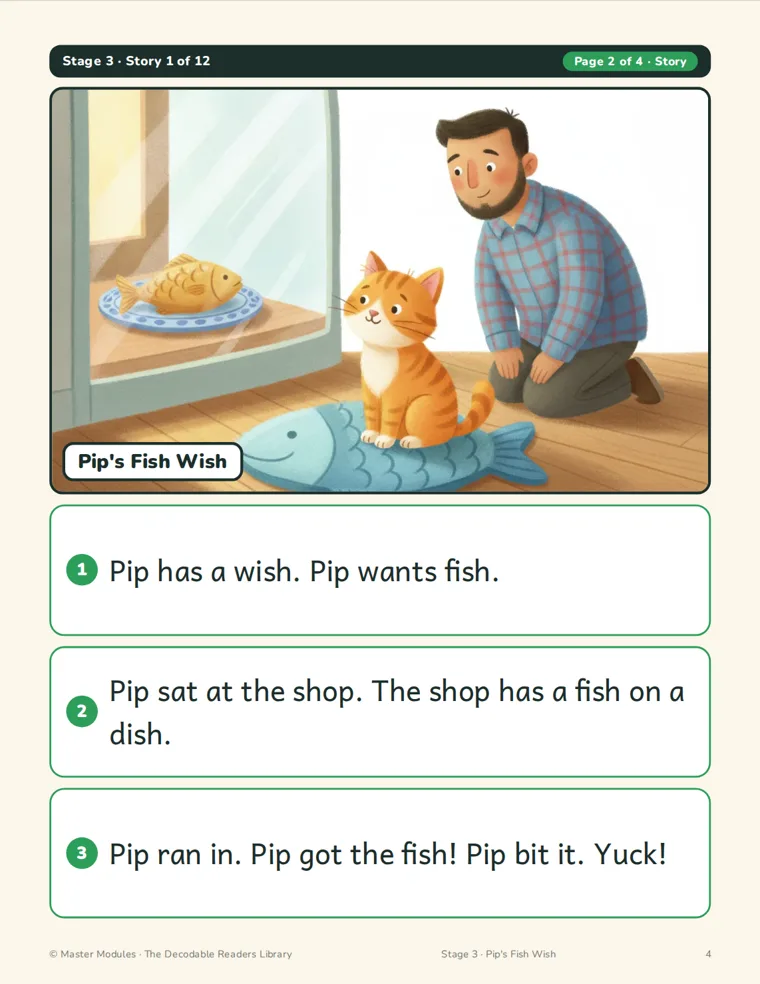
There are 108 stories across 9 stages, and a 3-Minute Placement Test that tells you which stage to begin with, so you can skip words your child already knows.
To see how heart words fit with the rest of the phonics order, read the phonics scope and sequence guide. If you are new to the idea of text that only uses taught patterns, start with what decodable books are. For a tour of the stages, see decodable readers: the 9 stages, and for the skill that comes before most heart words, how to teach blending.