Phonics Chart: The 44 English Sounds and Their Spellings
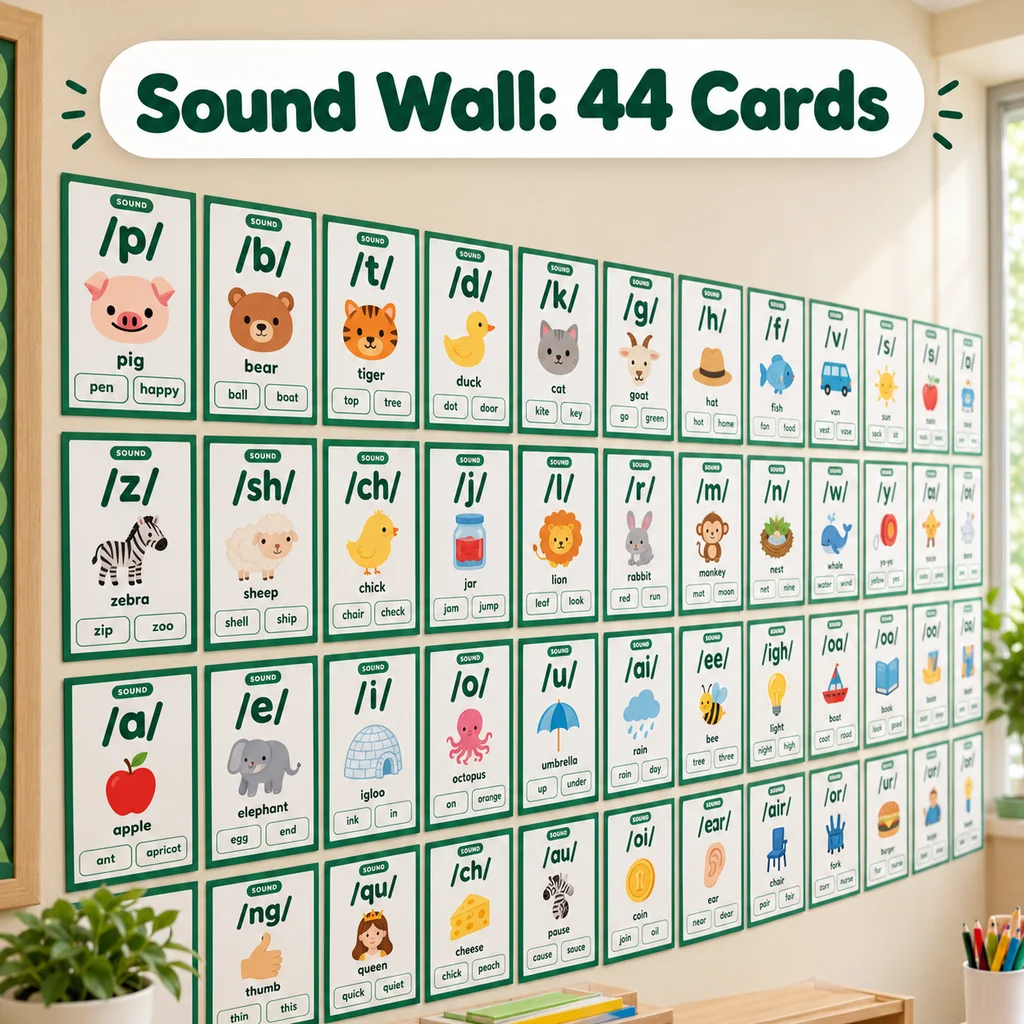
English has about 44 speech sounds, and each one can be written in more than one way. The chart below lists all 44 in two tables, consonants and vowels. For each sound you get a keyword and the common spellings with an example word. Use it as a quick look-up when a child hears a sound and needs a spelling, or when you are planning which patterns to teach.
How to read the chart
- A sound is shown between slashes, like /sh/. That is what you say, not what you write.
- The bold letters are the spelling. The word in brackets is an example.
- A spelling with an underscore, like a_e, means the letters are split by a consonant (as in cake).
- The first spelling listed is usually the most common one.
The 24 consonant sounds
| Sound | Keyword | Common spellings |
|---|---|---|
| /p/ | pig | p (pen), pp (happy) |
| /b/ | bat | b (bat), bb (rabbit) |
| /t/ | top | t (top), tt (letter), ed (jumped) |
| /d/ | dog | d (dog), dd (puddle), ed (played) |
| /k/ | cat | c (cat), k (kit), ck (duck), ch (school) |
| /g/ | goat | g (goat), gg (egg), gu (guess) |
| /f/ | fish | f (fish), ff (puff), ph (phone), gh (laugh) |
| /v/ | van | v (van), ve (give) |
| /th/ | thumb | th (thumb) |
| /th/ (voiced) | this | th (this) |
| /s/ | sun | s (sun), c (city), ss (kiss) |
| /z/ | zebra | z (zebra), s (dogs), zz (buzz) |
| /sh/ | ship | sh (ship), ti (nation), ci (special) |
| /zh/ | vision | si (vision), s (measure), ge (beige) |
| /h/ | hat | h (hat), wh (who) |
| /ch/ | chip | ch (chip), tch (catch), t (picture) |
| /j/ | jam | j (jam), g (giant), dge (badge), ge (cage) |
| /m/ | moon | m (moon), mm (hammer), mb (lamb) |
| /n/ | nest | n (nest), nn (dinner), kn (knee), gn (gnat) |
| /ng/ | ring | ng (ring), n (pink) |
| /l/ | leaf | l (leaf), ll (bell), le (table) |
| /r/ | rabbit | r (rabbit), rr (berry), wr (write) |
| /w/ | web | w (web), wh (whale), u (queen) |
| /y/ | yo-yo | y (yes), i (onion) |
Some points to notice:
- /k/ has four spellings in this chart, including the ck in duck, which depends on the vowel before it. See the ck guide.
- /j/ is written j, g, dge or ge. Choosing between them follows rules too.
- /th/ has two sounds, one voiced (this) and one unvoiced (thumb), both spelled th.
- /ng/ is written ng, and n before k (pink).
The 20 vowel sounds
| Sound | Keyword | Common spellings |
|---|---|---|
| /a/ | apple | a (apple), ai (plaid) |
| /e/ | egg | e (egg), ea (bread), ai (said) |
| /i/ | igloo | i (igloo), y (gym) |
| /o/ | octopus | o (octopus), a (swan) |
| /u/ | umbrella | u (umbrella), o (son), ou (touch) |
| /ā/ | cake | a_e (cake), ai (rain), ay (play), eigh (eight) |
| /ē/ | tree | ee (tree), ea (leaf), y (happy), e (me) |
| /ī/ | kite | i_e (kite), igh (light), y (fly), i (tiger) |
| /ō/ | boat | o_e (home), oa (boat), ow (snow), o (go) |
| /yoo/ | cube | u_e (cube), ue (rescue), ew (few), u (music) |
| /oo/ (moon) | moon | oo (moon), ue (blue), u_e (rule), ew (grew) |
| /oo/ (book) | book | oo (book), u (put), ou (could) |
| /ow/ | cow | ow (cow), ou (house) |
| /oy/ | coin | oi (coin), oy (boy) |
| /aw/ | paw | aw (paw), au (haul), a (ball), o (off) |
| /ar/ | car | ar (car), a (father) |
| /or/ | corn | or (corn), ore (store), oar (roar), our (four) |
| /er/ | bird | er (fern), ir (bird), ur (turn), or (work) |
| /air/ | chair | air (chair), are (care), ear (bear), ere (there) |
| /eer/ | deer | eer (deer), ear (ear), ere (here) |
Some points to notice:
- The first five rows (/a/ to /u/) are the short vowels.
- The next five rows (/ā/ to /yoo/) are the long vowels. The sound /yoo/ is the long u.
- The two /oo/ rows are the vowel in moon and the vowel in book.
- The last five rows (/ar/, /or/, /er/, /air/, /eer/) are the r-controlled vowels. See the vowel teams guide for more on the teams in this table.
What the chart shows (and what it does not)
A sound chart lists the possible spellings. It does not tell you which to choose. That is the job of spelling rules: ck after a short vowel, ai in the middle and ay at the end, ge after a long vowel, and so on. A good routine pairs the two: look up the sound on the chart, then check the rule. The list of 130 rules is the second half of the system.
Ways to use the chart
- Plan your sequence. Tick the sounds and spellings you have taught. Blank spots show what is left.
- Diagnose spelling errors. If a child writes rane for rain, find /ā/ and show the choices, then use the rule for ai.
- Support multilingual learners. Some of these sounds do not exist in other languages. Highlight the ones a learner finds hard.
- Make a class chart. Let students add their own example words to a blank copy.
From chart to wall
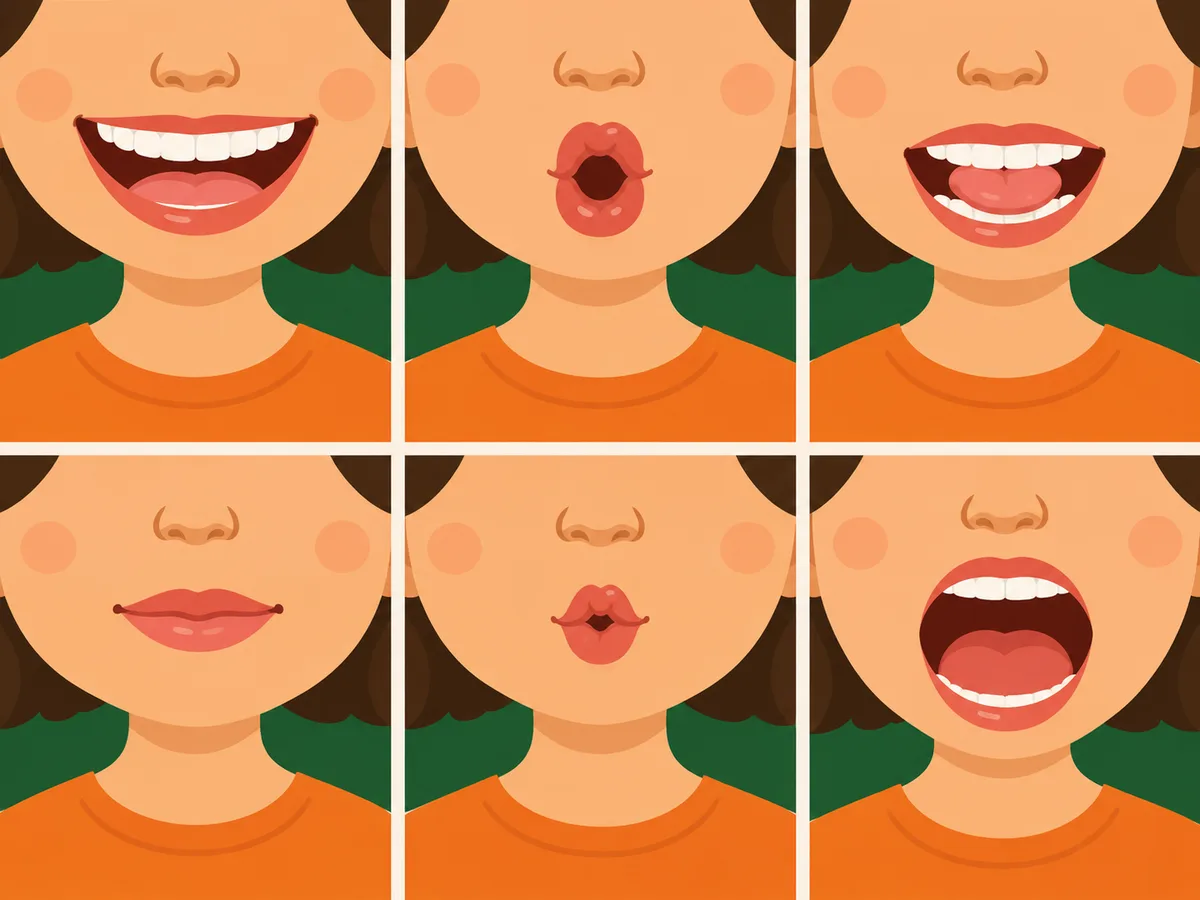
The same information can be turned into a classroom display. A sound wall puts one card for each sound on the wall, usually with a mouth picture and the spellings. The 44-Sound Sound Wall with Mouth Pictures is a separate add-on and is not part of the main poster set. The Phonics & Spelling Rules Posters cover the next layer: 130 rules that decide which spelling to use, plus an Index of All 130 Rules, a Quick-Start Teacher Guide and 130 decodable sentence cards.
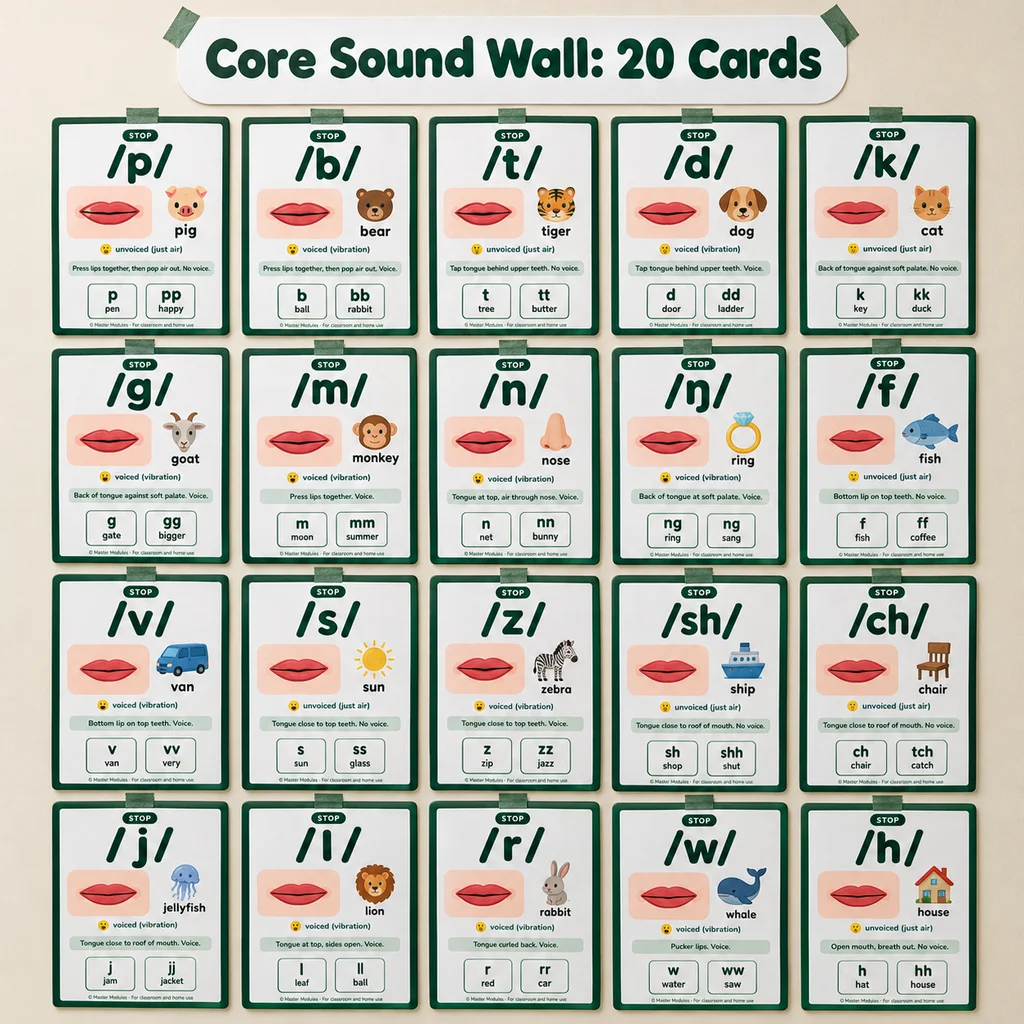
For help deciding how many posters to put up, see how many phonics posters a classroom needs.