A good phonics sentence repeats one spelling pattern so the child can hear it, see it and read it in context. Below are 36 sentences, grouped by rule, that you can read aloud, put on the board or use for dictation. Each is built around its target pattern, with a few everyday words (the, a, to, of) that children learn by sight. Use them as models for your own, or as a quick warm-up at the start of a lesson.
How to use a phonics sentence
Teach the rule first. Say the rule, show three words, then bring in the sentence.
Read it together. Point to each word. Read it once slowly, once at a normal pace.
Find the pattern. Ask kids to underline or circle every word with the target spelling.
Dictate it. Say the sentence in short chunks and let the kids write. Check spelling against the rule, not just against the page.
Change one word. Ask: how would we write it with rock instead of dock?
The point is to read connected text while the pattern is fresh. Sentences are a short step between single words and a full story.
Short vowels
Rule
Sentence
Short a
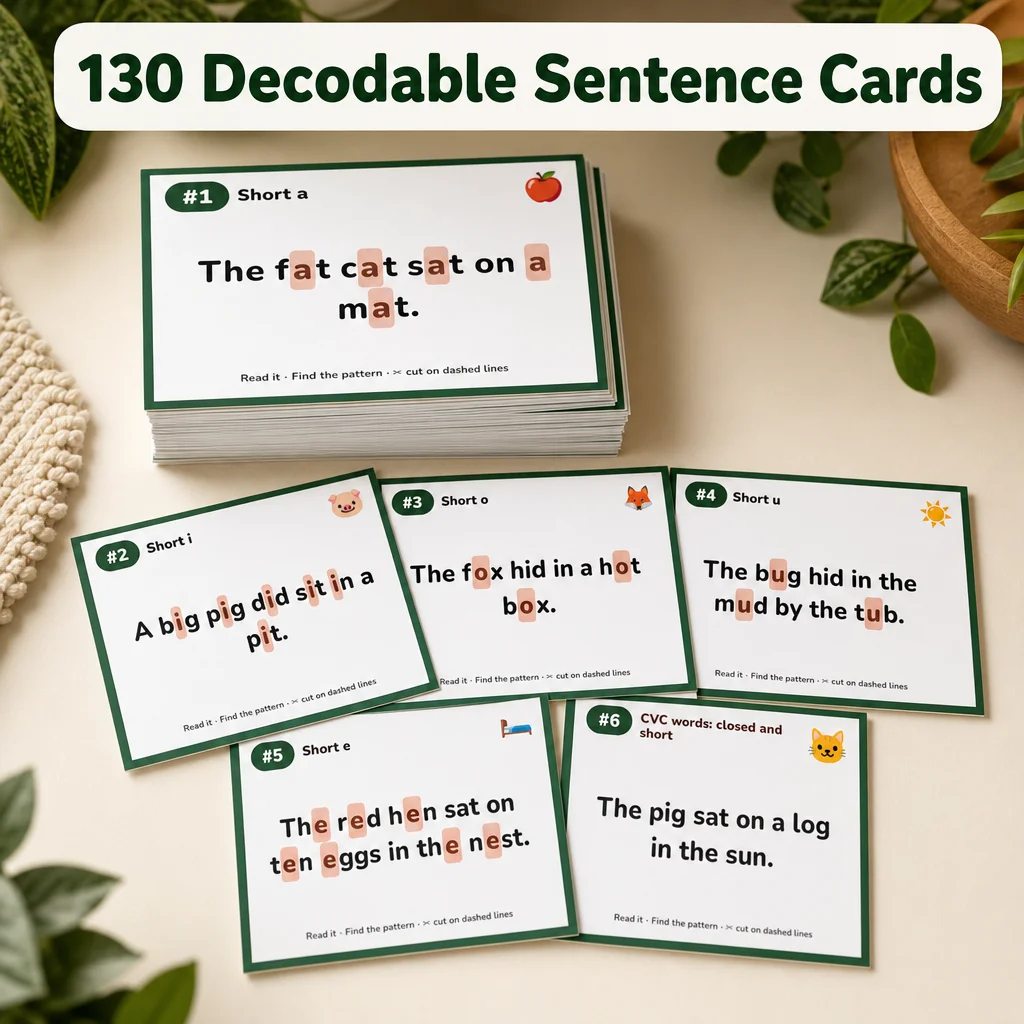
The fat cat sat on a mat.
Short e
The red hen sat on ten eggs in the nest.
Digraphs
Rule
Sentence
sh
The fish in the dish is fresh.
ch
The chick had a chat on a bench.
Endings that protect short vowels
Rule
Sentence
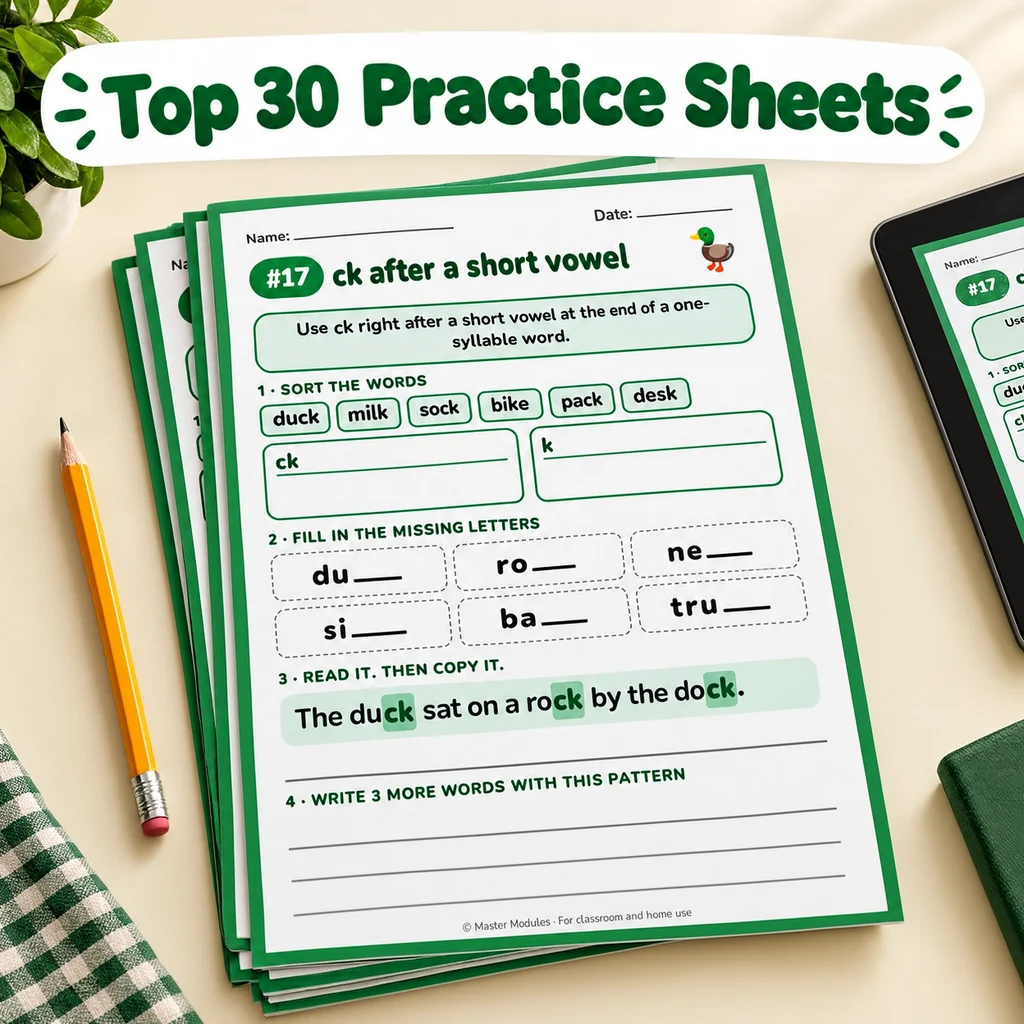
ck after a short vowel
The duck sat on a rock by the dock.
FLOSS (ff, ll, ss, zz)
Jill fell off the hill.
-all, -oll, -ull
The tall boy can call the small ball.
-tch after a short vowel
I can catch the ball and fetch a patch.
-dge after a short vowel
The judge sat on the edge of the bridge.
See the ck guide for the full rule behind the first of these.
Blends
Rule
Sentence
l-blends
Flip the black flag on the plank.
Magic e and soft c and g
Rule
Sentence
a_e
Jake can bake a cake at the lake.
i_e
I like to ride my bike in the sun.
Soft c
The mice ran in a circle in the city.
Soft g
The giant giraffe ate ginger at the gym.
Vowel teams
Rule
Sentence
ai in the middle
The snail got wet in the rain on the trail.
ay at the end
We play all day and stay out in the gray clay.
ee
The sheep sleep under the green tree.
ea says /ē/
Each team eats a peach on the beach.
igh
The bright light was high in the night sky.
oa in the middle
The goat in the coat sat in the boat.
oo (moon)
At noon we go to the zoo and swim in the pool.
oo (book)
The cook took a good look at the book.
ou says /ow/
The mouse ran round the house and out of sight.
ow says /ow/
The brown cow is in town.
oi in the middle
I put a coin in the soil by the oil can.
R-controlled vowels
Rule
Sentence
ar
A star shone far over the dark farm yard.
or
The horse ate corn on the porch.
er, ir, ur
The girl in the skirt fed the bird.
Syllables
Rule
Sentence
Closed syllable
The rabbit sat in a basket at the picnic.
V/CV division
The tiger will open the paper at the hotel.
Adding endings
Rule
Sentence
1-1-1 doubling
The frog was hopping and swimming in the big pond.
Drop the silent e
I am baking a cake and using lots of sprinkles.
Change y to i
The funniest clown carried a tiny puppy and tried to smile.
Suffix -ful
The helpful girl was thankful for the colorful gift.
Silent letters and tricky spellings
Rule
Sentence
kn and gn
The gnome tied a knot and knocked on my knee.
i before e, except after c
I believe my niece will receive a piece of pie.
Tips for writing your own
Pick one target pattern and use it three or four times.
Keep everything else simple. Use words your learners can already decode, plus a few sight words.
Make it make sense. A silly sentence is fine. A sentence with no meaning is not.
Keep it short. Eight to twelve words is plenty for early readers.
Check the contrast. If the rule is ck, add a word that does not follow it (milk) so children notice the boundary.
The 36 sentences above come from the same set as the Phonics & Spelling Rules Posters, which includes 130 Decodable Sentence Cards, one for every rule in the set. The cards sit alongside the 130 posters, the Index of All 130 Rules, the Quick-Start Teacher Guide and the other printable pieces. See the full rule list for the order the rules follow.
Frequently asked questions
What is a decodable sentence?
A decodable sentence is built mostly from words that follow the phonics patterns a child has already learned, so the child can sound it out instead of guessing. A few high-frequency words such as the, to and of are usually taught by sight.
How should I use phonics sentences?
Teach the rule, read the sentence together, then ask the child to find and underline the words with the target pattern. Finish with a dictation: say the sentence and let the child write it.
How many sentences does a child need per rule?
One well-built sentence is enough for a first read. Add more by changing one or two words, or asking the child to write their own using the same pattern.
When should children start reading full sentences?
As soon as they can blend sounds in single words. Start with short vowel sentences and add one new pattern at a time.