Decodable Passages vs. Decodable Stories: Which Does Your Reader Need?
Decodable passages and decodable stories are both made only from patterns a child has been taught, which makes them easy to confuse. The difference is in the form and the purpose. Passages are short, text-only pieces for fluency practice. Stories are illustrated mini-books with characters and a plot. This guide compares them and explains where each fits.
Side by side
| Decodable passages | Decodable stories | |
|---|---|---|
| Form | A paragraph or short block of text | A short illustrated book or packet |
| Pictures | Usually none | Illustrated, page by page |
| Main purpose | Fluency: speed, accuracy and expression | Applying phonics in a story; enjoyment and comprehension |
| Typical use | Timed or repeated readings | Read two or three times, then talk about it |
| Feel for the child | Practice drill | A small book to finish |
| Good for | Older beginners and fluency work | Kindergarten and first readers |
What passages are good at
A passage is compact. It can fit many words from a single pattern into a short block, which makes it handy for fluency drills. If a teacher wants to time one minute of reading and compare it over several weeks, a passage is a natural choice. Passages are also quick to print and easy to bundle into a binder for classroom use.
What stories are good at
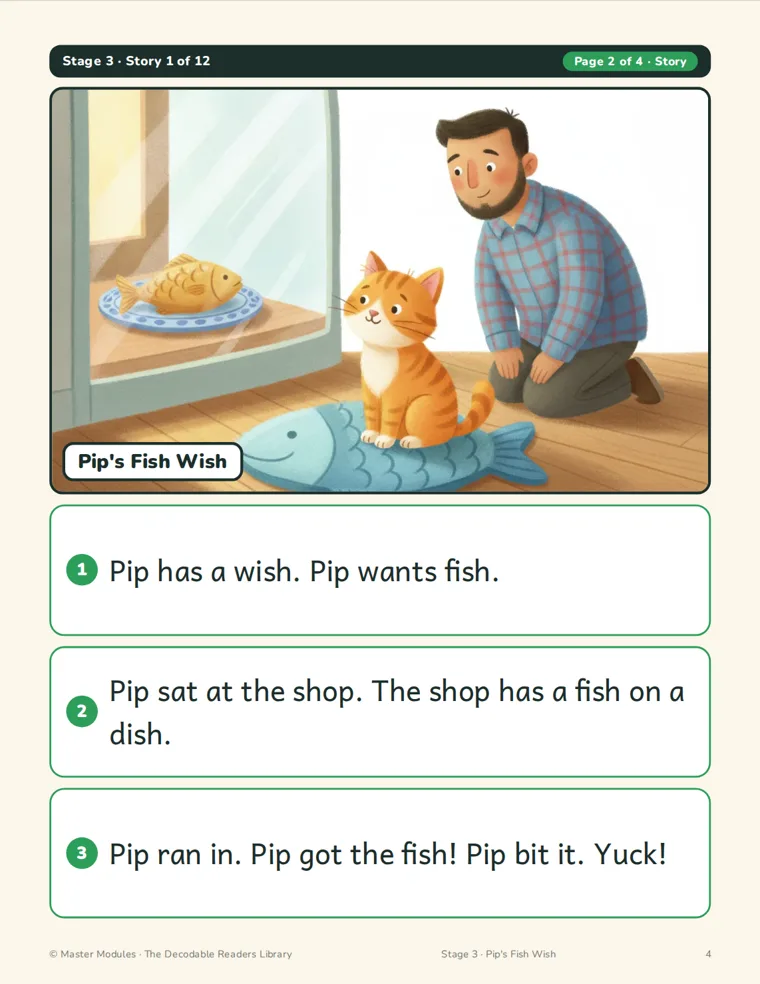
A story gives a child a reason to read to the end. A character, a small problem and a funny twist make rereading enjoyable. Pictures show the meaning of the story and give a reward after the reading. The questions afterward are about something the child cares about.
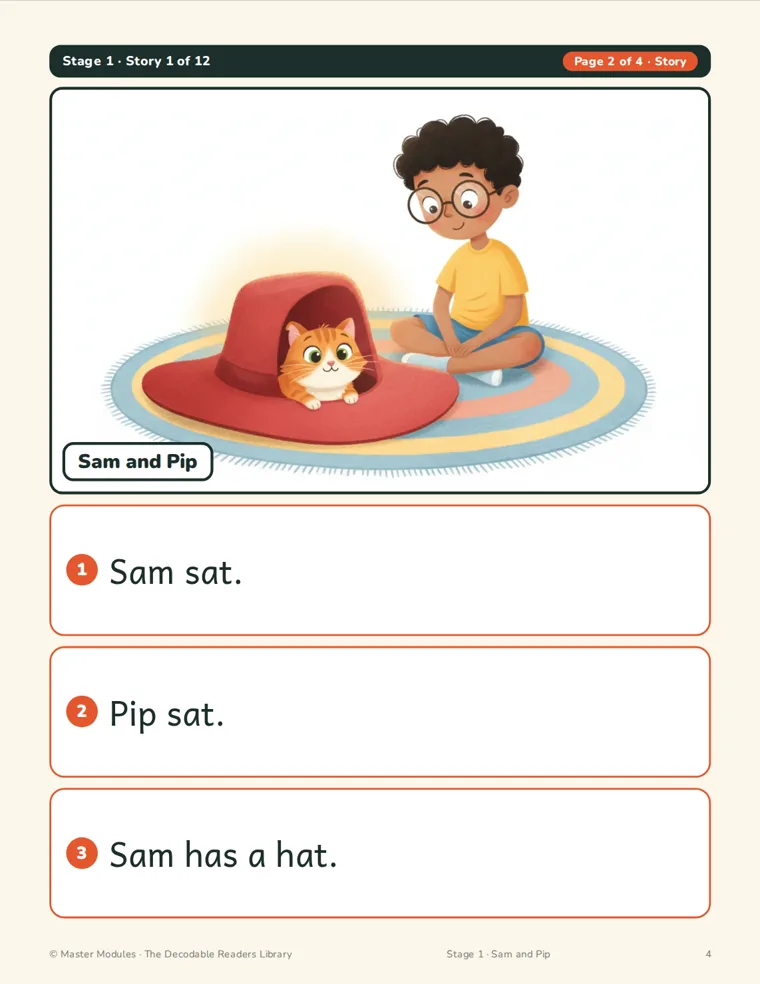
For a young child, that engagement matters. A five-year-old is more likely to reread a story about a hat that runs away than a paragraph of words with the same sound.
What to be aware of
- Passages with no pictures can feel dry to younger children.
- Stories with pictures invite a child to guess from the image. Cover the picture on the first read and let the child look at it afterward.
- Either form can be memorized if it is read many times. Use new-context activities, such as a word hunt, to check the child still reads the words.
What this library includes, and what it does not
The Decodable Readers Library contains stories, not separate fluency passages. The 108 stories are spread across 9 stages with 12 in each. Each story has six pages, and the number of words on a page rises by stage, from up to 12 on a Stage 1 page to up to 48 on a Stage 9 page.
It does not include a set of text-only fluency passages. If you want a bank of timed passages, you would need to add one from another source.
How the stories still build fluency
Fluency comes from repeated reading, and the stories are designed for it.
- Speed read. The warm-up page has a list of the story's words. The child reads the list three times and colors a star each time.
- Three readings. The Parent Guide describes a first read for accuracy, a second for smoothness and a third that should sound like talking.
- Weekly fluency log. The Progress Tracker includes a fluency log. Once a week, time one minute of a story the child has already read twice, and record the words read correctly and the mistakes.
- Rereading favorites. On Fridays, reread two old stories.
- New voices. Read in a whisper, a robot voice or a "Gran" voice, to make rereading fun.
The Parent Guide offers a reminder that applies to any text: speed is a result, not a goal. Never race a child.
Which should you choose?
| Your situation | Better fit |
|---|---|
| Kindergarten or first grade, learning to decode | Stories |
| You want a child to enjoy rereading | Stories |
| A classroom that times one-minute reads | Passages, or a story reread |
| An older student who needs targeted fluency drills | Passages |
| A child who learns best with pictures | Stories |
| You want both | Use stories for daily reading and add passages occasionally |
A simple fluency routine with a story
- Read the warm-up speed-read list three times.
- Read the story once for accuracy, with help as needed.
- Read it again for smoothness.
- On another day, read it a third time with expression.
- Once a week, time one minute and write the result in the fluency log.
Aim for a steady trend rather than a magic number, and celebrate progress.
For a wider view, see decodable vs. leveled readers and the pros and cons of decodable texts. To see how the stories are arranged, read decodable readers: the 9 stages, and for daily routines, reading practice for kindergarten.