Commercial Use Printable Activities for Kids: What the Licence Must Say Before You Sell
If you plan to sell anything made from someone else's elements, the commercial licence is the most important document you will read. For printable kids' activities such as word searches, mazes, jokes and coloring pages, it determines whether you may sell a finished product, use the artwork in mockups and offer the file as a digital download. This guide is general information, not legal advice, and it explains what to look for.
Why it matters
New sellers often assume that if they bought a pack of clipart or puzzles, they can sell anything made from it. That is not always true. Many packs are for personal use only. Others allow commercial use with limits. A few allow almost anything. A shop built on the wrong files can be removed, and the work behind it lost.
Reading a licence takes ten minutes. Rebuilding a shop takes weeks.
The five questions
1. May I sell finished products made with the elements?
This is the core question. "Commercial use" should say yes, and it should specify what a finished product is: a printed placemat, a PDF download, a bundle.
2. May I resell or share the elements themselves?
Almost always no. You may sell the placemat, but not the loose word searches and mazes as a pack for others to build with. Some sellers confuse these two and get into trouble. If the licence says "no resale of the files," that includes uploading them as a separate product.
3. Are there limits on volume or channels?
Some licences cap the number of copies, or forbid certain platforms. Look for "unlimited" or specific numbers.
4. Is attribution required?
Some licences ask for a credit line. Others do not. Know which.
5. What about fonts and images from other sources?
A kit may cover its own elements but not the fonts you add yourself. Check those separately.
What the licence in this kit says
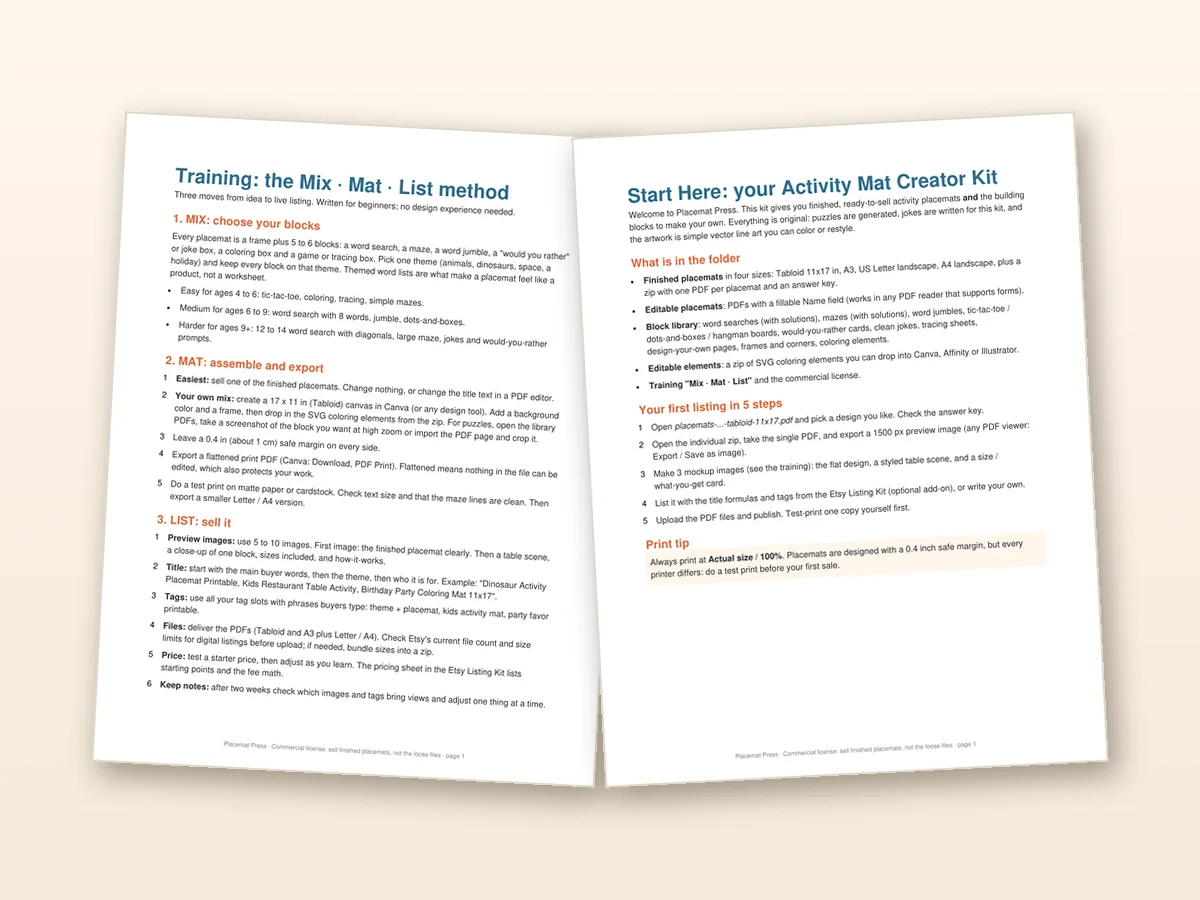
The Placemat Press · Activity Mat Creator Kit includes a commercial licence: you may sell finished placemats you make with the kit, whether printed or as a flattened PDF; you may not resell or share the kit or its loose elements. That means:
- Yes: a placemat PDF listed as a digital download.
- Yes: printed placemats you sell at a market.
- Yes: a bundle of finished placemats.
- No: the word search library as a pack.
- No: sharing the kit with a friend.
- No: uploading the SVG files as a product.
Always read the licence file itself, because it governs, not this summary.
Flattening: the practical rule
A flattened PDF is a finished page where the elements are merged into one image or document. A buyer cannot extract a maze and reuse it. This is the correct way to deliver a printable and it is what the licence is designed around. Export a flattened PDF, test it, then upload it.
Mockups and photos
Photos of your finished placemat are your marketing. If you use a stock mockup, check that it also allows commercial use. If you use the kit's artwork in a mockup, show the finished product, not a screenshot of the library.
Protecting yourself
- Keep a folder with the licence and the date you bought the kit.
- Note which elements you used in each product.
- Do not copy another seller's design.
- Do not use brand names, characters or logos in your products.
- Read marketplace rules about digital goods.
What to avoid claiming
Do not promise that buyers will make money, that children will learn specific skills or that a product is certified. Describe the product honestly. Leave out health or education claims you cannot support.
Questions to ask any seller of elements
- Where is the licence written?
- Does it say commercial use in plain words?
- What is forbidden?
- Can I see a sample?
- Is there a refund if I decide it is not right?
A short story of what goes wrong
A seller buys a bundle of 500 clip-art images for a few dollars, builds a set of coloring pages and lists them. A month later, a notice arrives: the images were for personal use only. The listing comes down, the effort is gone. The fix is easy: spend ten minutes on the licence before you spend ten hours on the product.
Where this fits in selling
Once you are comfortable with the licence, the rest is a process: build, photograph, list. Follow how to sell printables on Etsy, use the listing template guide and start with a placemat built from the template layout.
The kit costs $17.00, one time. It is a set of digital templates and guides. It does not promise income, and Etsy fees and rules change, so check their current terms. This guide is not legal advice.
A pre-listing licence audit you can do in fifteen minutes
Before you publish a product, run this short audit and write the answers down in a note you keep with the file.
- List every element used. Word search number, maze number, coloring element, joke, frame. If you cannot say where an element came from, take it out.
- Match each to a licence. Elements from the kit are covered by the kit's commercial licence. Fonts you added yourself are covered by their own terms. Any stock photo in your mockup has its own terms too.
- Check the output. Is the file you will deliver a flattened PDF? Can a buyer pull out one maze and reuse it as their own product? If yes, flatten it more.
- Check the wording of your listing. It should say the buyer gets the file for personal use and may not resell or share it. That protects you and the people whose work you used.
- Save the evidence. Keep the receipt, the licence file and a screenshot of the terms on the day you bought.
Sellers who do this once usually turn it into a habit, and it costs almost nothing. A shop built on clear licences also feels calmer to run: there is no background worry that a notice will arrive. When you later add a new theme or a new size, the audit takes five minutes because the elements and their licence are already documented. That is the quiet advantage of starting from a kit that states its commercial terms in plain words, rather than from a folder of files whose origin nobody remembers.