Activity Placemat Printable: How to Build One That Kids Actually Use
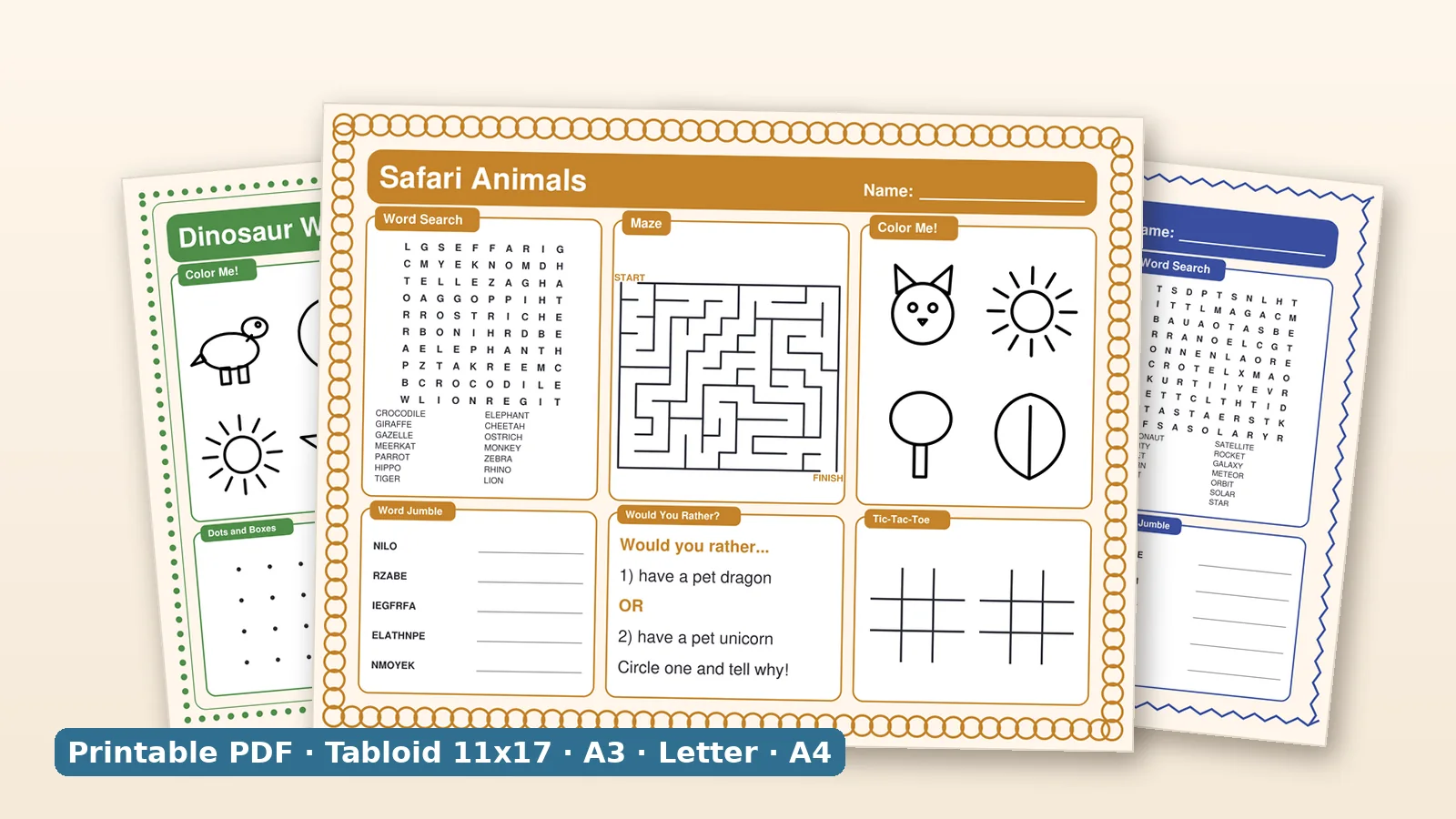
A good printable activity placemat is a mixed page: one big frame, four to six short activities, one theme. It sits under a plate at dinner, it comes out in the waiting room, and it gives an eight-year-old something to do for twenty minutes while the grown-ups finish a conversation. If you have ever wondered why the ones you see online look so polished, the answer is mostly structure, not talent. This guide walks through that structure so you can build one in an evening.
Why a placemat works better than a worksheet
A worksheet asks a child to sit down and do school. A placemat is already on the table, it is big, and it looks like a game. That difference matters. Children pick up a placemat without being asked because there is a maze in one corner and a joke in another, and nothing on it looks like homework.
The format also solves a practical problem. A single 11x17 sheet holds enough variety that a child who gets stuck on the word search can switch to coloring and come back later. You do not need to hand out a second page.
Think about where a placemat gets used:
- At home: breakfast, dinner, a rainy afternoon at the kitchen table.
- Out and about: restaurants, cafes, a family wedding table.
- In the classroom or at a party: a quiet table activity at the start of a session.
- In a shop: as a digital download that parents print at home.
The anatomy of a placemat
Every placemat in the Placemat Press · Activity Mat Creator Kit kit follows the same simple recipe, and you can copy it.
1. A frame
The frame is the border or the corner artwork that makes the page look finished. Without it, a pile of puzzles looks like a pile of puzzles. With a frame, it looks like a product. The kit includes 10 corner frames so you can match a frame to the season or theme.
2. A header area
Leave room at the top for a title such as "Dino Dig" or "Space Mission". An editable name field is the most loved detail, because a child who sees their own name on the mat will not want to put it down. The kit includes editable-name versions in Tabloid and landscape Letter.
3. Four to six activity blocks
A block is a self-contained activity that fits in a rectangle. Good blocks for a placemat are:
- a word search (the kit has 24 themed ones, each with an answer key);
- a maze (24 of them, sized for young kids);
- a word jumble (12 themed scrambles);
- a coloring element (23 simple line illustrations);
- a clean joke (40 in the library);
- a would-you-rather prompt (60 of them);
- a paper game such as tic-tac-toe, dots and boxes or hangman.
4. One quiet block
Every placemat needs one block that asks for no reading: a coloring corner, a draw-your-own prompt, a tic-tac-toe grid. That block is for the youngest child at the table.
A worked example: the Safari mat
Say you want a safari theme for kids aged 5 to 8. This is how the blocks go together:
| Position | Block | Why it is there |
|---|---|---|
| Top banner | Title and name field | Personal, instantly attractive |
| Top left | Animal word search | Reading and spelling practice |
| Top right | Jungle maze | Short, finishable challenge |
| Middle | Safari joke and would-you-rather | Gets a smile and a conversation |
| Bottom left | Coloring elephant | Quiet corner |
| Bottom right | Tic-tac-toe grid | Two-player moment |
That is six blocks, one theme, and it takes about as long to assemble as it takes to make a cup of tea. The kit ships with 12 finished mats built just like this (the safari, dino and space ones are among them), so you can see the logic and then make your own.
What size to print
Tabloid (11x17 inches) and A3 are the standard placemat sizes. They are big enough to hold the blocks without cramping the text. If you are printing at home on Letter or A4 paper, use the landscape version: it keeps the same blocks but at a smaller scale. The kit includes all four layouts, plus individual-page versions of the finished mats, so you do not have to rebuild anything for a different printer. For a deeper look at sizes, see the size guide.
Make it last
Printing on regular paper is fine for a one-off meal. If you want it to survive more than one dinner:
- Print on 100 gsm paper or light card.
- Laminate with a pouch laminator (or use clear self-adhesive sheets).
- Give the child a dry-erase marker so the mat can be wiped and reused.
Laminated mats are a good fit for car trips, because the answers can be erased and the same sheet goes back in the bag. Pair them with printable road trip games for a full screen-free trip kit.
Keeping it age-appropriate
A placemat for a four-year-old and one for a ten-year-old should not look the same. Use this quick rule:
- Ages 3 to 5: big coloring areas, simple mazes, no reading. Maybe one match-the-shape block.
- Ages 6 to 8: word searches with short words, jumbles, jokes, tic-tac-toe.
- Ages 9 to 12: longer word lists, harder mazes, would-you-rathers that need an explanation.
If you want age-by-age ideas beyond placemats, printable activities by age goes deeper.
From a single mat to a collection
Once you have one mat that works, a theme set is easy: change the frame, change the words in the word search, swap the joke. A set of four seasonal mats takes the same effort as one when the blocks are ready-made. That is the idea behind the Mix, Mat, List system: mix a handful of blocks, mat them into a frame, then list or use the result.
What this kit gives you
Placemat Press · Activity Mat Creator Kit is a set of digital templates and guides: 349 commercial-use elements, 10 corner frames, 12 finished placemats in four sizes, a Start Here guide and a listing template. It is a one-time purchase at $17.00. You print the mats yourself, or, with the commercial licence, you can sell the finished placemats you make. You cannot resell or share the kit or its loose elements.
Quick checklist before you print
- Is there a title and a name field?
- Are there four to six blocks, not ten?
- Is there one block that needs no reading?
- Does the frame match the theme?
- Did you test-print a draft at actual size?
Run through those five and your first placemat will look like it came from a shop, because it follows the same layout as the ones that do.