Printable Activities for Kids by Age: Ages 3–5, 6–8 and 9–12
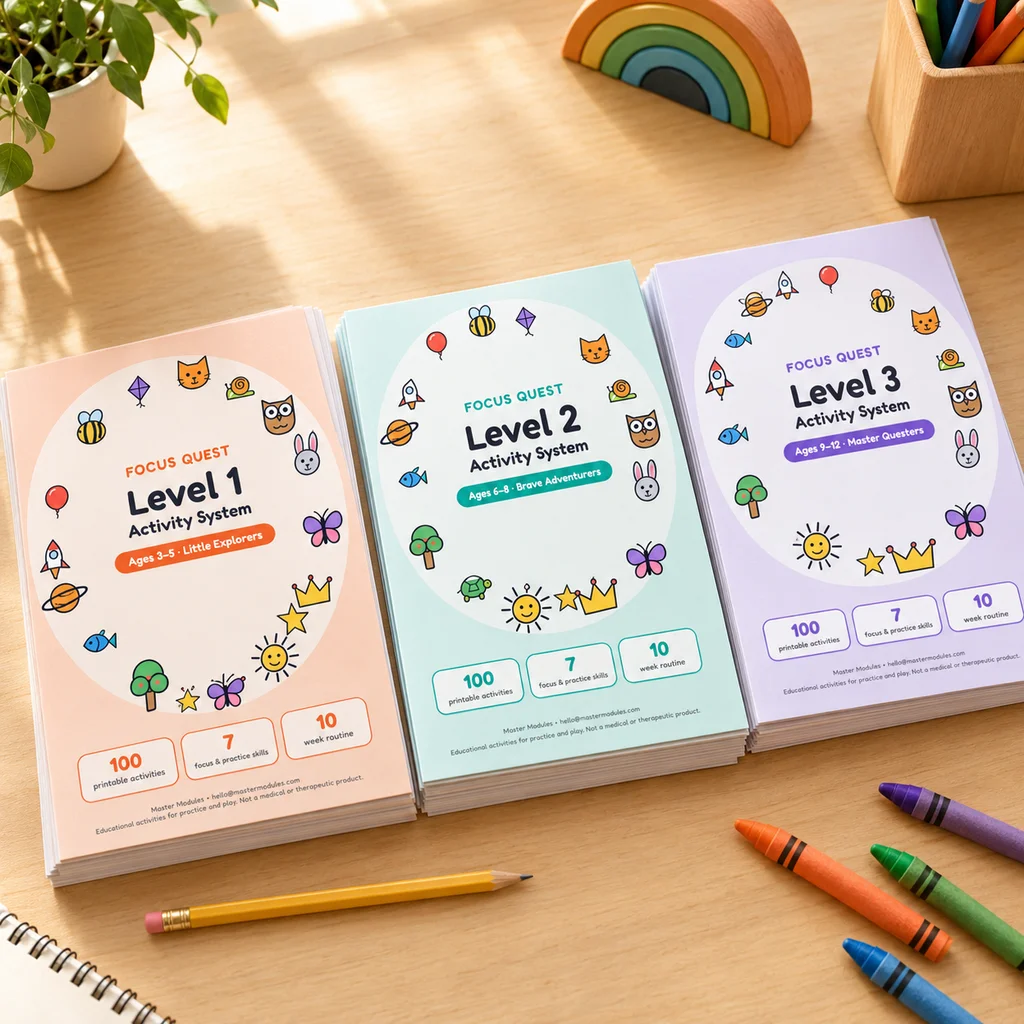
Printable activities fit a child best when the difficulty matches their age and the session is short enough to finish. For ages 3 to 5, look for matching, tracing and simple mazes. For 6 to 8, add memory, patterns and dot-to-dot. For 9 to 12, move to logic sequences, ciphers and mirror drawing. This guide gives examples for each band, shows how to tell when to move up, and suggests a 10-minute session for each.
How to match activities to age
Age is a starting point, not a rule. Children of the same age can vary a lot. Use this three-step check with any activity:
- Can they start without much help? If not, it may be too hard.
- Does it take effort but end well? That is the sweet spot.
- Is it done in a minute or two? Time to try the next level.
The Focus Quest Activity System is organized in three levels along these lines: Level 1: Little Explorers (ages 3 to 5), Level 2: Brave Adventurers (ages 6 to 8) and Level 3: Master Questers (ages 9 to 12), with 100 activities each.
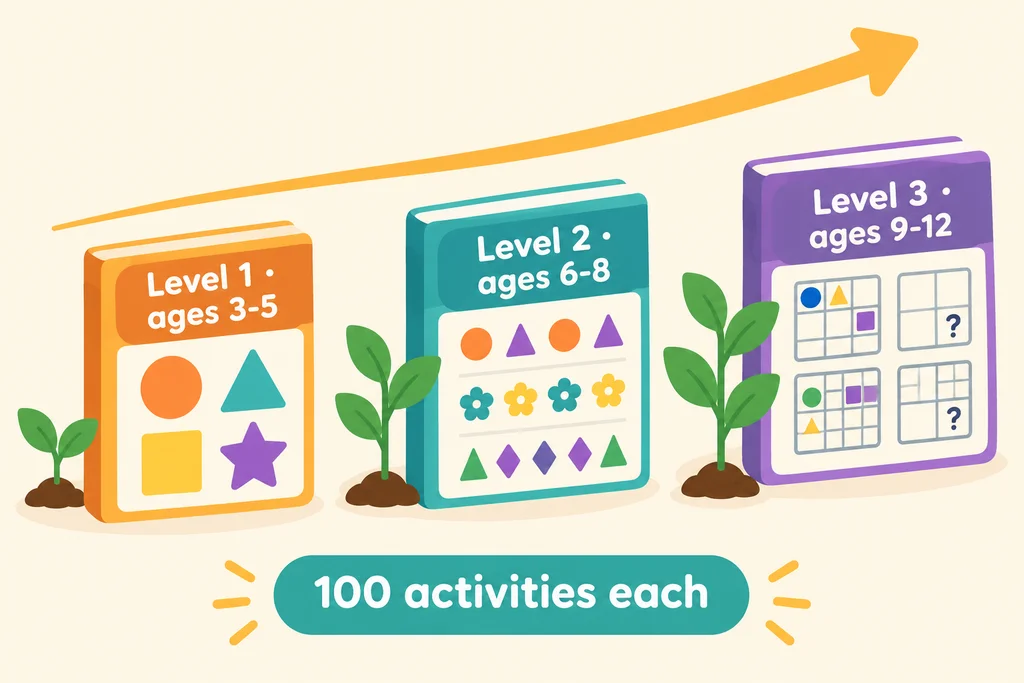
Ages 3 to 5: Little Explorers
At this age, pages should be big, simple and visual, with plenty of movement and short bursts.
Examples of what works:
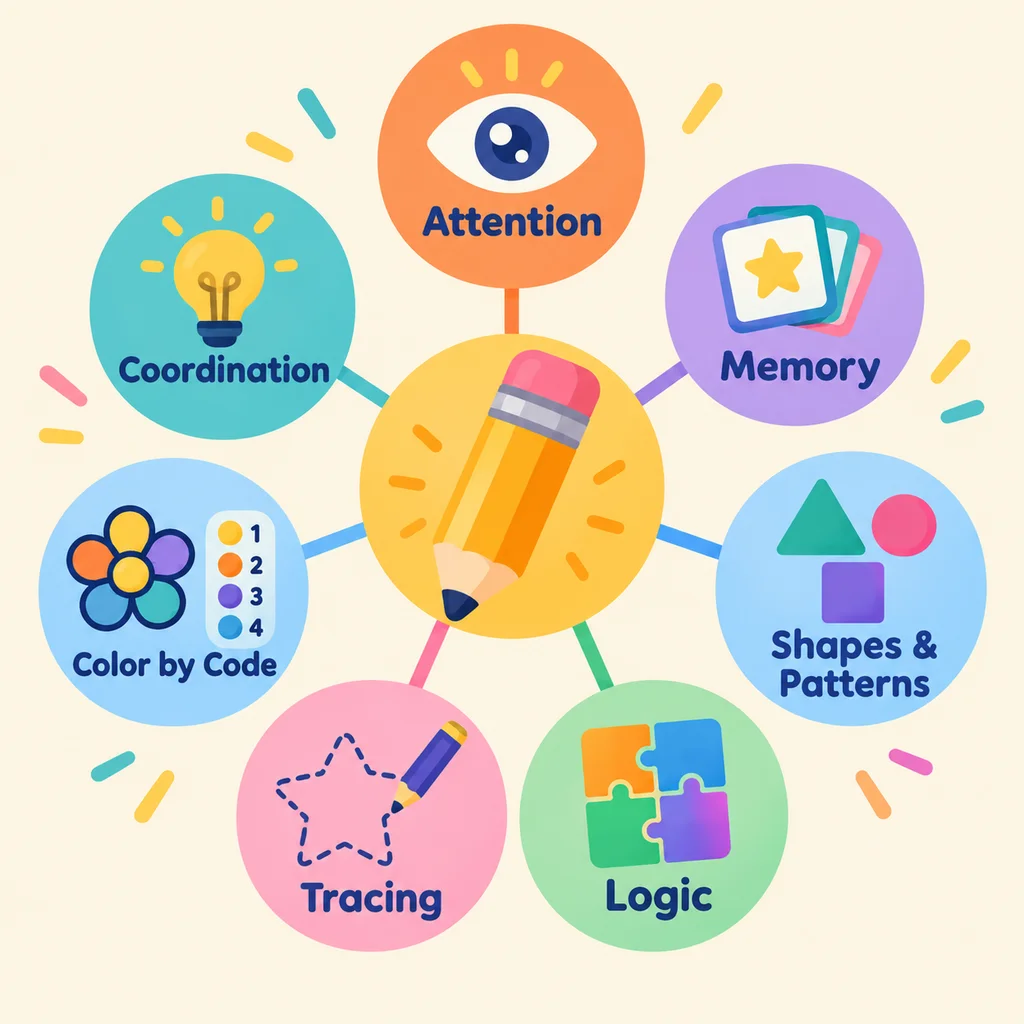
- Odd One Out and Circle All the Trees (Attention)
- Grid Memory and Look, Cover, Remember (Memory)
- Match the Shapes and Keep the Pattern Going (Shapes & Patterns)
- Small to Big and Which One Does Not Belong? (Logic Sequences)
- Straight Line Journeys and Trace the Shapes (Tracing & Fine Motor)
- Mystery Picture: Color by Number and Color by Shape (Color by Code)
- Maze Adventure and dot-to-dot (Coordination)
Sample 10 minutes: one matching or odd-one-out page, then one trace or maze page.
Tip: sit with your child for the first few pages, and stop while they still want to go on.
Ages 6 to 8: Brave Adventurers
Children this age can follow instructions with a few steps, like to win against their own score and often love puzzles with a secret.
Examples of what works:
- Find the pair, spot the differences, count the objects (Attention)
- Number memory, what's missing and shape sequence (Memory)
- Turn and match, shadow match, grid patterns (Shapes & Patterns)
- Number sequences, sort it, shape math (Logic Sequences)
- Trace words, copy the pattern and mirror drawing (Tracing & Fine Motor)
- Mystery pictures, mosaics and symbol codes (Color by Code)
- Mazes, dot-to-dot and tangles (Coordination)
Sample 10 minutes: a memory page, then a maze or color-by-code page.
Tip: ask your child to say how they solved it. Explaining deepens understanding.
Ages 9 to 12: Master Questers
Older kids want challenge and independence. Avoid anything that looks like it is for little children, and let them run their own sessions.
Examples of what works:
- Circle letters, circle numbers, spot the differences (Attention)
- Look, cover, remember with longer lists and number memory (Memory)
- Turn and match with harder shapes (Shapes & Patterns)
- Number sequences, matrices and shape math (Logic Sequences)
- Trace words, mirror drawing and copy the pattern (Tracing & Fine Motor)
- Ciphers with numbers or symbols (Color by Code)
- Long mazes, dot-to-dot and tangles (Coordination)
Sample 10 minutes: a logic or cipher page, then a maze.
Tip: give them the Answer Key Book so they can check their own work and learn from mistakes.
The seven skills at a glance
| Skill | What it practices | Pages per level |
|---|---|---|
| Attention | Noticing, scanning, comparing | 15 |
| Memory | Holding and recalling | 14 |
| Shapes & Patterns | Seeing what repeats or turns | 14 |
| Logic Sequences | Order and rules | 14 |
| Tracing & Fine Motor | Pencil control | 14 |
| Color by Code | Following a key | 14 |
| Coordination | Mazes, dot-to-dot, tangles | 15 |
When to move up a level
| What you see | What to do |
|---|---|
| Pages done in a minute or two with no thinking | Try the next level up |
| Pages take effort and end with a smile | Stay |
| Frustration within a couple of minutes | Step down for now |
Within each level, pages are arranged from easier to harder, so a child grows through the level.
Choosing activities when interests differ
Age sets a starting level, but interest drives effort. A child who loves drawing may take to tracing and mirror drawing quickly, while one who loves puzzles may lean toward mazes and ciphers. Offer a choice of two pages from different skills, and let the child pick. Over a few weeks the plan still covers all seven skills, because pages are mixed through the routine.
Setting up for success
- Print pages one session at a time so nothing gets lost.
- Keep a pencil, an eraser and a timer on the same shelf.
- Put finished pages in a folder; seeing the pile grow is its own reward.
- Keep the Answer Key Book out of sight of younger children and in reach of older ones.
Keeping older and younger kids both happy
When siblings share a slot, let the younger child go first with a short page while the older child starts their own. Then swap roles: the older child can read the instructions aloud or check the younger child's answers, which builds confidence on both sides. Keep the pages separate so neither feels judged by the other's level.
Mixed-age families
If you have children at different levels, give each their own level and the same 10-minute slot. The 10-Week Routine Planner comes with one planner for each level, so each child has their own checklist.
For the full routine, see the 10-week focus routine plan. For expectations on how long to ask for, see attention span by age. For ideas without paper, see screen-free activities by age.
These are educational activities for practice and play, not a medical or therapeutic product.