Phonics Scope and Sequence: The Order to Teach Letter Patterns in 9 Stages
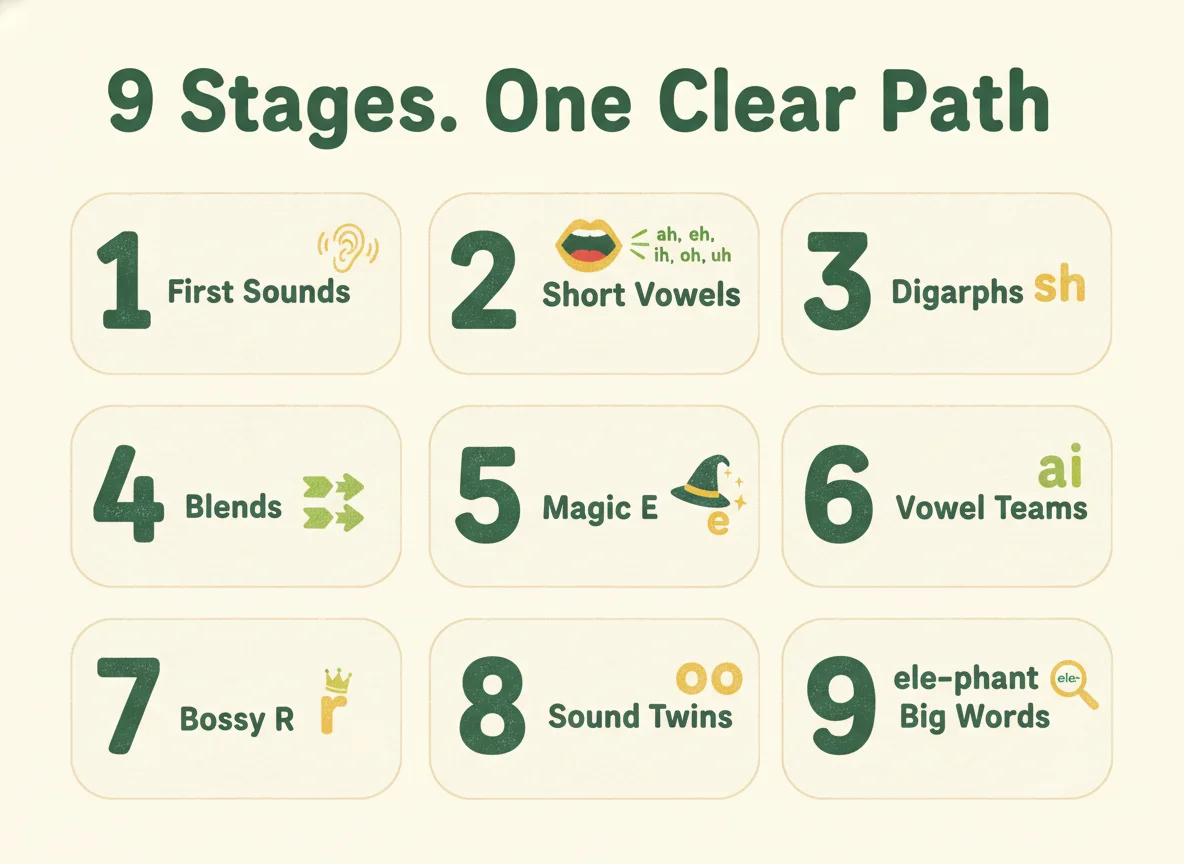
A phonics scope and sequence is the plan for what to teach and in which order. The scope lists the letter-sound patterns; the sequence puts them in a sensible order, from simple to complex, so every new pattern rests on ones the child already knows. Below is a nine-stage sequence with the new graphemes, tricky words and rules for each stage, followed by notes on how to use it.
The big picture
| Stage | Name | Focus |
|---|---|---|
| 1 | First Sounds | Short a and i, first consonants |
| 2 | All Short Vowels | Short o, u, e and the rest of the alphabet |
| 3 | Digraph Detectives | sh, ch, th, wh, ck, ng, nk and double ff, ll, ss, zz |
| 4 | Blend Builders | Beginning and ending blends |
| 5 | Magic E | Silent e: a_e, i_e, o_e, u_e, e_e; -tch, -dge |
| 6 | Long Vowel Teams | ai, ay, ee, ea, oa, ow, igh and y at the end |
| 7 | Bossy R | ar, or, ore, er, ir, ur |
| 8 | Sound Twins | oo, ou, ow, oi, oy, au, aw, ew, ue |
| 9 | Big Word Readers | Endings, compound words, -le and two-syllable words |
Each stage is cumulative: it can use everything from the earlier stages.
Stage by stage
Stage 1: First Sounds
New graphemes: a, i, m, s, t, p, n, c, f, d, g, h, b, r, l. Tricky words: the, a, I, is, to, and, his, has. Rules covered: short a, short i, and the closed-syllable pattern in consonant-vowel-consonant words. Pages are limited to 12 words.
Stage 2: All Short Vowels
New graphemes: o, u, e, k, j, v, w, x, y, z, qu. Plural s appears. Rules covered include short o, u and e, c and k both saying /k/, qu (q brings u), x saying /ks/ and s saying /z/. Tricky words: of, was, you, he, she, we, me, be, said, are, do, no, go, so. Pages up to 16 words.
Stage 3: Digraph Detectives
New graphemes: sh, ch, th, wh, ck, ng, nk, ff, ll, ss, zz. Rules include the sh, ch and wh digraphs, th with two sounds, ck after a short vowel, the floss rule for doubled ff, ll and ss, ng and nk endings and the two sounds of plural s. Tricky words: they, what, where, there, here, one, two, put, want, come, some, look. Pages up to 20 words.
Stage 4: Blend Builders
Blends are sounds side by side. Rules include l-blends, r-blends, s-blends, final blends, three-letter blends, the all, oll and ull patterns and es after sibilants. Tricky words: have, give, live, who, from, your, were, could, would, should, many, any. Pages up to 24 words.
Stage 5: Magic E
New patterns: a_e, i_e, o_e, u_e, e_e, plus -tch and -dge after a short vowel. The silent e makes the earlier vowel say its name. Tricky words: done, gone, love, once, other, mother, brother, friend, again, only. Pages up to 28 words.
Stage 6: Long Vowel Teams
New graphemes: ai, ay, ee, ea, oa, ow, igh, ie, oe. Rules include ai in the middle and ay at the end, ee and ea for long e, oa in the middle, ow for long o, igh for long i, y as long i in a short word and as long e in a longer word and open syllables. Tricky words: water, because, does, great, eye, people, very, every. Pages up to 32 words.
Stage 7: Bossy R
R changes the vowel before it. Graphemes: ar, or, ore, er, ir, ur. Rules: ar, or, ore, the shared sound of er, ir and ur and unstressed endings. Tricky words: word, work, world, learn, early, heart, door, floor. Pages up to 36 words.
Stage 8: Sound Twins
New graphemes: oo, ou, oi, oy, au, aw, ew, ue, al. Rules include the two sounds of oo (moon, book), ou and ow for the same sound, oi in the middle and oy at the end, au in the middle and aw at the end, ew and ue at the end and al saying /aw/. Tricky words: through, thought, laugh, busy, pretty, sure, half, walk, talk. Pages up to 40 words.
Stage 9: Big Word Readers
New patterns: -le and -tion, endings -ed, -ing, -er, -est, -ful, -less and -ly, compound words and two-syllable words. Rules include the sounds of -ed, dropping the silent e, doubling the final consonant, consonant-le syllables and splitting a word between two consonants. Tricky words: beautiful, special, favorite, enough, answer, different, together, usually, clothes, their, whole, young. Pages up to 48 words.
Why this order works
- Easy sounds first. Short vowels and continuous consonants let a child blend simple words right away.
- One idea at a time. Digraphs come before blends because a digraph is one sound, which is simpler to track.
- Silent e before vowel teams. Silent e has a single clear rule, while vowel teams have several choices.
- R-controlled vowels after long vowels. Once a child knows how vowels can change, r's effect is easier to understand.
- Endings last. Big words rely on every earlier pattern.
How to use a sequence with a child
- Find the starting point. Use a short placement test, not age. The 3-Minute Placement Test in the library scores a short list for each stage and tells you where to start.
- Teach, then read. Warm up the new sounds, then read a text that uses only what has been taught.
- Mix in review. Cumulative texts already review earlier patterns.
- Move on when ready. If a child reads a stage's stories accurately on the second read, go to the next one. If not, stay longer and add activities.
- Come back later. Re-test every six to eight weeks to confirm the level.
How the library applies it
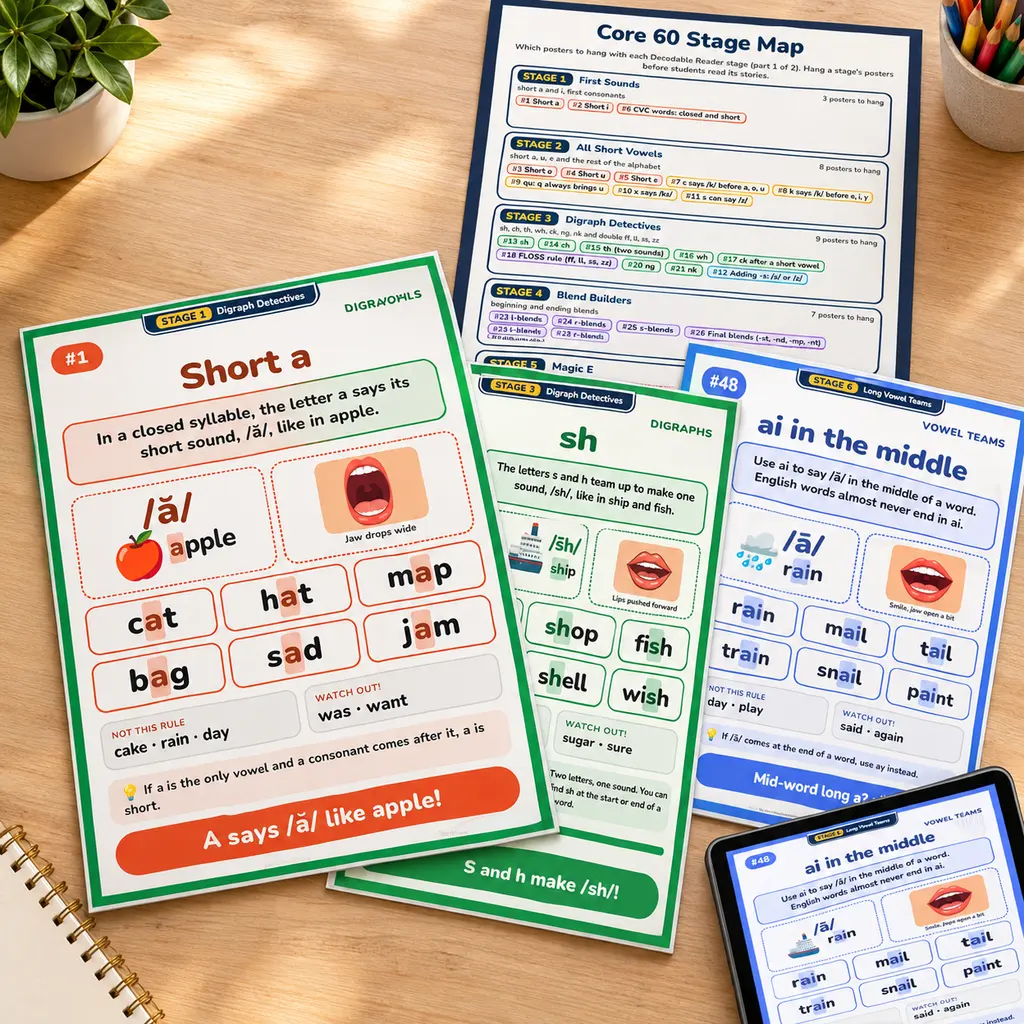
The Decodable Readers Library follows this sequence. There are 12 stories for each of the 9 stages (108 in all), each checked by a script against the patterns and tricky words taught up to its stage, so nothing untaught can slip in. The Parent Guide includes a page for each stage that lists the new sounds, the tricky words and the rules in kid-friendly language, with examples. There are 8 activity centers for each stage, and the Progress Tracker has a page for each of the 9 stages.
For the tricky words in detail, see heart words by stage. For the overview of all nine stages and their stories, see decodable readers: the 9 stages. If the term is new, read what decodable books are, and to find the right place to begin, see the phonics screener and placement test.