Decodable Books for Kindergarten: Where to Start and What to Look For
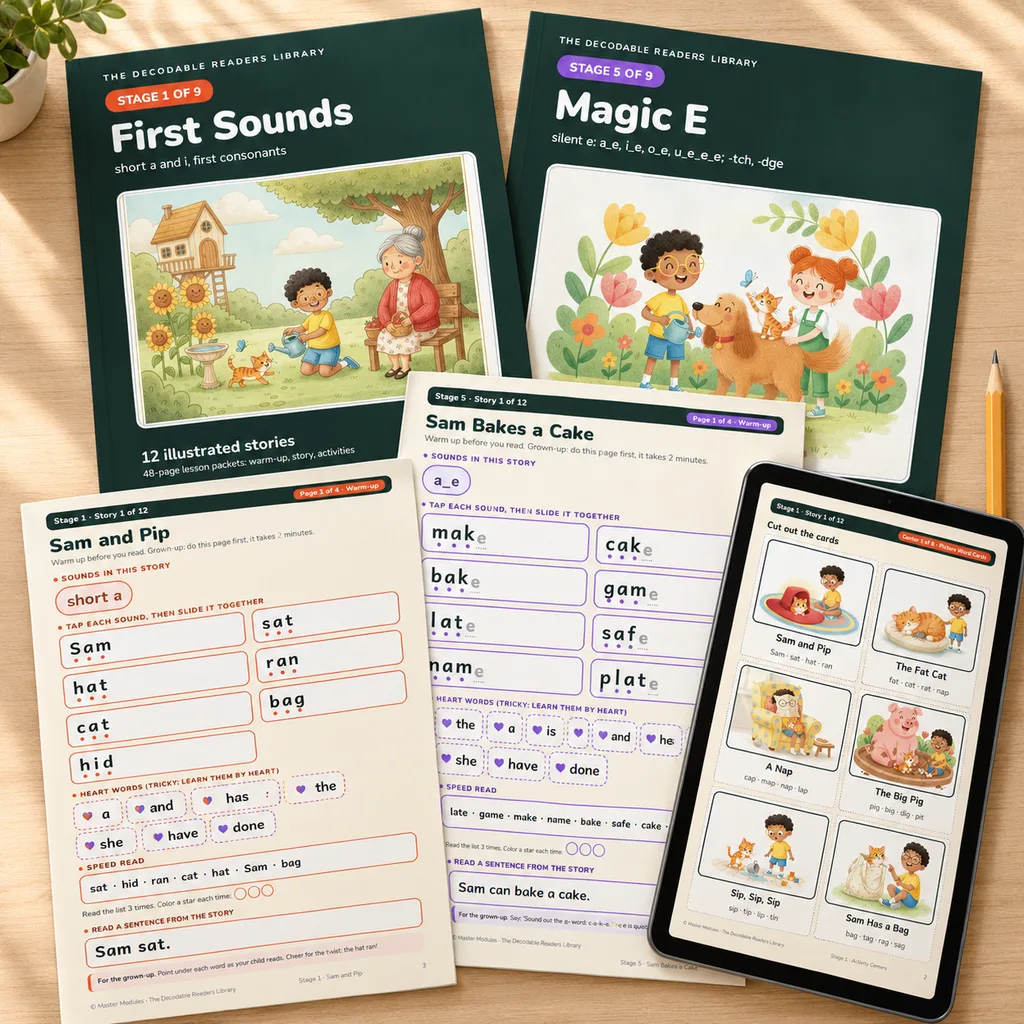
For kindergarten, the best decodable books start tiny and grow slowly: a few letter sounds, short sentences, words a child can really sound out and a story worth rereading. This guide lists what to look for and shows how the first three stages of a nine-stage series are laid out, because the first three stages are what most kindergartners work through.
What to look for in a kindergarten decodable book
Use this checklist when you look at a set.
- A stated order of sounds. The set should say which letter sounds each book uses and in what order.
- Very small steps at the start. The first book should use only a few letters. A child who learns many new patterns at once will guess.
- Tricky words taught first. Words like the, is and to are allowed if they are introduced before they appear.
- Short pages. At the beginning, a page should be a few words. Long lines are too much.
- A story with a point. Even in three-word sentences, a twist or a joke gives a child a reason to reread.
- Room to practice. Look for words to warm up on, questions to answer and something to write.
What the first three stages teach
In The Decodable Readers Library, the first three of nine stages cover the usual kindergarten ground. Each stage has 12 stories, so these three stages contain 36 of the 108.
| Stage | Name | New sounds and patterns | Words per page (up to) |
|---|---|---|---|
| 1 | First Sounds | Short a and short i, with consonants m, s, t, p, n, c, f, d, g, h, b, r, l | 12 |
| 2 | All Short Vowels | Short o, u, e; the rest of the alphabet; qu; plural s | 16 |
| 3 | Digraph Detectives | sh, ch, th, wh, ck, ng, nk; double ff, ll, ss, zz | 20 |
Everything is cumulative, so a Stage 3 story can use anything from Stages 1 and 2.
Stage 1: First Sounds
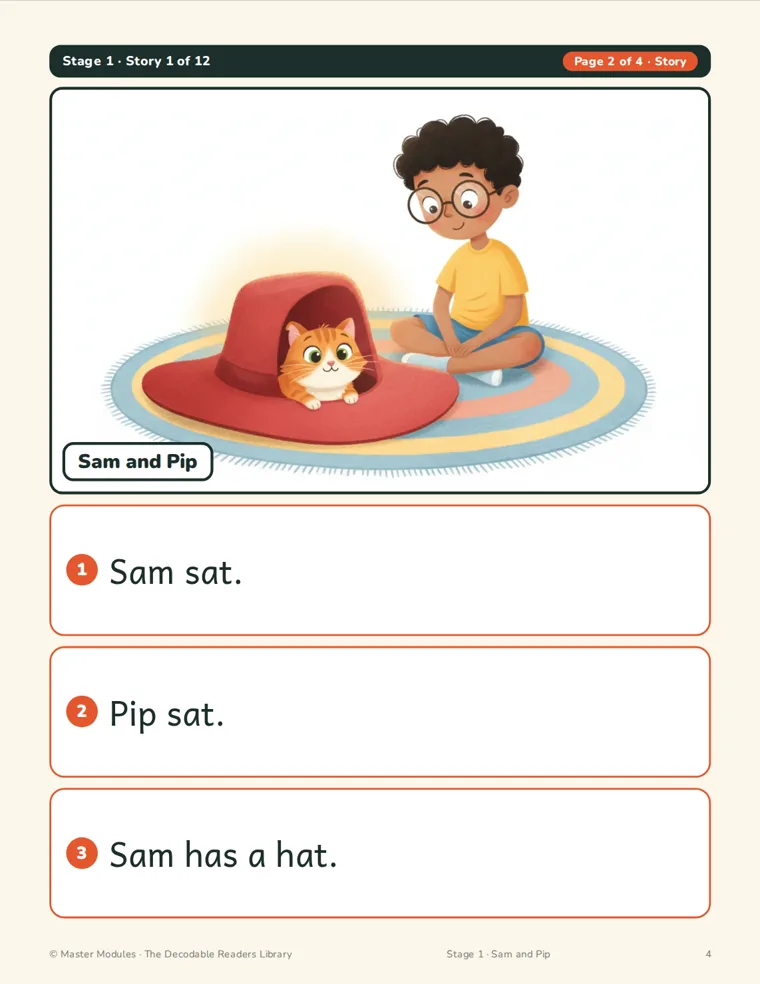
The first stage uses short a and short i with a small group of consonants. Titles include Sam and Pip, The Fat Cat, A Nap, The Big Pig, Sip, Sip, Sip, Sam Has a Bag, Sit, Pip!, A Hat and a Cap, Sam and the Hill, Hiss!, The Fan and The Big Dig. Tricky words in this stage are the, a, I, is, to, and, his, has.
Stage 2: All Short Vowels
Stage 2 adds short o, u and e and finishes the alphabet. Stories include Max the Dog, Hop on the Log, Mud Fun, The Bug on the Rug, Ten Hens, Max Gets a Vet, The Fox in the Box, Quit It, Max!, Zip and Buzz, Wag, Wag, Wag, Hugs, Hugs, Hugs and Mix It Up. Fourteen new tricky words arrive here, including was, you, said and are.
Stage 3: Digraph Detectives
Stage 3 teaches letter teams that make one sound. Stories include Pip's Fish Wish, Max and the Shed, Meg and the Lunch Chick, Lunch on the Bench, Max and the Bath, The Moth on the Math and Bugs in the Mugs.
How to know where your kindergartner should start
Age is a poor guide, and the letters a child knows are a better one. The library includes a 3-Minute Placement Test. You show your child a short list of words for each stage, starting at Stage 1, and score each list. You stop at the first list that is not a pass, which keeps the test short.
| Score on a list | What it means |
|---|---|
| 9 or 10 of 10 | Pass. Try the next stage's list. |
| 7 or 8 of 10 | Stop. Start at this stage, Story 1. |
| 6 or fewer | Stop. Start one stage lower. |
If a child cannot read the Stage 1 words at all, ask for the sounds of six letters and begin at Stage 1 with the warm-up page each day.
A kindergarten routine that fits in ten minutes
Short and daily beats long and rare. A day with one story packet looks like this.
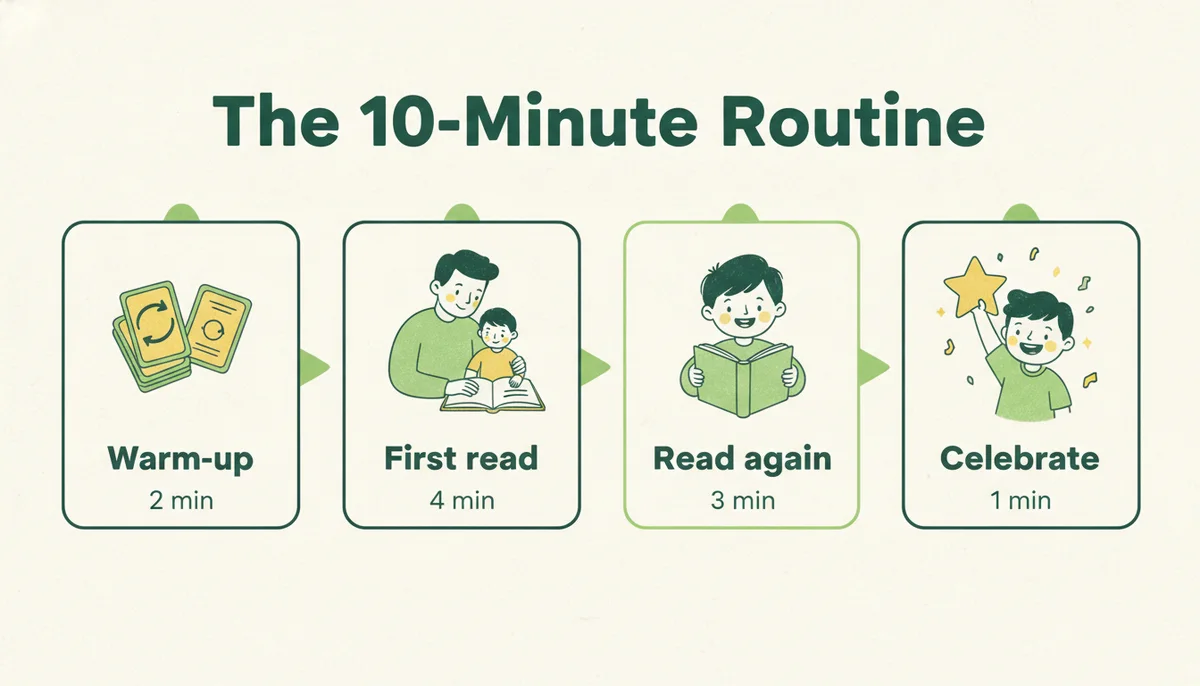
- Warm-up (about 2 minutes). Tap and slide the new words. Read the tricky words.
- First read (about 3 minutes). Your child reads the story; you help only when asked or stuck.
- Second read (about 2 minutes). Read it again, smoother and faster.
- Talk (about 2 minutes). Ask the three questions on the activity page.
- Done (about 1 minute). Add a sticker and celebrate.
A stage of 12 stories takes roughly two to three weeks at one packet a day. If your child is tired, do the writing activity on another day. Reading comes first.
Tips for kindergarten readers
- Point under each word. A finger keeps the eyes on the letters.
- Cover the picture if the child keeps looking at it. The picture is a reward for after the reading.
- Praise the strategy. Say "I love how you checked the letters," not just "good job".
- Re-read favorites. Rereading is where smoothness comes from.
- Stop while it is fun. Ten good minutes beat thirty tearful ones.
What comes in the library besides the stories
Each story arrives as a four-page packet: a warm-up page, the story on pages two and three and an activity page with questions, a word hunt, a sentence to write and a space to draw. Each stage also has 8 activity centers: picture word cards, word building, clip cards, roll and read, tracing, sentence scramble, read and match and a reward chart. A progress tracker with a wall chart and a certificate for each stage helps young children see how far they have come.
Everything is a printable PDF in color and in black and white, on US Letter paper.
To go further, see how to teach blending, short vowel stories, 10-minute reading practice for kindergarten and a tour of all 9 stages.