Activities Without Screens for Kids, by Age
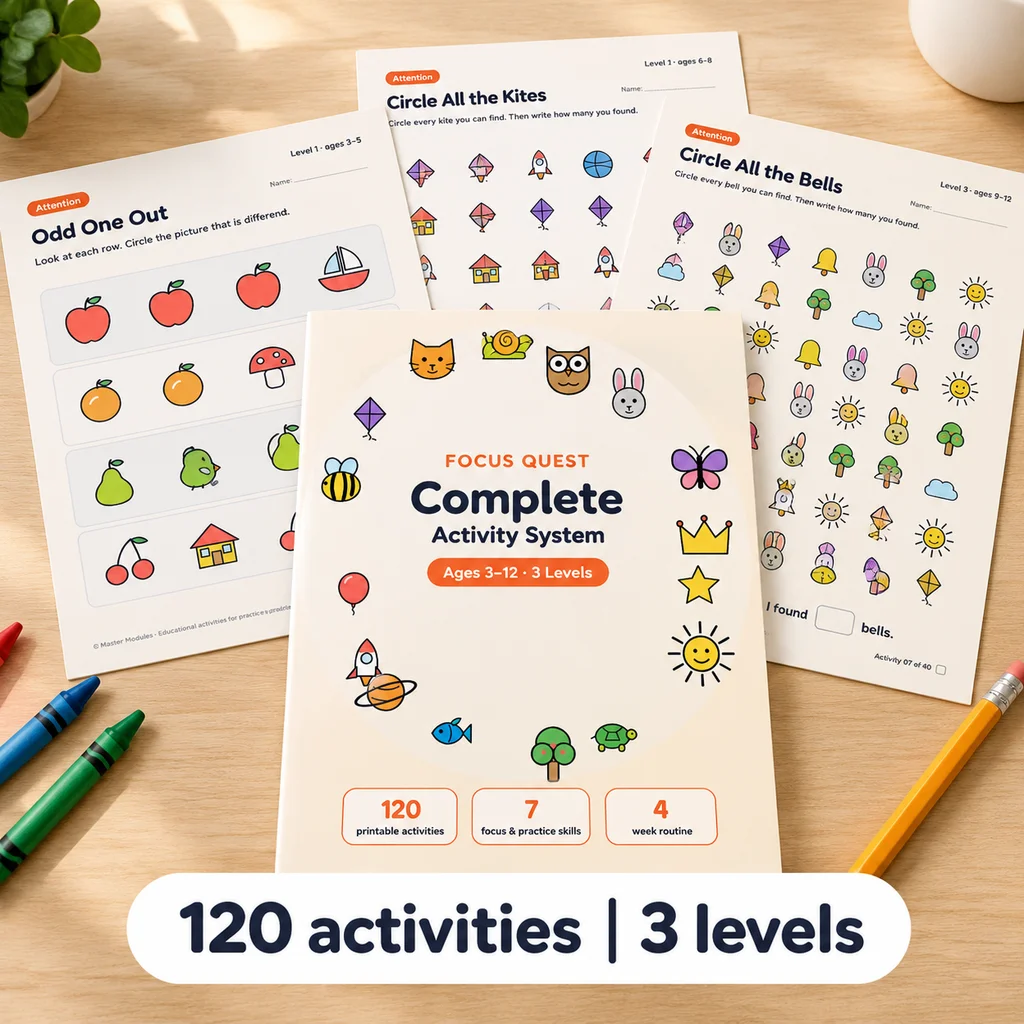
The best screen-free activities for kids are short, easy to start and clearly finishable, with a harder option available once they get the hang of it. This list is grouped by age (3 to 5, 6 to 8, and 9 to 12), tells you what you need, and gives an easier and a harder version of each game so you can fit your own child. Every idea fits into about 10 minutes.
How to pick the right activity
Three questions help:
- Can my child start without me? Pick activities with simple steps for independent play, and more involved ones for when you can join.
- Does it have a clear end? A maze has an exit; a "draw whatever" has no end and can feel aimless.
- Is the first try a success? Start easy. You can always go harder.
The games below come from the 50 Screen-Swap Cards in the Focus Quest Activity System, plus a few printable page types from the system's 300 activities. Each card has three steps and two difficulty options. Cards fall into seven groups: Observe, Remember, Move, Draw, Words, Numbers and Breathe.
Ages 3 to 5
At this age, short and physical is best. Aim for 5 to 10 minutes.
| Activity | What you need | How it works | Easier / harder |
|---|---|---|---|
| Sound Safari | Nothing | Close your eyes for one minute and count the different sounds | Name 3 sounds / order sounds from nearest to farthest |
| Shape Hunt | Nothing (paper optional) | Pick a shape and find objects with that shape | One shape only / find shapes hidden inside bigger objects |
| Statue Freeze | Music (optional) | Move slowly, freeze when the music stops, hold for a count | Count to 5 / balance on one foot |
| Clap Back | Just your hands | Copy a short clapped rhythm | 2 claps / 6 claps and a stomp |
| Flower and Candle | Nothing | Breathe in through the nose, blow out slowly | Do it 3 times / make the blow last 6 seconds |
| Straight Line Journeys | Pencil and a printed page | Trace lines from start to finish | Straight lines / curves |
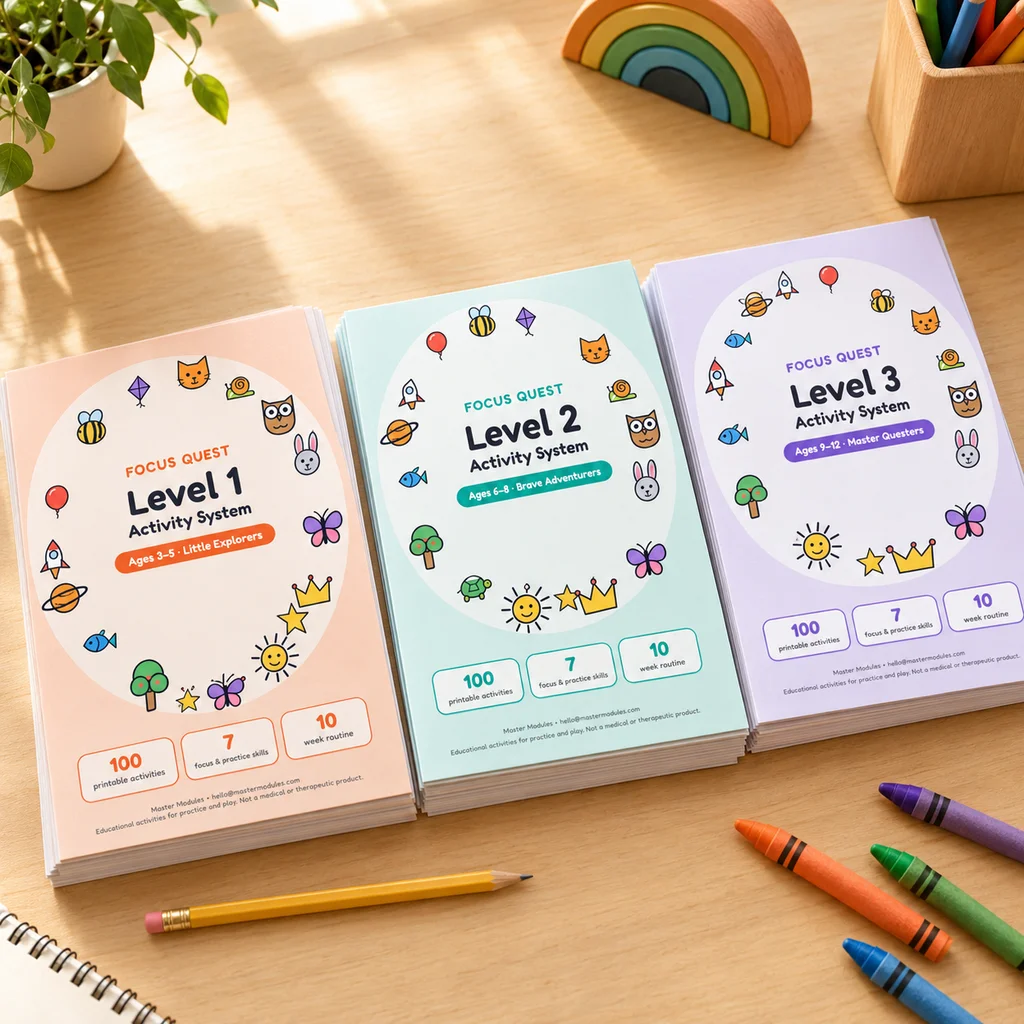
The printable pages in Level 1 (ages 3 to 5) include matching shapes, odd-one-out, simple mazes, tracing lines and shapes, and color by number.
Ages 6 to 8
Kids this age can handle a few simple rules and enjoy beating their own score. Aim for about 10 minutes.
| Activity | What you need | How it works | Easier / harder |
|---|---|---|---|
| Tray Memory | A tray or towel, 6 to 10 small objects | Look for 30 seconds, cover, then list what you remember | 5 objects / 12 objects, in order |
| What Changed? | 8 small objects and a tray | Close your eyes while one object is moved or swapped | 5 objects / change two |
| Pack the Picnic | Nothing | Add an item each turn and repeat the whole list | 3 items / alphabetical order |
| Mirror Me | A partner | One leads, the other copies at the same time | Arms only / no talking, add faces |
| Roll and Add | 2 dice or number slips | Roll, add and say the total | One die and count dots / subtract |
| One-Line Drawing | Paper, pencil | Draw a whole picture without lifting the pencil | Scribble first / draw a face in 2 minutes |
Level 2 (ages 6 to 8) adds memory grids, pattern continuation, turn-and-match, dot-to-dot, ciphers and copy-the-pattern lines.
Ages 9 to 12
Older kids resist anything that feels babyish. Offer challenges with a bit of strategy and let them set their own targets.
| Activity | What you need | How it works | Easier / harder |
|---|---|---|---|
| Zoom In | A small object (leaf, shell, coin) | Look closely for one minute, then describe it for a partner to guess | 3 details / describe without color words |
| Change One Letter | Paper, pencil | Change one letter to make a new word and keep chaining | Words spoken aloud / four-letter words |
| Estimate It | A jar and small items | Guess how many are inside, then count in groups of 5 | A small jar / check by counting in tens |
| Map of My Room | Paper, pencil | Draw your room from above and hide an X for a partner | 3 things / left-and-right directions |
| Memory Walk | A room or hallway | Look at 5 things in order, return, say them in order | 3 things / say them backward |
| Three Good Things | Nothing (paper optional) | Name three good things from the day | One thing / add why it was good |
Level 3 (ages 9 to 12) includes number sequences, shape math, mirror drawing, word tracing, ciphers and longer mazes.
Tips for making screen-free time stick
- Choose a regular slot. After school or while you cook dinner works for many families.
- Offer two options. Choice cuts resistance.
- Use a visible timer. Ten minutes goes by faster when the end is visible.
- Celebrate finishing. A sticker or star is enough.
- Keep a small "go bag." Paper, pencil, a few objects and a few cards in a bag makes it easy to start anywhere.
To go deeper on cutting screen time, see how to reduce screen time without battles. For trips, see printable road trip games.
What to do when an activity flops
Not every game lands. If your child loses interest after a minute, switch to the easier version, change the setting (try the floor or the kitchen table), or let them choose between two other cards. A flopped activity is information, not failure: next week the same game may work. Keep the ones that do and set aside the rest.
Make it a routine
One-off activities help; a routine keeps them going. The system includes a 10-Week Routine Planner with a printable calendar that schedules two activities a day for five days a week, plus a Celebration Pack with certificates, stickers, bookmarks, a "Focus Time" door hanger and a 30-day calendar. For help picking pages for your child's age, read printable activities by age.