Reading Progress Tracker and Certificates: How to Make Progress Visible
A reading progress tracker turns a slow, daily skill into something a child can see. Each finished story gets a tick and a star, each finished stage gets a certificate and a wall chart slowly fills up. This guide explains what a good tracker holds, how to use one and what the Progress Tracker and Reading Certificates in The Decodable Readers Library contain.
What a tracker should do
- Show what comes next. The child should be able to see the next story.
- Record the effort, not just the result. Tick boxes for the warm-up and each reading reward the routine.
- Show smoothness. A star for a smooth read makes the goal clear.
- Make the whole journey visible. A wall chart that fills up gives a sense of distance travelled.
- Celebrate milestones. A certificate for each stage gives a natural moment to stop and enjoy.
The Progress Tracker in the library
The tracker is a printable PDF, in color and in black and white.
| Page | What it is |
|---|---|
| Cover and how-to | "My Reading Progress," with the name, start date and instructions |
| 9 stage trackers | One for each stage, listing all 12 stories |
| Fluency log | A weekly one-minute timing log |
| 2 sticker sheets | Story stickers and celebration stickers |
| Wall chart | A circle for each of the 108 stories, arranged by stage |
The stage tracker
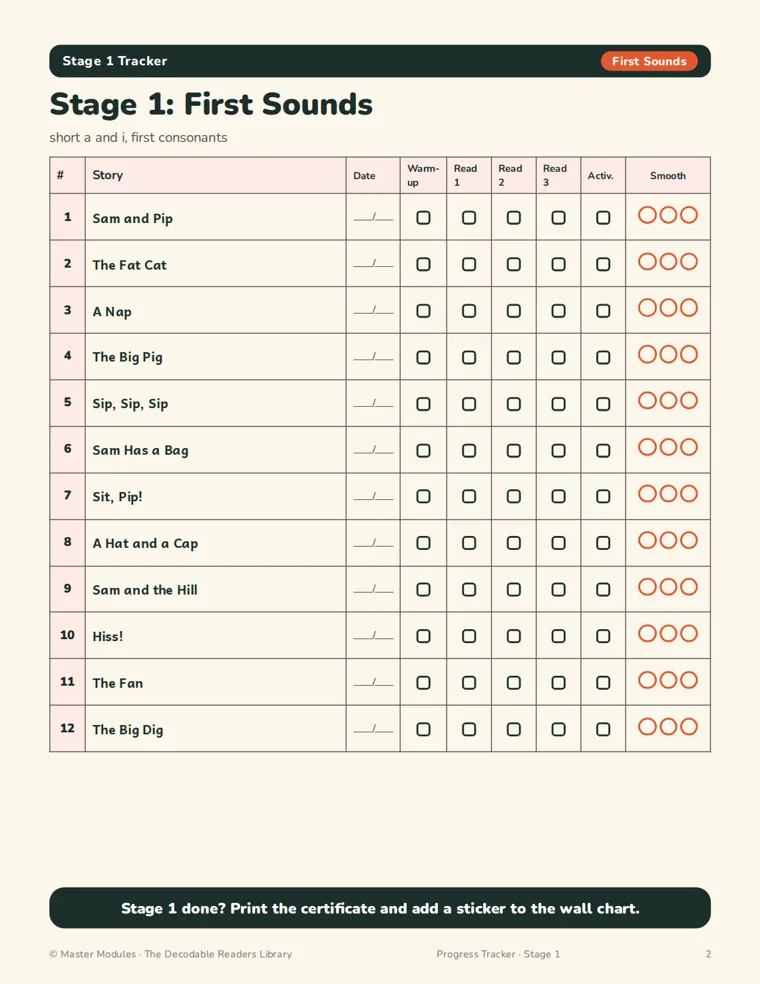
Each stage page lists the 12 stories by title and has columns for:
- Date
- Warm-up done
- Read 1, Read 2 and Read 3
- Activities done
- Smooth: three stars to color
The three reads match the routine in the Parent Guide: read 1 is for sounding out, read 2 for smoothness and read 3 should sound like talking. At the bottom is a reminder to print the stage's certificate and add a sticker to the wall chart.
The fluency log
Once a week, time one minute of a story the child has already read twice. Write down the date, the stage and story, the words read, the mistakes and a smooth-reading rating of one to three stars. The idea is to look for a steady trend, not a particular number. Never race your child.
Stickers and the wall chart
The sticker sheets have a story sticker for each finished story and a celebration sticker for each finished stage. The wall chart shows 9 rows, one for each stage, with 12 circles in each. Fill every circle and the child has read 108 stories.
The Reading Certificates
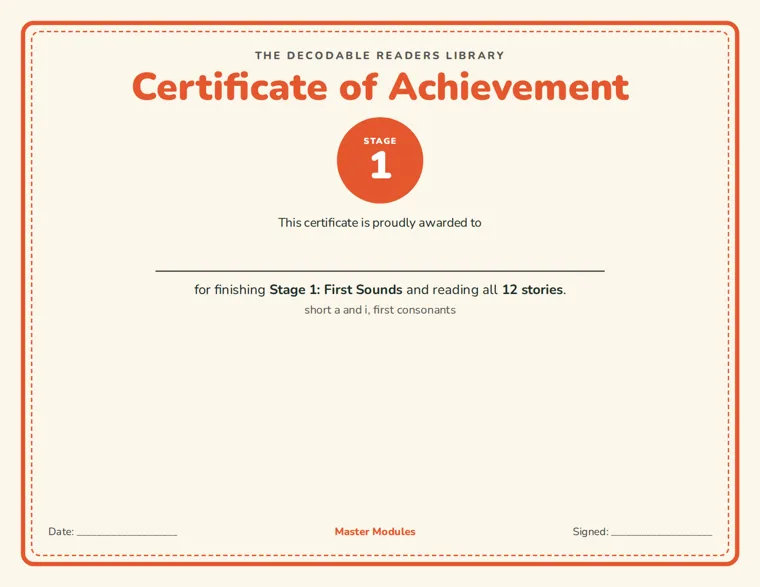
There is a certificate for each of the 9 stages and a final Certificate of Reading Success for finishing all 108 stories, so 10 in all. A stage certificate has a space for the child's name and says what the child has finished: "for finishing Stage 3: Digraph Detectives and reading all 12 stories," with the stage's focus underneath.
Certificates work as a reward without being a bribe, and they give you a photo moment. Print a color copy for the fridge.
How to use the tracker day to day
- After a story, tick the warm-up and each reading.
- Color a star if the read was smooth.
- Add a sticker to the wall chart.
- Once a week, do the one-minute timing and log it.
- When the stage is full, print the certificate and celebrate.
If you have more than one child, print a tracker for each. They can take turns with the stories.
Using the tracker as a record
Homeschool families sometimes need to show what was done. The stage trackers give dated entries for each story, and the placement test sheet records the starting stage and the date to re-test. The tracker is not a formal assessment, but it is a clear record of what was read and when.
Keeping it motivating
- Let the child do the coloring. Ownership matters.
- Praise the effort. "You read it three times!"
- Display it. Put the wall chart where the child can see it.
- Do not compare. Each child's pace is their own.
- Take a photo of the finished tracker. One day your child will want to see how far they came.
Where it fits
The tracker is one piece of the library. The others are the placement test, the Parent Guide, 108 stories in 9 stages and 72 activity centers. All of them are printable PDFs, and a members web app is included too.
For the full tour of the set, read decodable readers: the 9 stages. To plan a daily routine around the tracker, see reading practice for kindergarten and homeschool phonics practice. To choose where to start, see the phonics screener.