Preschool Math Worksheets: What to Practice and in What Order
Good preschool math worksheets practice a few ideas: counting objects, recognizing numerals, comparing, sorting, noticing patterns and naming shapes. The best order is hands-on first, then drawn, then written. This guide walks through what to practice, in what order, with number activities you can do at home using nothing but household objects and a pencil.
What preschool math really covers
Preschool math is less about arithmetic and more about number sense: understanding what numbers mean. Typical areas include:
- Counting. Saying numbers in order and counting objects one by one.
- Numeral recognition. Matching the written symbol to the quantity.
- Comparing. More, fewer, bigger, smaller.
- Sorting. Grouping by color, shape or size.
- Patterns. Noticing what repeats.
- Shapes. Naming and finding circles, squares, triangles and others.
Programs and children differ, so treat this as a guide, not a checklist to pass.
The best order: hands-on, drawn, written
- Concrete. Use real objects: buttons, blocks, snacks. Count them aloud while touching each one.
- Pictorial. Move to pictures of objects on paper. The child circles, crosses out or colors.
- Abstract. Introduce numerals and written problems.
Worksheets belong in the second and third steps. If a child struggles on paper, go back one step.
Number activities that need no materials
The Focus Quest Activity System includes 50 Screen-Swap Cards, several of which are number games:
| Card | Ages | What to do | Easier / harder |
|---|---|---|---|
| Count Around | 3 to 6 | Pick an item (chairs, windows) and count how many | Count up to 5 / count in groups of 10 |
| Number Hunt | 4 to 8 | Find numbers 1 to 10 on clocks, books and packages | 1 to 5 / 11 to 20 |
| Make 10 | 5 to 8 | Split 10 buttons into two piles in as many ways as possible | Make 5 / make 20 using 20 buttons |
| Skip-Count Hop | 5 to 10 | Hop once for each count by 2, 5 or 10 | Count to 10 by ones / count by 3s |
| Roll and Add | 5 to 9 | Roll two dice and add them | One die and count dots / subtract |
Printable number pages in Focus Quest
Alongside the cards, the system's 300 pages include a number-focused mix:
- Trace Numbers. Level 1 includes pages for the numbers 1 to 10 and 0 to 9, which combine pencil control with numeral recognition.
- Count the objects. Scene pages ask the child to count items in a picture.
- Circle the numbers. The child finds and circles a given number in a field of digits.
- Number Memory. The child looks at numbers, covers them and recalls.
- Number sequences. The child fills in the missing numbers in a sequence.
- Shape math. At Levels 2 and 3, shapes stand for numbers and the child works out values.
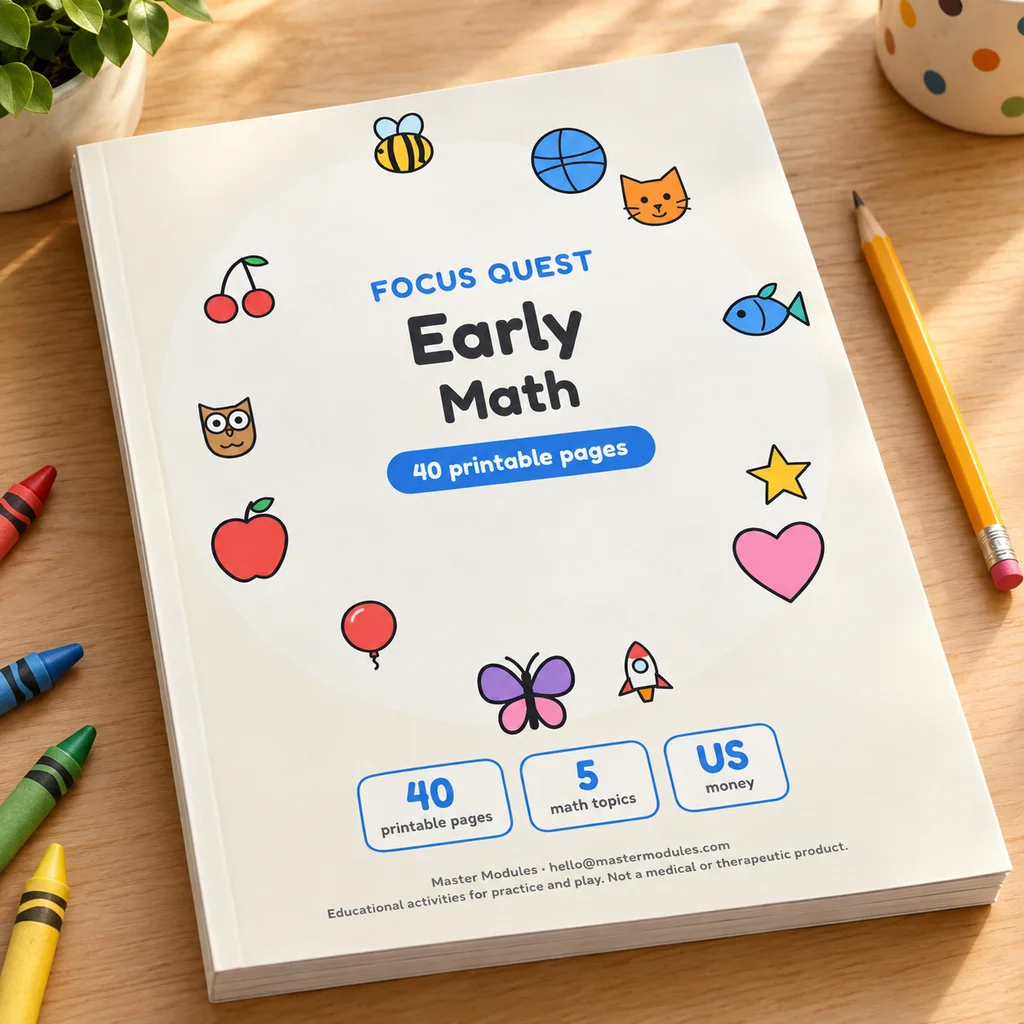
These sit among seven skill groups; the system is a general activity system for attention, memory, patterns and fine motor practice. It is not a full math curriculum. If you want a dedicated set of counting, adding and subtracting pages, there is a separate add-on called Early Math (40 pages); it is sold on its own and is not part of the main system.
A sample week
| Day | 10-minute block |
|---|---|
| Monday | Count Around (cards), then Trace Numbers page |
| Tuesday | Pattern page, then Make 10 with buttons |
| Wednesday | Number Memory page |
| Thursday | Skip-Count Hop, then a number sequence page |
| Friday | Roll and Add, then a celebration sticker |
Tips for success
- Say numbers aloud. Hearing and saying numbers together builds the connection.
- Touch while counting. Pointing to each object avoids skipping or double-counting.
- Use everyday math. Count stairs, forks at the table, steps to the door.
- Praise strategy. "You counted each one carefully" is better than "correct."
- Stop on a win. End the session while it still feels fun.
Choosing a good counting worksheet
Look for a few things when you pick any counting page:
- Clear, uncluttered pictures. A page crowded with objects makes counting harder than it needs to be.
- A single task per page. "Count and circle the number" is clearer than three different instructions.
- Numbers in a sensible range. For most 3-year-olds, 1 to 5 is plenty. For 5-year-olds, 1 to 10 or 20.
- Room to write. Large boxes for the numeral help small hands.
- A way to check. Answers on hand let you see quickly whether the count was right.
Everyday math in ten seconds
You do not need a worksheet for every bit of practice. At snack time, ask "How many crackers are on your plate? If you eat two, how many are left?" On a walk, count steps or red cars. At bedtime, count the books. These tiny moments build the same idea of number as paper pages, and they cost nothing.
A note on pacing
Resist the urge to rush to bigger numbers. A child who counts to 10 with confidence and matches each number to a real group of objects is better prepared than one who recites to 100 without meaning. Repeat the same activity on several days, change the objects, and move on only when your child seems relaxed and a little bored.
Moving from preschool to early school
By about ages 6 to 8, many children move to adding and subtracting small numbers, reading simple word problems and measuring. Level 2 of the system includes number sequences and shape math, and Level 3 builds on them with larger values.
Patterns and sequences are closely linked to number sense. See sequencing and pattern worksheets for more. For pencil control while writing numerals, see fine motor activities for preschoolers, and to see what fits each age, see printable activities by age.