Fine Motor Activities for Preschoolers: 20 Simple Ideas
Fine motor skills grow best through short, regular play that uses the hands: squeezing, tearing, threading, tracing and drawing. Preschoolers do not need special equipment. Five to ten minutes a day of the activities below, mixed with free play, gives their hands plenty of practice for holding a pencil, using scissors and eventually writing. This list has 20 ideas, from no-materials finger games to printable tracing pages.
What fine motor skills are
Fine motor skills are the small movements of the fingers, hands and wrists. Children use them for drawing, cutting, buttoning, using utensils, and later for writing. Like other skills, they develop at different speeds from child to child and improve with practice that feels like play.
This page is general information. It is not a therapy guide. If you are concerned about your child's hand skills, talk to your pediatrician or your child's teacher.
Start with the hands
Before pencil work, many children benefit from activities that strengthen and warm up the hands.
1. Finger Dance
Touch your thumb to each finger in turn, forward and then backward, keeping a steady beat. Easier: one hand. Harder: both hands in opposite order. It is one of the 50 Screen-Swap Cards.
2. Play dough rolling and pinching
Roll snakes, pinch tiny balls, press shapes. Hide small beads in the dough and let the child dig them out.
3. Tearing paper
Tear strips of paper and glue them into a picture. Tearing builds finger strength without scissors.
4. Squeeze and drop
Use a sponge, an eye dropper or a turkey baster to move water between bowls.
5. Clothespin pick-up
Open a clothespin to pick up pom-poms or cotton balls and drop them in a cup.
6. Threading
Thread large beads or pasta onto a string or pipe cleaner.
7. Sticker peeling
Peeling and placing stickers is a satisfying pincer-grip exercise. The Celebration Pack that comes with Focus Quest includes printable stickers, certificates and bookmarks to cut out.
Cutting and drawing
8. Snipping
Give a child safety scissors and strips of paper to snip. Start with one-snip cuts.
9. Cutting along a line
Draw a thick straight line, then a curve, then a zigzag.
10. Mystery Doodle
One person draws a squiggle and the other turns it into a picture. It is a relaxed way to practice drawing control.
11. Shape Creatures
Draw five shapes anywhere on the page, connect them into a creature and name it.
12. Mindful coloring
Coloring inside the lines asks for slow, controlled strokes. The system includes 20 Mindful Coloring Pages.
Printed pencil-control pages
Printable pages give practice with a clear start and finish. In the Focus Quest Activity System, the Tracing & Fine Motor group has 42 activities across three levels, with 14 in Level 1 (ages 3 to 5).
13. Straight line journeys
Trace straight lines from start to finish. This is where most children begin.
14. Curves and mixed paths
Move on to curved and mixed lines (the system calls these Fun Pencil Paths).
15. Trace the shapes
Circle, square, triangle and diamond come first, then pentagon, hexagon, star and cross.
16. Trace letters and numbers
Trace uppercase letters and the numbers 0 to 9.
17. Trace words
Short words first, then phrases and sentences at later levels.
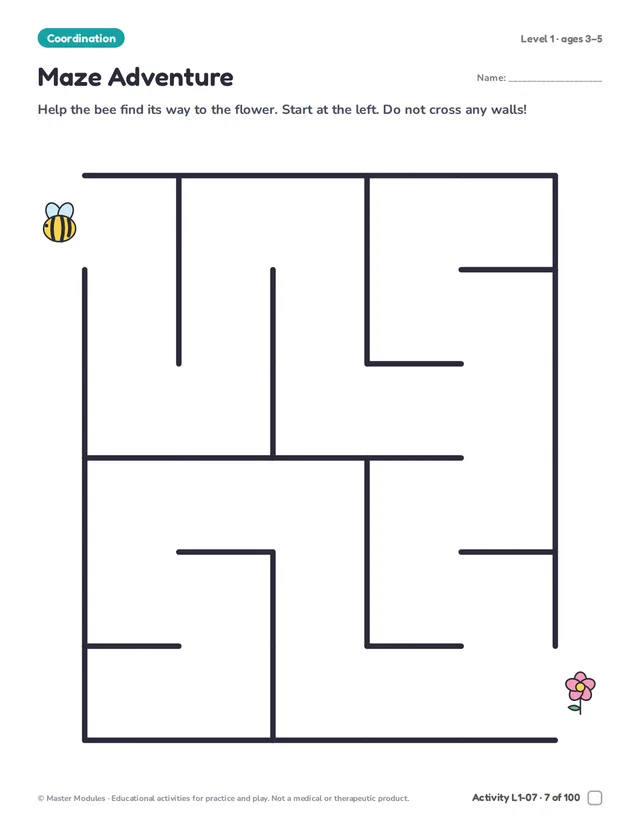
18. Mazes
Wide-path mazes ask a child to guide the pencil along a route. Level 1 has 6 mazes. See printable mazes by age.
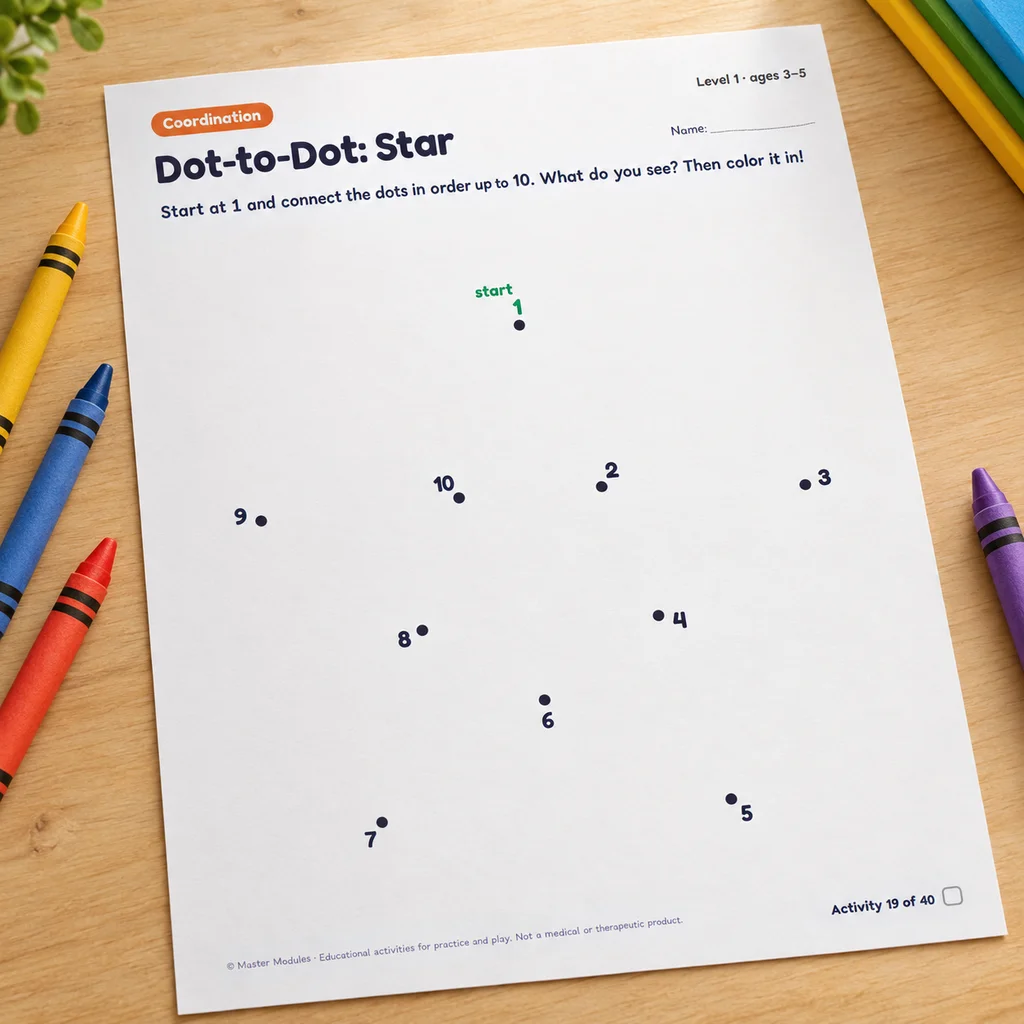
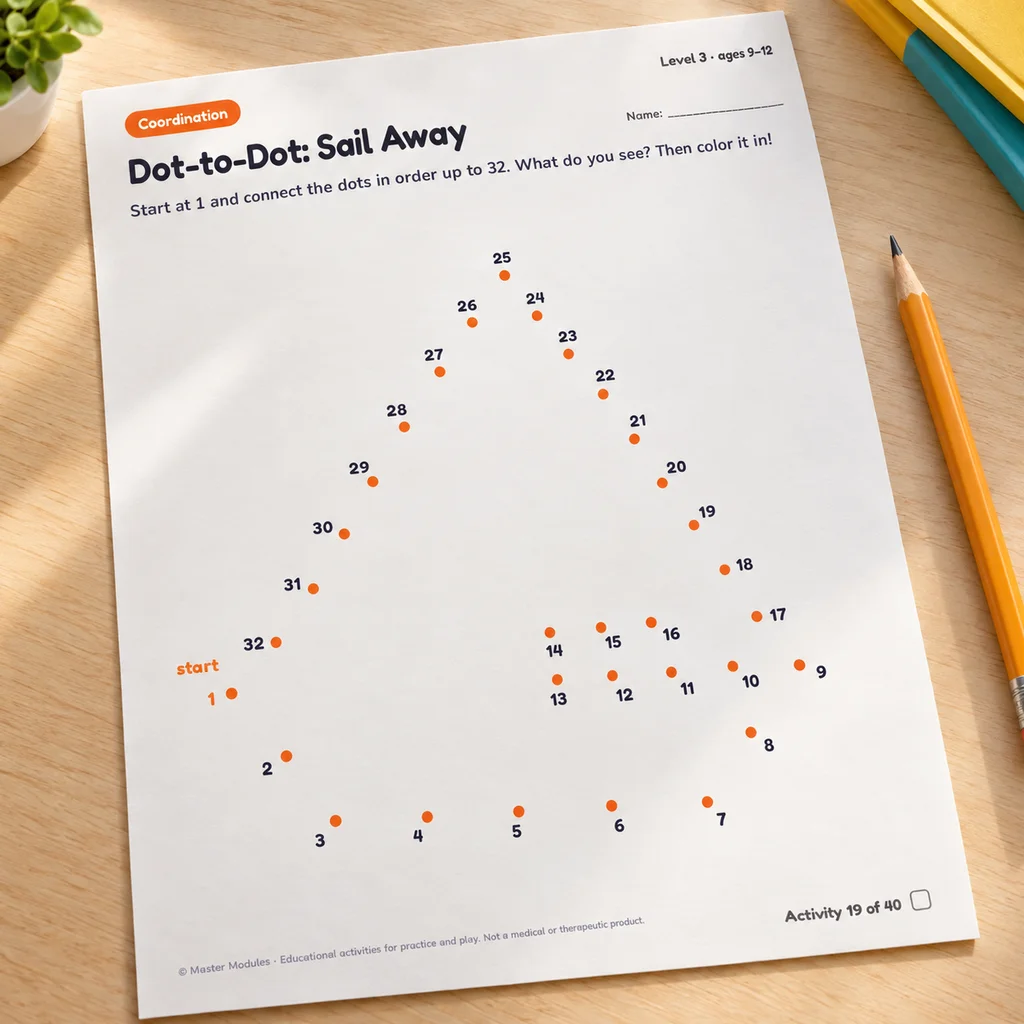
19. Dot-to-dot
Connecting numbered dots gives control and number practice together. Each level has 6 dot-to-dot pages.
20. Copy the pattern and mirror drawing
Copying a pattern of lines, or completing a symmetrical drawing, is a harder pencil task that appears in Levels 2 and 3.
Signs an activity is a good fit
- Your child can start with a little help and finish with a smile.
- Their grip changes over time from a fist toward fingers as practice builds.
- They ask to do it again.
If an activity ends in tears, shorten it, use a thicker crayon or a bigger page, or pick a different one. Fine motor control grows alongside everything else, so mix pencil work with play dough, tearing and threading, and let your child lead the pace.
Setting up a small fine motor basket
Keep a basket within your child's reach with a few items: a clothespin or two, a handful of pom-poms, a cup, safety scissors, a thick crayon, some play dough and a few large beads with a string. When the basket is easy to grab, children often start activities on their own, and five minutes here and there adds up across the week without any planning from you.
A simple weekly plan
| Day | 10-minute block |
|---|---|
| Monday | Finger Dance, then one tracing page |
| Tuesday | Play dough pinching, then a maze |
| Wednesday | Tearing paper collage |
| Thursday | Dot-to-dot, then a coloring page |
| Friday | Clothespin pick-up and a tracing page |
The system's 10-Week Routine Planner arranges two activities a day, five days a week, so the pencil work is mixed with memory, pattern and logic pages and does not become tiring.
Tips for pencil control
- Start with a thick crayon. Move to a pencil as control improves.
- Support the page. Tape it down or use a clipboard so it does not slide.
- Sit comfortably. Feet supported, table at about elbow height.
- Keep it short. Stop while the child still wants more.
- Praise effort. "You kept your line inside the path" is better than "perfect."
Related guides
For logic and pattern pages, see sequencing and pattern worksheets. To see what fits each age, see printable activities by age.