Cross Math Puzzles You Can Print: How They Work
Cross math is a crossword made of number sentences. Rows and columns share boxes, so one answer opens the next. Many people know it as an app; it also works very well on paper, where you can write, try, erase and keep a record.
The rules
- Every row and every column that ends in an equals sign is a number sentence.
- Fill each empty box with a whole number. The allowed numbers (for example 1 to 20) are printed under the grid.
- Look for a sentence with only one empty box, work out the missing number, then use it to open up the next one.
- When a sentence has two operations, work left to right: 2 + 3 × 4 means (2 + 3) × 4 = 20.
- Every number is a whole number of 1 or more: no fractions, no zero, no negatives.
- Each puzzle has exactly one answer.
Rule 4 is worth noticing. In cross math the two-operation sentences are read from left to right, which is different from the standard order of operations used in class. The book says so on its "How to play" page. For the standard rule, see the order of operations game.
A worked example
Here is a simplified example, with one shared box. This is a made-up illustration in the style of an Easy puzzle.
- Across: 9 + □ = 15
- Down: 20 − □ = 14
The empty box is shared by both sentences.
Step 1. Start with the across sentence. 9 + □ = 15, so the box is 15 − 9 = 6.
Step 2. Check the down sentence with 6: 20 − 6 = 14. It holds.
In a full puzzle there are several shared boxes, and you move between sentences:
- Scan for any sentence with one empty box.
- Solve it.
- Write the number in. It now helps the crossing sentence.
- Repeat.
If no sentence has just one empty box, look for one with a small allowed range. The numbers printed under the grid and the whole-number rule often leave only one choice.
Strategy
- Start where it is easiest, not at the top left.
- Use inverse operations. To solve 9 + □ = 15, undo the addition: 15 − 9.
- Check both directions when you fill a shared box.
- Work in pencil. Tentative numbers are normal in harder grids.
- Cross off used numbers if the list under the grid says each is used once.
Levels
| Level | Grid | Operations | Empty boxes |
|---|---|---|---|
| Easy (grades 3–4) | 2 across and 2 down | + and − | 4–5, numbers up to 20 |
| Medium (grades 5–6) | 3 across and 3 down | +, − and × | 5–6, numbers up to 60 |
| Hard (grades 7–8) | 4 across and 4 down | All four, two per sentence | 8–10, numbers up to 99 |
What cross math practices
- Inverse operations, since you often work backward from a result.
- Fact fluency, in addition, subtraction, multiplication and division. See math fact fluency games.
- Logical reasoning, since the grid constrains your choices.
- Persistence, because Hard grids need several passes.
Paper versus an app
The search results for this puzzle are mostly apps. Paper has its own strengths:
| Paper | App |
|---|---|
| Works without a screen | Needs a device |
| Easy to try, erase and compare | Instant feedback |
| Keeps a record of finished work | Can be distracting |
| Suitable for class or travel | May have ads or prompts |
Both are fine. If your child uses screens a lot already, a printed puzzle is a pleasant change; if you want both, the pack below also has a web app.
The Cross Math book in PuzzlePath Math Puzzle Pack
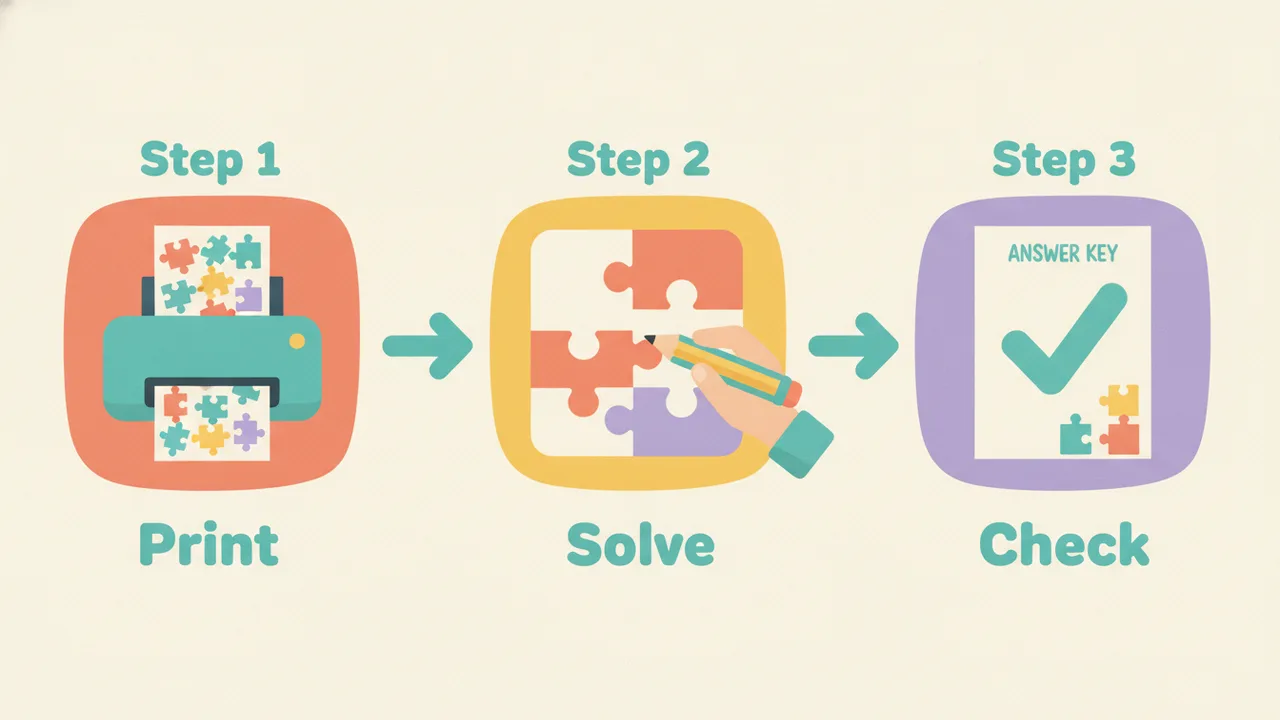
Cross Math is one of seven games in the pack. The book has 50 puzzles: 1–15 Easy, 16–35 Medium and 36–50 Hard, with a "How to play" worked example at the start and an answer key at the end. Each grid is checked by a separate solver that tests every possible filling, and a puzzle is kept only if exactly one fits. The pages are US Letter with dark ink on white, so they print clearly in black and white. A web app lets you play on screen or print. The levels are a guide to difficulty, not a promise about any child's grade.
Tips for adults
- Let the child find the first easy sentence.
- Ask, "What does this box have to be for both sentences to work?"
- If they get stuck, return to the printed list of allowed numbers.
- Use the answer key only after a full attempt.
Keep exploring
For a different kind of grid puzzle, see math mazes. To see all seven games side by side, read printable math puzzles.