Printable Math Puzzles: 7 Types and What Each One Teaches
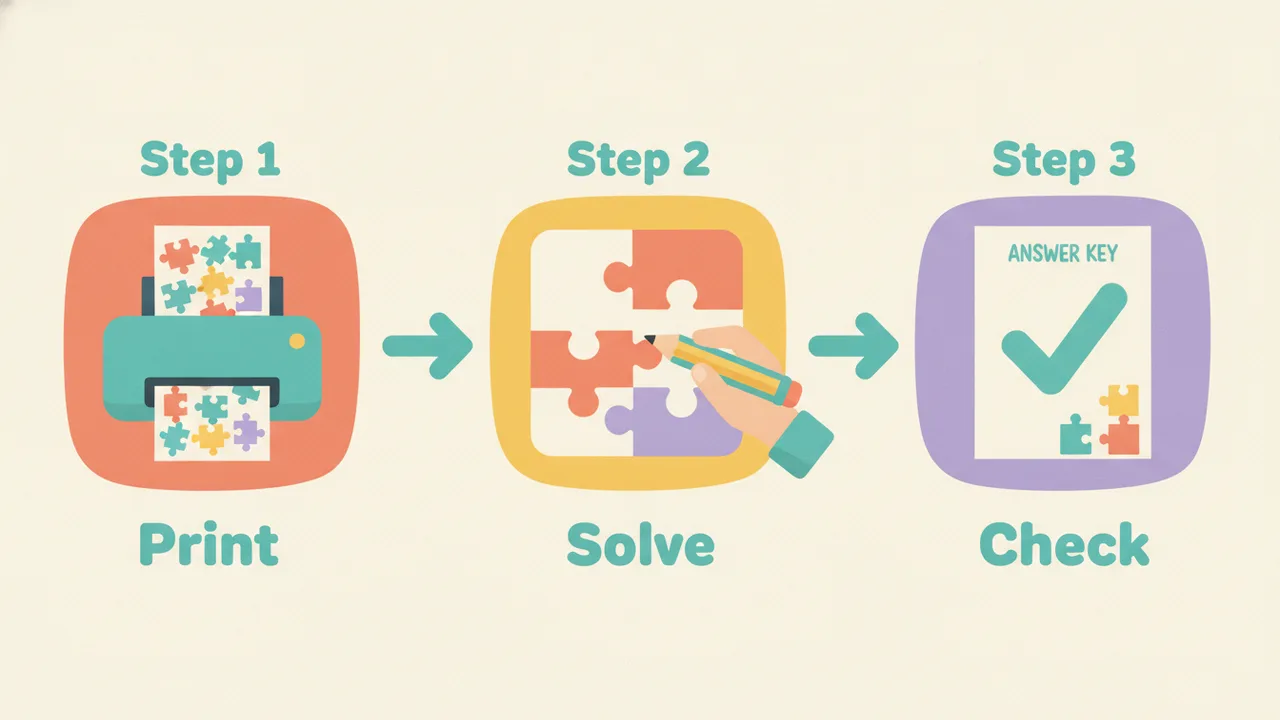
Printable math puzzles come in a handful of recognizable types, and each one exercises a different habit of mind. Knowing the differences helps you pick the right puzzle for a child, mix them through the week, and see what each is actually practicing.
Here are seven types, how each works and which skills it targets. The examples refer to the seven games in PuzzlePath Math Puzzle Pack, but the types themselves are general.
The seven types at a glance
| Type | The idea | Main skills |
|---|---|---|
| Path puzzle (Snake Math) | Follow a winding path, applying each operation to a running total | Mental math, all four operations, inverse operations |
| Equation grid (Cross Math) | Fill crossing number sentences | Operations, inverse thinking, logic |
| Hexagon sums (Honeycomb Math) | Fill cells so golden hexagons hit their sums | Addition, number sense, combinations |
| Arrow diagram (Math Flow) | Numbers flow along arrows with operations | Four operations, undoing operations |
| Shape code (Crack the Code) | Shapes stand for numbers; find them all | Algebraic thinking, order of operations |
| Number pyramid | Each brick is the sum of the two below | Addition, subtraction, missing addends |
| Maze (Math Mazes) | Only cells that follow a rule are safe | Multiples, mental arithmetic, patterns |
A real page from the pack, Snake Math Volume 1 puzzle #1, is on this page as a sample download.
1. Path puzzles
You start at a number and follow a snaking path. Each step says what to do (+7, −3, ×2, ÷4) and you write the new total in the next square. It looks like a worksheet but plays like a board game. Easy versions use only addition and subtraction; later ones add multiplication and exact division, and at Hard some steps are hidden behind a question mark that you deduce from the totals on either side.
2. Equation grids
Rows and columns are number sentences that share boxes, like a crossword made of math. You look for a sentence with only one empty box, solve it, and use the answer to open the next. It builds inverse thinking, because you often solve "something plus 9 equals 15" by working back from the result.
3. Hexagon sums
A honeycomb of hexagons where golden cells show the sum of the white cells that touch them. You fill white cells with digits 1 to 9, with no repeats around the same golden cell. It trains number sense and the many ways digits combine to make a given sum.
4. Arrow diagrams
Boxes joined by arrows, each arrow carrying an operation. A number enters at the top and flows through. When two arrows land in the same box, both must give the same number, so every puzzle checks itself. Harder ones need you to run an arrow backward by undoing the operation.
5. Shape codes
Each geometric shape stands for a whole number. The same shape always has the same value and different shapes have different values. Equations give you clues, and the final answer is a lock combination built from the shape values. It is early algebra in a friendly costume.
6. Number pyramids
Stacked bricks where each brick equals the sum of the two below. Some are given, the rest are found by adding up or subtracting down. For a full walk-through, see how to solve a number pyramid.
7. Math mazes
A grid of numbers or small calculations with a start and a finish. You step only on cells that follow the rule at the top of the page, such as "multiples of 5" or "calculations that equal 12". There is one path through.
Matching puzzle type to purpose
| If you want to... | Try |
|---|---|
| Quick mental arithmetic | Path puzzles, mazes |
| Inverse operations | Equation grids, arrow diagrams |
| Early algebra thinking | Shape codes, pyramids |
| Number sense | Hexagon sums, pyramids |
| A calm start to class | Easy puzzles of any type |
What to check before you print
A printable puzzle set should have:
- A worked example for every type, so the child can start without you.
- Real difficulty levels, not one level with a label.
- An answer key, and ideally one where every puzzle has a single answer.
- Print-friendly design: one puzzle per page, black ink on white paper, readable fonts.
Levels in PuzzlePath Math Puzzle Pack
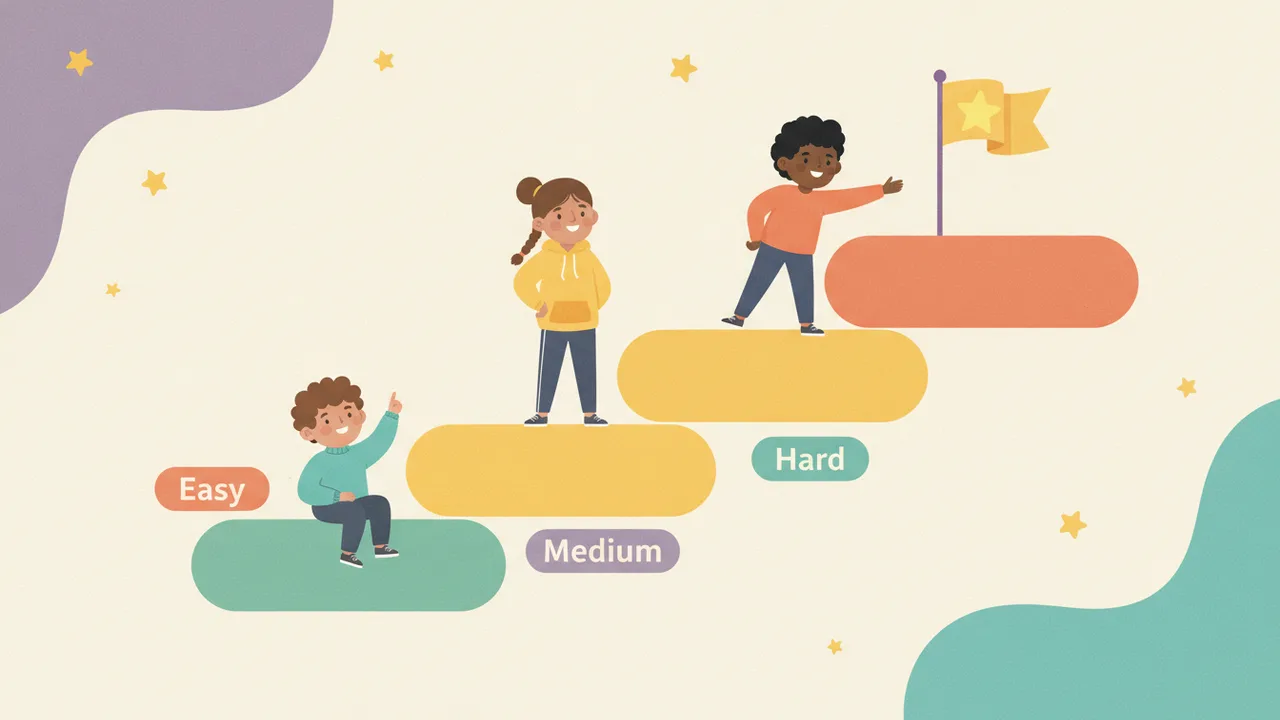
In each book, puzzles 1–15 are Easy (grades 3–4), puzzles 16–35 are Medium (grades 5–6), and puzzles 36–50 are Hard (grades 7–8). Difficulty goes up by measurable changes such as grid size, the operations used, the number of blanks and how many steps must be worked backward, not just by the label. The pages are US Letter, one puzzle per page, with the grid and numbers in dark ink so they print clearly in black and white. A separate solver checks that each puzzle has exactly one solution, and each book ends with an answer key. The levels are a guide to difficulty, not a promise about any child's grade.
Using the seven types over a week
| Day | Puzzle type | Time |
|---|---|---|
| Mon | Path puzzle | 10 min |
| Tue | Number pyramid | 10 min |
| Wed | Maze | 10 min |
| Thu | Shape code | 10 min |
| Fri | Child's choice | 10 min |
Rotating types keeps novelty high and lets each child find the formats they love, which are usually the ones worth doing more of.
Where to go next
If you are comparing a multi-game pack with a single-type book, read math puzzle book PDF: 7 games versus one type. For how verified answers work, see math puzzles with answers. For classroom-ready sets, see printable math games with no prep, and for choosing by grade, see math puzzles for 3rd to 6th grade.