Order of Operations Game: Practice With Puzzles, Not Worksheets
The order of operations is a rule kids need to memorize and, more importantly, to feel. A worksheet of twenty expressions can teach the steps, but it does not give a child a reason to care whether 2 + 3 × 4 is 14 or 20. A puzzle does, because the wrong order produces a wrong answer that breaks the rest of the solution.
This page covers the rule in a few lines, then shows which printable games practice it, with one important exception.
The rule in one table
| Step | Do this |
|---|---|
| 1 | Work inside parentheses |
| 2 | Multiply and divide, left to right |
| 3 | Add and subtract, left to right |
Two worked examples:
- 2 + 3 × 4: multiply first (3 × 4 = 12), then add: 2 + 12 = 14.
- 18 − 12 ÷ 3: divide first (12 ÷ 3 = 4), then subtract: 18 − 4 = 14.
If you add or subtract first, you get 20 and 2 instead of 14. That is the whole reason the rule exists.
Why puzzles help
In a drill, the order of operations is the topic. In a puzzle, it is a tool. A child decoding a lock combination must evaluate each clue correctly, so a slip in order is a slip in the answer. That gives:
- A reason to be careful.
- An instant check, since a wrong order leads to numbers that do not fit the rest of the puzzle.
- Repetition without sameness, because each puzzle has different numbers.
Which games practice it
Four of the seven games in PuzzlePath Math Puzzle Pack (Snake Math, Cross Math, Crack the Code and Math Mazes) have order of operations among their listed skills. They use it in different ways.
| Game | How the rule appears |
|---|---|
| Crack the Code | Equations with several terms, where multiplication and division come before addition and subtraction ("2 + 3 × 4 = 14" is part of the instructions) |
| Math Mazes | Hard mazes use calculations in the cells, with multiplication and division evaluated before addition and subtraction |
| Cross Math | Sentences with two operations, but read from left to right (see below) |
| Snake Math | A chain of operations applied one step at a time to a running total |
The exception: Cross Math reads left to right
In Cross Math, a sentence with two operations is evaluated strictly from left to right, and the "How to play" page says so with an example. That is a rule of the puzzle, not the standard convention. It is useful practice for inverse operations and logic, but it is the wrong game to rehearse the standard rule. Use Crack the Code and Math Mazes for that, and tell children plainly that Cross Math plays by its own rule.
Snake Math is sequential
Snake Math applies one operation at a time to a running total, so there is no precedence to resolve in a single step. It builds the fluency behind the rule, because children keep doing exact multiplication, division, addition and subtraction in sequence.
Playing Crack the Code to practice the rule
Each shape stands for a whole number, and the same shape always has the same value. Equations give you clues. In the Medium and Hard levels, an equation may have three terms, so you must multiply or divide first.
A small example:
- ● + ● = 10, so ● = 5
- ● + ▲ × 2 = 11, so 5 + ▲ × 2 = 11, so ▲ × 2 = 6 and ▲ = 3
If you added 5 and ▲ first, you would get 2 × (5 + ▲) = 11, which has no whole-number solution. The puzzle tells you the order is wrong. That is the value of the format.
Math Mazes for the rule
At Medium, every cell is a calculation and only cells equal to 12 are safe. A cell like "2 + 5 × 2" equals 12 if you multiply first, but 14 if you add first, so the order decides whether it is a path or a dead end. At Hard, each step must go to a cell exactly 3 or 4 higher than the last, and cells again hold calculations.
A weekly routine
| Day | Activity | Time |
|---|---|---|
| Mon | Review the rule with the two examples above | 3 min |
| Tue | One Easy Crack the Code | 10 min |
| Wed | One Medium Crack the Code | 10 min |
| Thu | One Math Maze with calculations | 10 min |
| Fri | Child's choice, then explain the order out loud | 10 min |
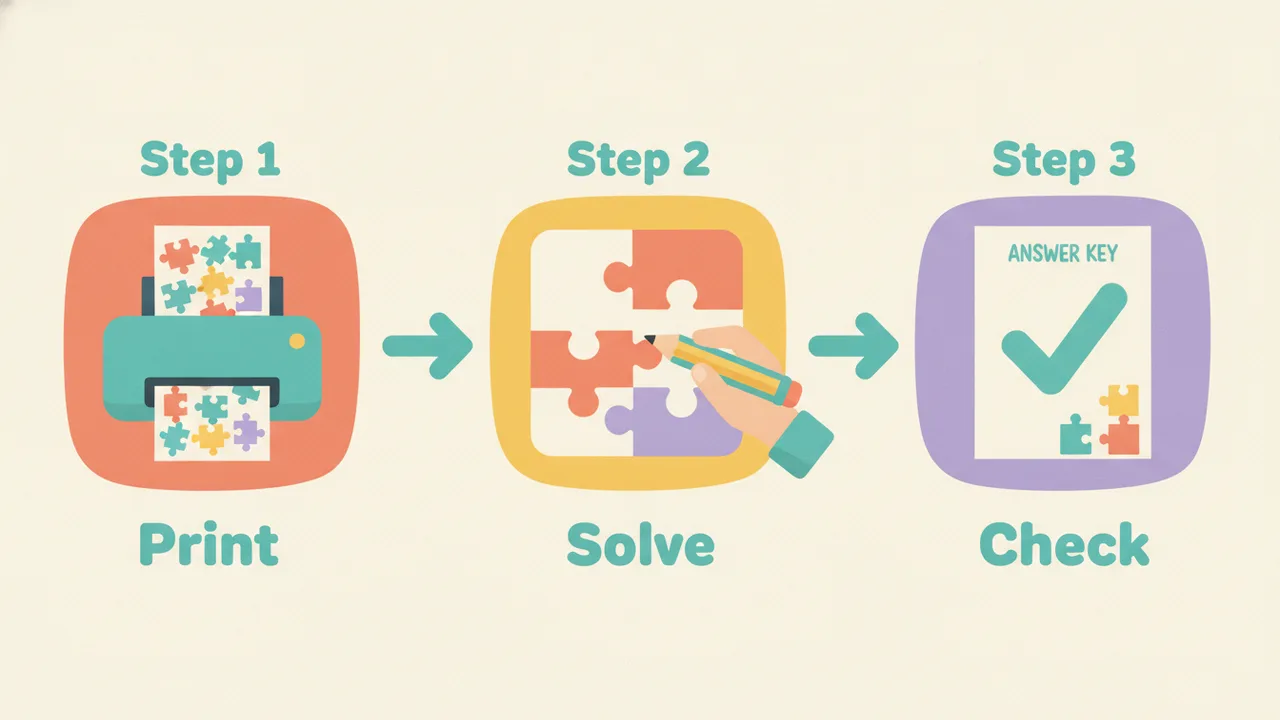
Easy Crack the Code uses only addition, so start at Medium for the rule itself. Keep the answer key for after the attempt.
Common mistakes to watch for
- Left-to-right habit. Kids add first because they read left to right. Ask, "Is there a multiplication in here?"
- Treating multiplication as always before division. They have equal rank, so go left to right.
- Ignoring parentheses. Brackets override everything.
- Not checking. The puzzle's fit is the check.
About the levels
Every book has Easy (puzzles 1–15, grades 3–4), Medium (16–35, grades 5–6) and Hard (36–50, grades 7–8). The levels are a guide to difficulty, not a promise about any child. Each puzzle has exactly one answer, confirmed by a separate solver, and each book ends with an answer key.
Related reading
For more fluency games, see math fact fluency games. For the code puzzle in detail, see crack the code math puzzles and for mazes see math mazes. For a Hard-level overview, see math puzzles for middle schoolers.