Would You Rather Questions for Kids: Printable Prompts for the Table and the Car
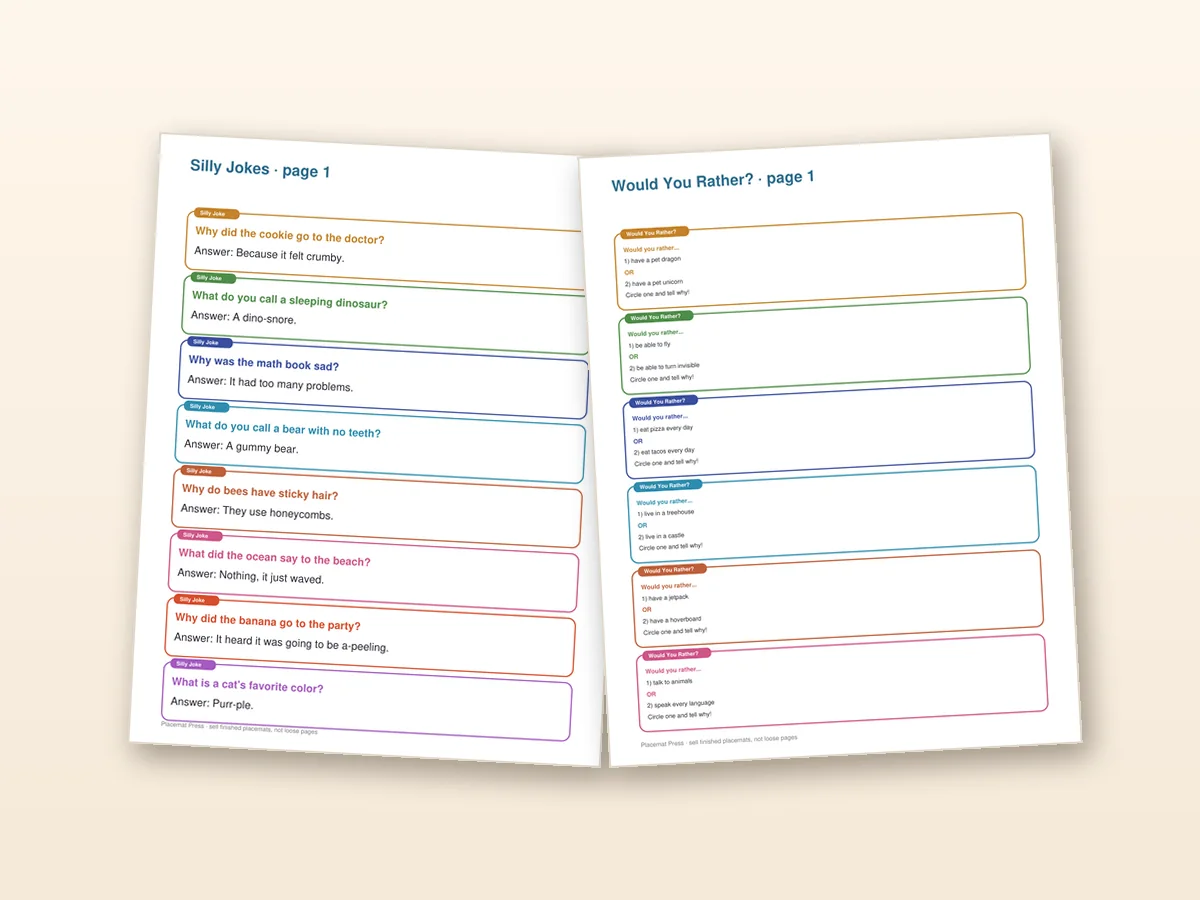
Would you rather questions work because they ask a child to choose and then explain. There is no right answer, nobody is graded, and the follow-up ("why?") is where the fun is. They are a quiet way to get a child talking at dinner, on a drive or in a waiting room, and they fit neatly on a printable placemat. Below are questions sorted by age, plus ways to use them so they feel like a game and not an interview.
Ages 4 to 6: concrete and silly
Young children like choices they can picture.
- Would you rather have a pet dinosaur or a pet dragon?
- Would you rather eat pancakes for dinner or pizza for breakfast?
- Would you rather ride a giant turtle or a friendly elephant?
- Would you rather have rainbow hair or sparkly shoes?
- Would you rather live in a treehouse or in a castle?
- Would you rather be as small as an ant or as tall as a giraffe?
- Would you rather have a talking cat or a talking dog?
- Would you rather splash in puddles all day or build sandcastles?
Tip: let a four-year-old point or draw the answer. They do not need to explain.
Ages 7 to 9: a little more thinking
- Would you rather be able to fly or be invisible?
- Would you rather explore the deep sea or outer space?
- Would you rather have a robot helper or a pet monster?
- Would you rather never do homework or never do chores?
- Would you rather read minds or talk to animals?
- Would you rather live in a house made of candy or one made of Lego?
- Would you rather win a game by luck or by skill?
- Would you rather give a big hug to a polar bear or a penguin?
Tip: ask "what would you do first?" after the choice. It starts a story.
Ages 10 to 12: choices with trade-offs
- Would you rather be the fastest runner in the world or the best singer?
- Would you rather have a day with no school or a day with no rules at home, but you must do it all alone?
- Would you rather invent a new sport or a new food?
- Would you rather be a famous YouTuber or an astronaut?
- Would you rather be able to speak every language or play every instrument?
- Would you rather spend a week in the jungle or a week in the Arctic?
- Would you rather lose your phone for a week or your favorite snack for a month?
Tip: ask for the trade-off. "What is the best thing about your choice, and what is the hardest?"
Rules for keeping it kind
- No questions that make a person the loser ("Would you rather be teased or ...").
- No questions about being hurt, scared or alone for young children.
- Let anyone pass.
- Respect silly answers. A child who says "both!" is thinking.
Ways to use them
At the table
Choose one question per course. Everyone answers, including the adults, and the youngest goes first. This gives shy children a turn when they are not under pressure.
In the car
Pair them with road trip games. Questions work when a child cannot look down for long, because it is all talking.
In a waiting room
A single card in a bag is enough. See waiting room and restaurant activities for more ideas.
On a placemat
A prompt block with two boxes ("A" and "B") and a line for "because..." fits any mat. The kit includes 60 prompts you can drop into a frame, and 12 finished mats that already show how it looks. See the placemat build guide for the layout.
Turn it into a mini tournament
Give each player a pencil and a tally. Ask a question, everyone writes A or B, then reveals at once. Score a point if you match the person on your left. It is a gentle way to practice reading expressions and guessing what others think.
Make your own
The best questions come from the child's world. Ask yourself:
- What is their favorite animal, food or place?
- What are they curious about?
- What would make them laugh?
Combine two things they love, and you have a question. Write four per week and keep them in a jar.
Printable ready to use
The Placemat Press · Activity Mat Creator Kit is a set of digital templates, and one part of it is a library of 60 would-you-rather prompts you can place on a mat, a card or a page. It also includes 40 clean jokes, 112 simple games, 349 commercial-use elements overall and a commercial licence for finished placemats. It costs $17.00 once. If you plan to sell finished cards or mats, the licence covers finished products you make, not the loose elements.
A last idea: the family question of the week
Print one question on the placemat for Sunday dinner and keep a note of the answers. Children love to see how their answers change from week to week. After a year, you have a record of what each child thought at each age, and a stack of mats worth keeping.
Sorting questions into three piles
Over time you will notice that questions fall into three kinds, and a good set mixes them.
Silly questions make everyone laugh and lower the temperature at a tense table. "Would you rather have spaghetti for hair or noodles for fingers?" Nobody needs to think hard, and that is the point.
Imagination questions invite a story. "Would you rather live in a lighthouse or a treehouse?" The follow-up, "what would you see from your window?", turns a one-word answer into a minute of talking.
Choice-with-cost questions suit older children. "Would you rather have a pet robot that never needs feeding but cannot cuddle, or a pet cat that cuddles but sheds everywhere?" These show how a child weighs things and are fun for adults to answer too.
When you fill a placemat block, pick one from each pile. The silly one gets the first laugh, the imagination one gets the talking and the cost one gives older children a reason to stay at the table. If you keep a jar of questions, write the pile on the back of each slip so you can draw one of each type without thinking about it.