Crack the Code Math Puzzles: How They Work and How to Solve Them
In a crack the code puzzle every shape hides a whole number, and the equations are your clues. Find the value of each shape and you can open the lock. It is a first taste of algebra, with shapes in place of letters.
The rules
- Every shape is a whole number from 1 to 9.
- The same shape always has the same value, everywhere in the puzzle.
- Different shapes always have different values.
- Start with the equation that uses just one shape, find its value, then use it to unlock the next equation.
- In longer equations multiply and divide first, then add and subtract: 2 + 3 × 4 = 14.
- Write each value next to its shape, then copy the values into the lock in the order of the shapes above it.
Easy example
Three shapes, only addition. This is a made-up puzzle in the style of an Easy one.
- ● + ● = 10
- ● + ▲ = 8
- ▲ + ■ + ● = 16
Step 1. The first equation uses one shape. Two equal numbers that add to 10 means ● = 5.
Step 2. The second equation has ● and ▲. Since ● = 5, 5 + ▲ = 8, so ▲ = 3.
Step 3. The third uses all three. 3 + ■ + 5 = 16, so ■ + 8 = 16 and ■ = 8.
Check. The values 5, 3 and 8 are all different, and each equation holds: 5 + 5 = 10, 5 + 3 = 8, 3 + 8 + 5 = 16.
If the lock shows ● ▲ ■, the code is 5, 3, 8.
Medium example
Four shapes, with multiplication. Another made-up puzzle.
- ● + ● = 10
- ▲ × ● = 20
- ■ + ▲ × 2 = 14
- ◆ + ■ = 13
Step 1. ● = 5.
Step 2. ▲ × 5 = 20, so ▲ = 4.
Step 3. The third equation has two operations. Multiply first: ▲ × 2 = 8, so ■ + 8 = 14 and ■ = 6.
Step 4. ◆ + 6 = 13, so ◆ = 7.
Check. The values 5, 4, 6 and 7 are all different. If you added before multiplying in step 3, you would get (■ + 4) × 2 = 14, so ■ = 3, and then the last equation gives ◆ = 10, which is not a digit from 1 to 9. The puzzle tells you the order matters.
Strategy
- Find the one-shape equation. It is your way in.
- Substitute everything you know before looking for the next clue.
- Rewrite long equations in short steps. Replace known shapes with numbers and simplify.
- Use the "different values" rule. If two shapes could both be 4, only one can.
- Check every equation with the final values.
What the levels ask for
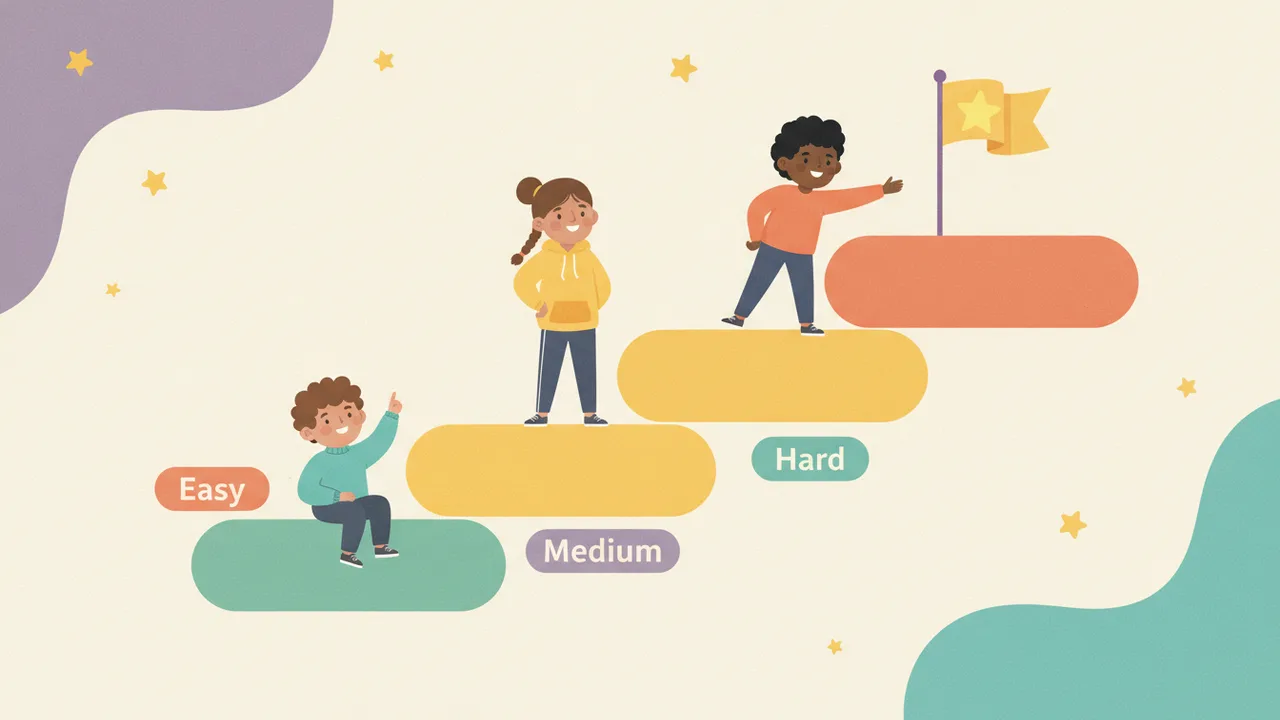
| Level | Shapes | Operations | Equations |
|---|---|---|---|
| Easy (grades 3–4) | 3 | Addition only | 3 equations of 2–3 terms |
| Medium (grades 5–6) | 4 | +, − and × | 4 equations, with a multiplication |
| Hard (grades 7–8) | 5 | All four | 5–6 equations with three terms |
What it practices
- Algebraic thinking: unknowns solved from constraints.
- Order of operations: multiplication and division come first. See the order of operations game.
- Logical reasoning: ruling out values.
- All four operations, at Hard.
The Crack the Code book in PuzzlePath Math Puzzle Pack
Crack the Code is one of seven games in the pack. The book has 50 puzzles: 1–15 Easy, 16–35 Medium and 36–50 Hard. The shapes are drawn as geometric forms, not emojis. Each puzzle has exactly one set of values, confirmed by a separate solver that tries every combination, and the book ends with an answer key. It opens with a "How to play" page and a worked example. The levels are a guide to difficulty, not a promise about any grade. For why a verified answer matters, read math puzzles with answers.
Tips for adults
- Ask "Which equation has only one shape?" before offering help.
- Encourage writing values next to the shapes.
- If a child gets a negative or a fraction, one earlier value is wrong. That is a useful signal, not a failure.
- Let them make their own code puzzle for you. Making one is harder than solving one.
Related
For another puzzle built on sums, see how to solve a number pyramid. For a grid puzzle where the walls are math, see math mazes.