Printable Activity Book vs Random Worksheets: How to Choose
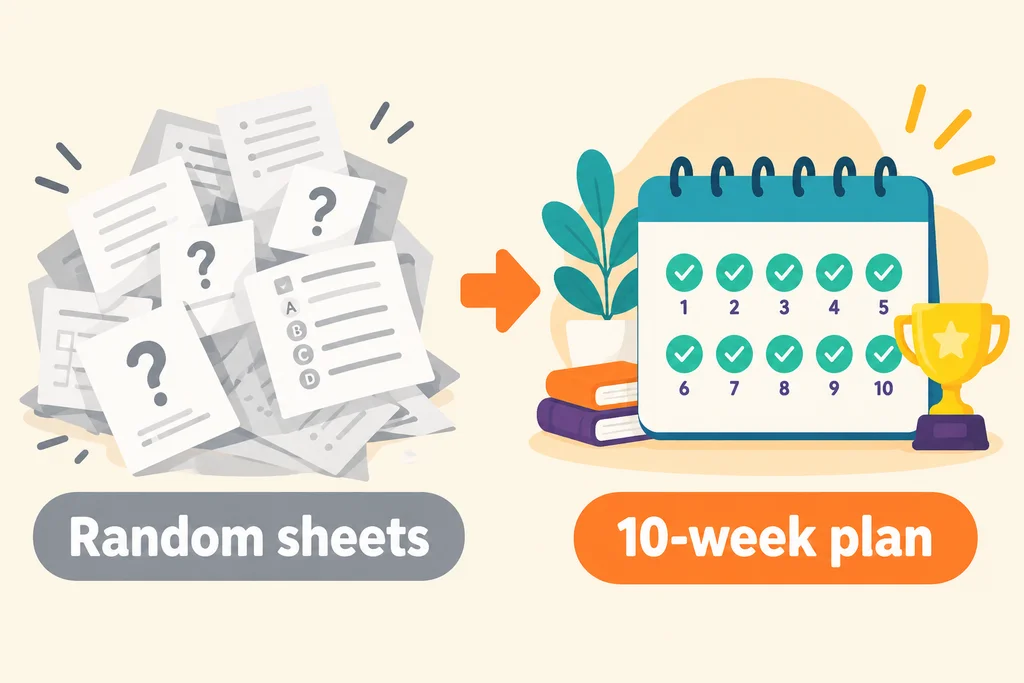
Loose worksheets are best for a specific topic or a quick extra; an organized printable activity book is better for a daily routine because it removes the planning. The real difference is not the paper but the plan: who decides what comes next, in what order, and how hard it should be. This guide compares the two on seven points and helps you choose, with examples from the Focus Quest Activity System.
The short answer
| If you want | Choose |
|---|---|
| One page on one topic, right now | Loose worksheet |
| A daily habit with no daily planning | Organized activity book |
| Extra practice on something your child loves | Loose worksheet |
| Steady progression over weeks | Organized activity book |
| Maximum variety of skills | Organized activity book |
| To follow a child's changing interests | Mix of both |
Comparison on seven points
| Random worksheets | Organized activity set | |
|---|---|---|
| Your time | Searching, printing, sorting. Every day you pick | Plan done once; follow the schedule |
| Order | Whatever you found. Difficulty is uneven | Easy to hard, built into the order |
| Variety | Often one skill repeated | Planned mix of skills |
| Answers | Often missing or on another site | Answer key in one place |
| Quality | Varies page by page | Consistent look and instructions |
| Follow-through | Easy to drop when planning gets tedious | Schedule and checklist keep it going |
| Flexibility | Total | Within the plan, with room for extras |
Your time
The hidden cost of loose worksheets is the work of finding them. Ten minutes of activity can take another ten to find, print and check. On a busy weekday that is often the point where the routine stops.
Order and difficulty
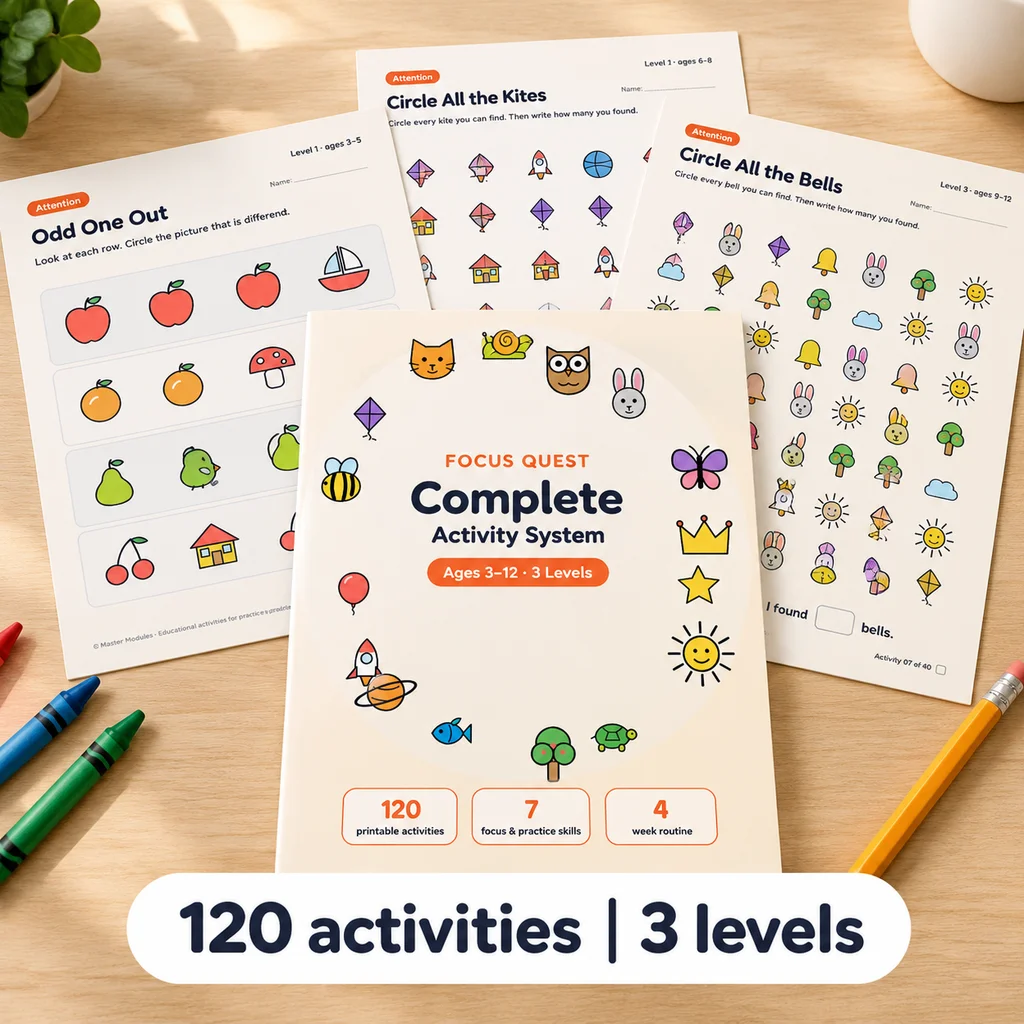
A worksheet found online may be a level too hard or too easy, and you only find out after printing. In an organized set, difficulty is built in. In Focus Quest, the pages in each of the three levels run from easier to harder, and the levels are Level 1 for ages 3 to 5, Level 2 for ages 6 to 8 and Level 3 for ages 9 to 12.
Variety
If you pick pages yourself, you tend to repeat what you know, such as mazes or coloring. A planned set mixes skills so that sessions feel fresh. Focus Quest's 300 activities spread across seven skills: Attention, Memory, Shapes & Patterns, Logic Sequences, Tracing & Fine Motor, Color by Code and Coordination.
Answers
Checking work is part of learning. With many random pages, there may be no answer key. The Answer Key Book in the system gives all 300 solutions (53 pages), so you can check in seconds.
Follow-through
A routine only works if you can keep it up. The system includes a 10-Week Routine Planner with a printable calendar and two activities a day, five days a week. See the 10-week focus routine plan for how a session runs.
What to look for in any printable set
Use this checklist before you print anything.
- Clear age or level labels.
- A planned order from easier to harder.
- A mix of skills, not one repeated.
- Answers included.
- Page count you can verify. Check that the number in the title is the number you get.
- Instructions for the grown-up. Short, plain guidance on how to run a session.
- A schedule or checklist.
- Print-friendly design. Black-and-white friendly saves ink.
- No claims you cannot check. Be wary of any set that promises exact results by a set date.
When loose worksheets are the better choice
- Your child has a specific interest, such as dinosaurs or space.
- You need one page on one topic, like tracing a particular letter.
- You want to fill a gap quickly.
- You already have a routine and want occasional extras.
Even then, pairing a few worksheets with an organized set works well. For example, the system's weekend menu suggests optional extras such as a coloring page or a Screen-Swap Card, and you can add your own worksheets there.
A few cautions about "activity books"
- Page counts can include covers and blanks. Look for the number of actual activities.
- A book is not a curriculum. Focus Quest is a practice routine for attention, memory, patterns and fine motor skills; it is not a full math or reading curriculum.
- Results vary by child. No set can promise specific outcomes.
This is general information. Educational activities are for practice and play, not a medical or therapeutic product.
Where to see what fits your child
To see which level suits each age with examples, read printable activities by age. For a full breakdown of pages and bonuses, see what's inside the Focus Quest Activity System.